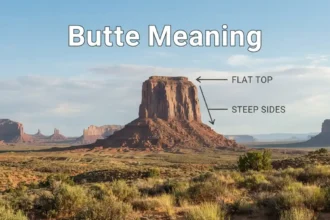
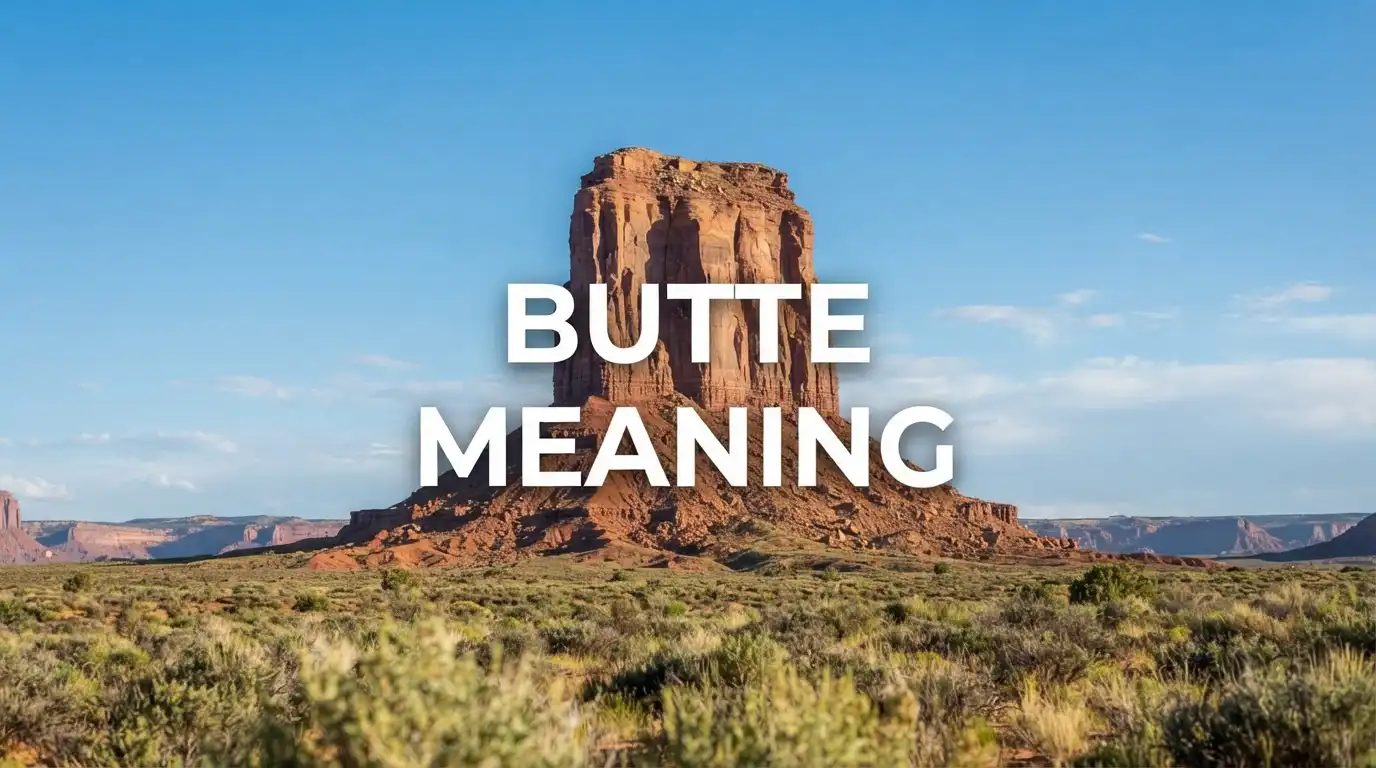
A butte is a lone hill that rises sharply from flat land, with steep sides and a small, fairly flat top like a stone tower standing by itself in the desert.
You’ve probably seen buttes in old Western movies without knowing their name: those tall, flat-topped red rocks behind the cowboys.
The word comes from French and simply means “small hill,” but a real butte looks anything but small. So what exactly makes a hill a butte, and how is it different from a mesa or a plateau? Let’s break it down in the simplest way possible.
Butte Meaning in Short
A butte (pronounced BYOOT, rhyming with “beaut”) is an isolated hill with steep, often almost vertical sides and a flat top. Buttes stand alone in open, mostly dry land, mainly in the western United States.
A few quick facts:
- Pronunciation: BYOOT
- Origin: From the French word butte, meaning a knoll or small hill
- Looks like: A tall hill or short tower with a flat roof
- Found in: Arizona, Utah, New Mexico, Montana, and other western states
- Formed by: Erosion — wind and water slowly wearing soft rock away
The explorers Lewis and Clark helped bring this French word into English as they crossed the American West in the early 1800s, and the name stuck.
How Does a Butte Form?
A butte is not built up. It is what’s left behind.
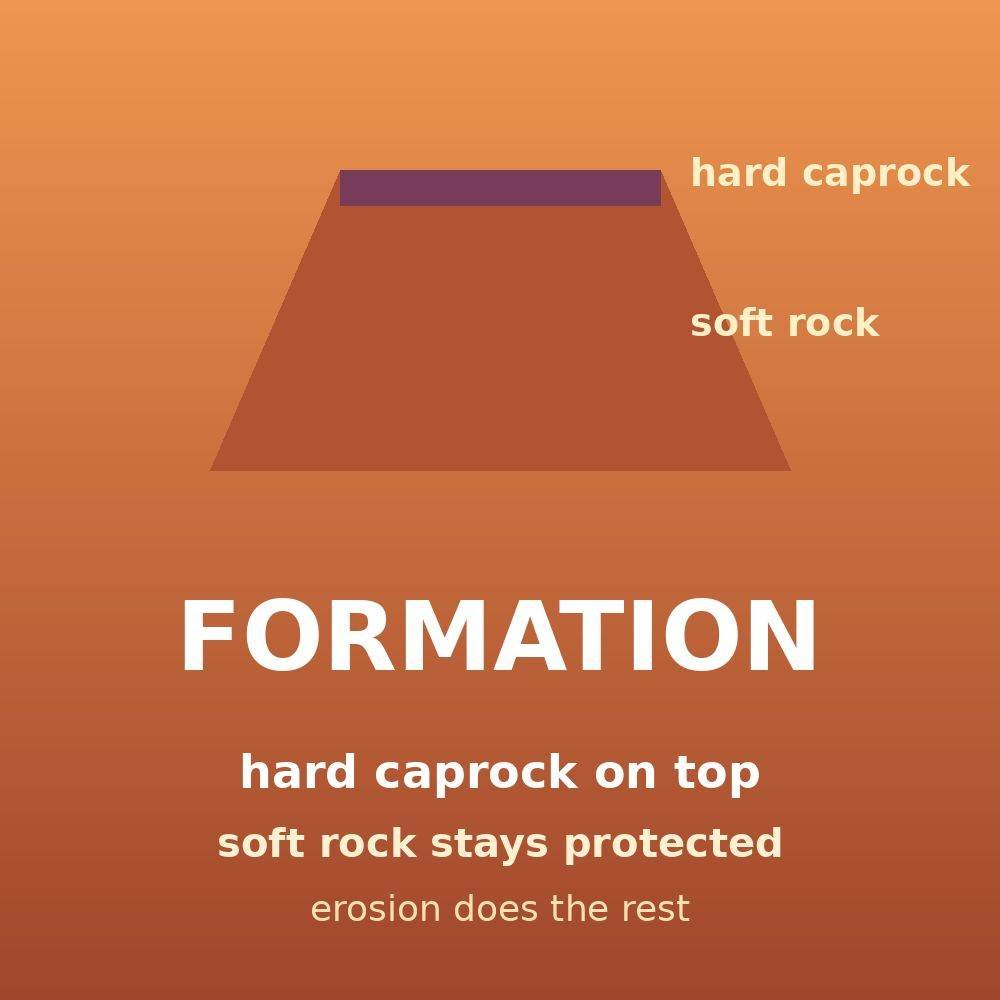
Long ago, the land in these areas was much higher and flatter. Then wind, rain, and rivers began to wear the surface down. Soft rock washed away quickly, but in some spots a layer of hard rock sat on top like a cap. That hard cap protected the softer rock beneath it.
Think of it like this: imagine a cake covered with a hard chocolate shell. If you wash away everything around it, the part under the shell stays standing while the rest disappears. That’s almost exactly how a butte forms.
As erosion continues, pieces break off and pile up around the base, forming a sloping skirt of rock bits. Over a very long time, even the butte itself will slowly shrink — but that process takes millions of years.
Butte vs Mesa vs Plateau: What’s the Difference?
These three landforms look alike, and people mix them up all the time. Luckily, geographers use one simple rule to tell a butte from a mesa:
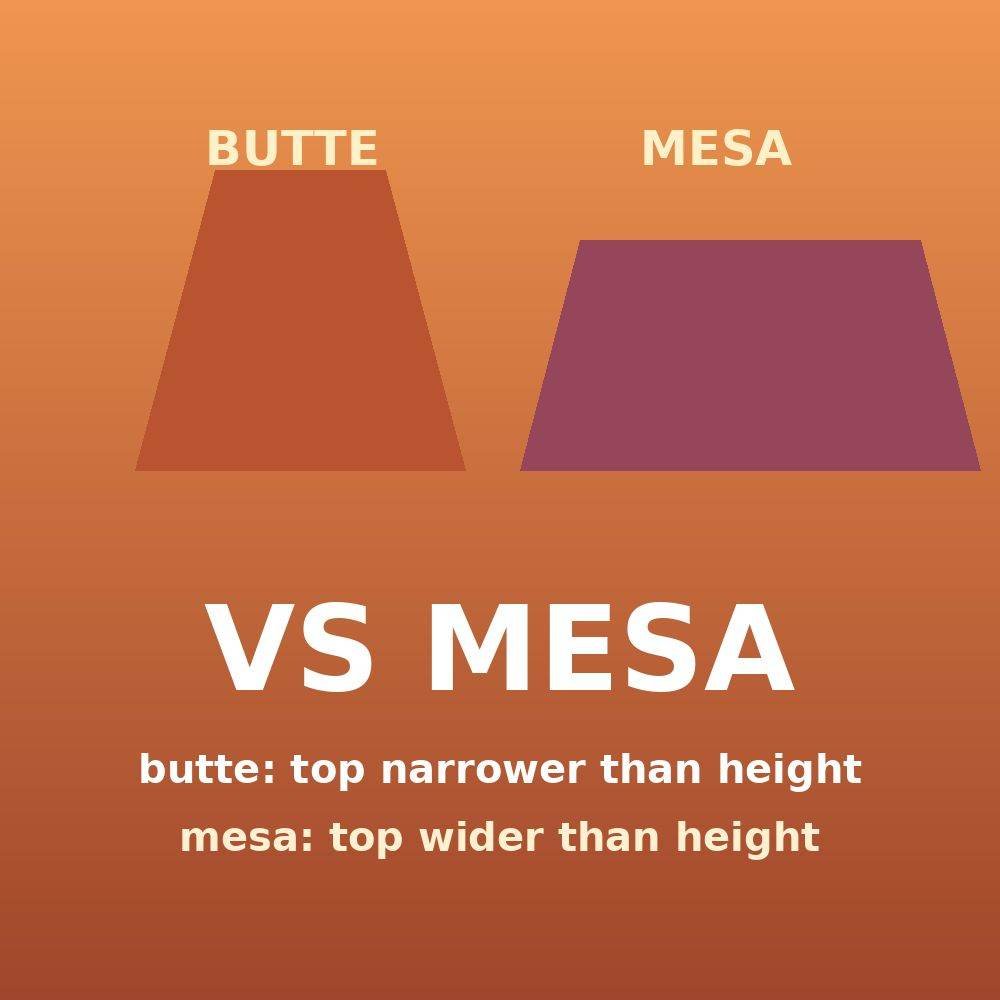
- A mesa’s top is wider than the landform is tall.
- A butte’s top is narrower than the landform is tall.
A plateau is the biggest of the three — a whole region of high, flat land.
| Landform | Size | Top Compared to Height | Simple Example |
|---|---|---|---|
| Butte | Smallest of the three | Top is narrower than its height | A lone rock tower in the desert |
| Mesa | Medium | Top is wider than its height | A broad, table-like hill |
| Plateau | Largest | A huge raised flat area | The Colorado Plateau |
In fact, the word mesa is Spanish for “table” — and that’s the easiest way to remember it. A mesa is a wide table. A butte is more like a single tall chair standing next to it.
Many geographers also believe a butte is what a mesa becomes after ages of erosion: the wide table slowly wears down into a narrow tower. If you enjoy landform words like this, our [geography words in simple English] guide covers more of them.
Famous Buttes You May Have Seen
Buttes are natural landmarks, so many famous ones appear in photos, films, and postcards.
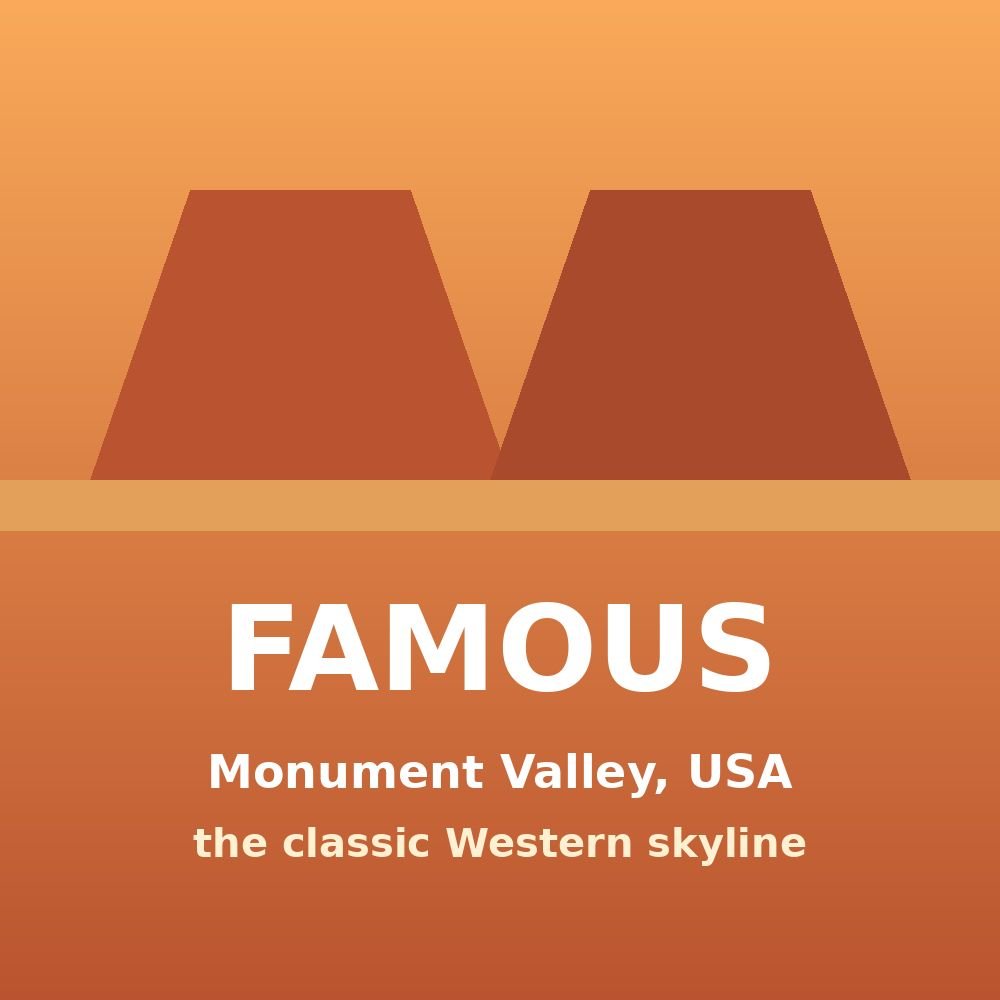
- The Mittens and Merrick Butte, Monument Valley (Utah–Arizona). These are the classic “Western movie” buttes. Director John Ford featured the Monument Valley buttes in seven of his films, and they remain the most photographed buttes in the world.
- Devils Tower, Wyoming. A striking rock tower rising above the plains. People argue about whether to call it a butte, but it shows the same lone-tower shape.
- Courthouse Butte and Bell Rock, Arizona. Popular with hikers and photographers near Sedona’s red-rock country.
- Buttes in old Westerns. If a cowboy film has a dramatic desert skyline, odds are good that at least one butte is in the frame.
Because they stand alone, buttes were also useful to early travelers as landmarks — you could spot one from far away and steer by it.
Butte Is Also a Place Name
If you see “Butte” written with a capital B in American news, it may be a place, not a landform.
- Butte, Montana is a historic mining city once famous for copper. It took its name from the rocky butte-like hill nearby.
- Butte County exists in both California and South Dakota.
So “we drove through Butte” means the city, while “we climbed the butte” means the hill. Capital letters and context make the meaning clear.
How to Use “Butte” in a Sentence
Here are natural ways the word appears in real writing:
- “A single butte rose from the desert floor, glowing red in the sunset.”
- “The trail winds between two buttes before reaching the river.”
- “From the top of the butte, we could see the whole valley.”
- “Old Western films loved filming near the buttes of Monument Valley.”
You will mostly meet this word in travel writing, geography lessons, nature documentaries, and stories set in the American West.
Butte at a Glance
| Question | Answer |
|---|---|
| What is a butte? | An isolated, steep-sided hill with a flat top |
| How do you say it? | BYOOT |
| Where does the word come from? | French butte, “small hill” |
| What is it made of? | Hard caprock over softer rock |
| Where can I see one? | The western US, especially Arizona and Utah |
| How is it different from a mesa? | Its top is narrower than it is tall |
Words Close to Butte and How They Differ
Close landform words: mesa (wider flat top), plateau (much larger raised flat area), hill, cliff, pinnacle.
Quick difference: a butte is tall and narrow, a mesa is wider than it is tall, and a plateau is the largest of the three.
Common Mistakes With the Word Butte
- Calling every hill a butte: a true butte has steep sides and a small flat top, shaped by erosion.
- Saying it like the word butt: butte is said like byoot, with a long u sound.
FAQs
Butte pronunciation
Butte is pronounced “byoot” (IPA: /bjuːt/), rhyming with “mute” or “beaut.”
Butte meaning in english
In English, a butte is an isolated hill with steep sides and a flat top, smaller than a mesa.
Butte meaning in French
In French, “butte” means a small hill, mound, or hillock, and also appears in the phrase “être en butte à” (to be exposed to something).
Butte meaning ship
“Butte” refers to US Navy ships named USS Butte, including the attack transport APA-68 and the ammunition ship AE-27.
Butte meaning in spanish
In Spanish, a butte is typically described as a “cerro aislado” or “otero,” meaning an isolated flat-topped hill.
Butte meaning in Chinese
In Chinese, butte is translated as 小方山 (xiǎo fāng shān), meaning a small isolated hill with steep sides and a flat top.
Butte meaning in arabic
In Arabic, butte is expressed as تَلّ مُسَطَّح القِمَّة, referring to a flat-topped isolated hill.
Butte meaning in german
In German, “Butte” mainly means a large tub or vessel (especially for carrying grapes), while the landform is often called a Härtling or kept as Butte.
Conclusion
A butte is one of nature’s simplest sculptures: a lone, steep-sided hill with a flat top, left standing after wind and water wore the softer land around it away. Remember the easy test top narrower than its height means butte, wider means mesa and you’ll never mix them up again. Next time a Western movie opens with those red rock towers, you’ll know exactly what you’re looking at. For more landscape words explained this simply, explore our [nature and landform meanings] section.

Hi, I’m Benjamin Dreyer. I enjoy exploring the English language and making difficult words simple to understand. At Defineexa.com, I write about word meanings, text abbreviations, acronyms, and internet slang. My goal is to give readers clear, accurate, and easy-to-read explanations that help them learn something new and use English with greater confidence every day.