
The coda meaning is a final part that helps bring something to an end.
You may hear this word in music, books, stories, speeches, and art.
It often means a short closing part that gives the whole work a clear and complete ending.
What Does Coda Mean?
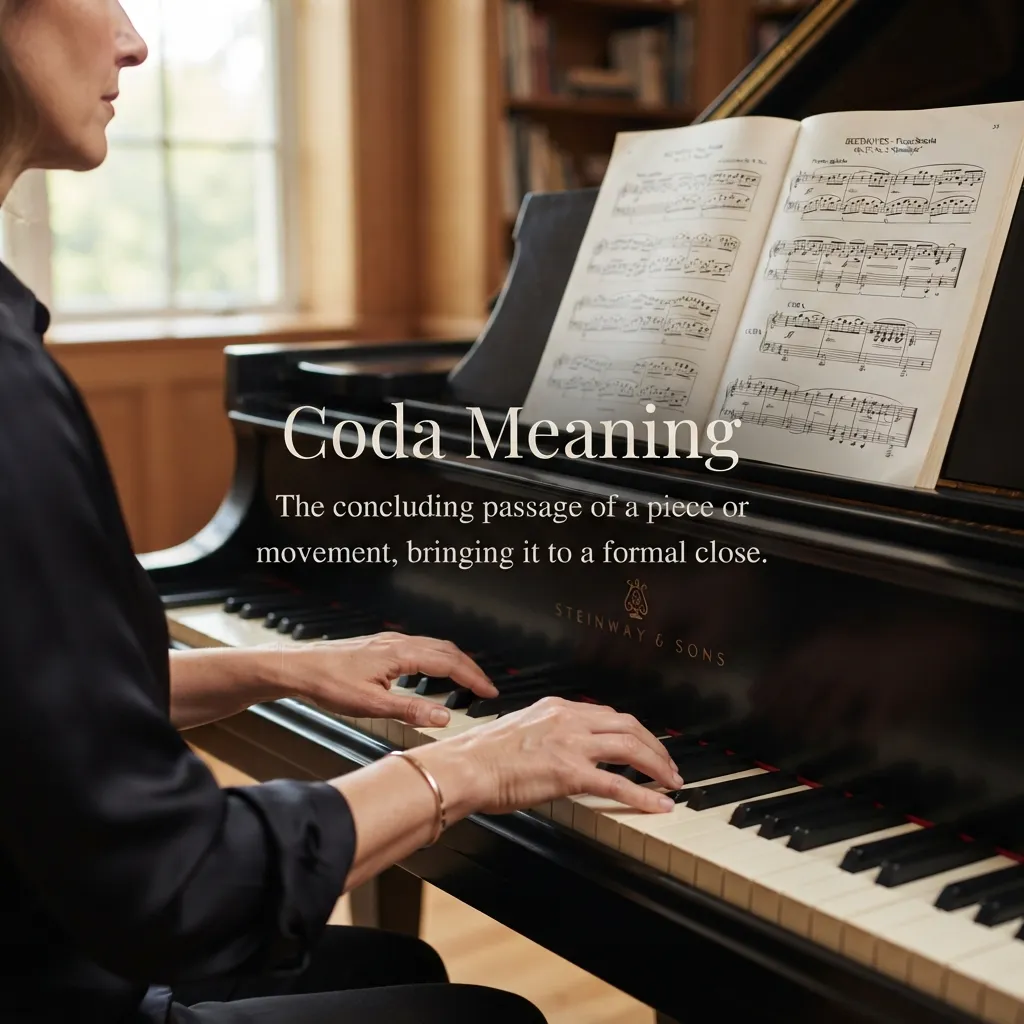
In simple English, coda means the last part of something.
It is often used when the main part is already over, but one more part is added. This last part can give the work a stronger finish.
The word is most common in music. A song or piece of music may have a coda near the end. The coda can repeat an idea, add a new sound, or simply bring the music to a close.
The word can also be used in writing. A story may have a coda that tells us what happens after the main story ends.
For example:
- “The song ends with a soft coda.”
- “The last chapter is a coda to the story.”
- “Her final speech was a fitting coda to the event.”
So, the easiest way to remember it is:
Coda = a final part that gives something a sense of closure.
What Does Coda Mean in Music?
In music, a coda is a closing section of a song or musical piece.
It comes near the end. The main musical ideas have usually been heard before the coda begins.
A composer may add a coda to make the ending feel stronger. It can also give the music more emotion or help bring it to a smooth finish.
For example, a song may have a verse and chorus. After the final chorus, the music may move into a new closing part. That part can be the coda.
Here are three simple examples:
- “The piano piece has a beautiful coda.”
- “The coda makes the ending feel calm.”
- “The band played the coda very softly.”
A coda can be short or long. It depends on the piece and what the composer wants to do.
What Is the Coda Symbol?
You may see a special coda symbol in sheet music.
The symbol looks like a circle with a cross inside it. It tells the musician where the coda section is.
Some music also uses the words “To Coda.” This tells the player to move to the marked coda later in the piece.
The basic idea is simple:
- The musician plays the main music.
- The music reaches a “To Coda” sign.
- The player moves to the marked coda.
- The coda brings the piece toward its ending.
This is useful in long or complex pieces where the music does not follow a simple straight path.
Coda Meaning in a Story
The word coda can also be used in books and stories.
Here, it means a final part that comes after the main events. It may show what happens to the characters later. It may also give the reader one last thought.
For example, a story may end with the main problem solved. Then the writer adds a short section about the characters many years later. This section can work as a coda.
Consider these examples:
- “The final pages form a quiet coda.”
- “The author added a coda about the family years later.”
- “The last scene works as a coda to the story.”
A coda does not always add new events. Sometimes it simply gives the story a calm or meaningful finish.
Coda Meaning in Writing
Coda can also describe the last part of an essay, speech, article, or other written work.
In this use, it often means a final thought or closing section.
For example, a speaker may spend most of a speech talking about a difficult time. At the end, they may share a short message about hope. That final message could be called a coda.
Here are three examples:
- “He ended his speech with a hopeful coda.”
- “The final paragraph acts as a coda.”
- “Her closing words gave the talk a strong coda.”
This use is less common in everyday speech. Still, you may see it in books, reviews, essays, and other formal writing.
Where Does the Word Coda Come From?
Coda comes from Italian.
The Italian word means “tail.” It comes from the Latin word cauda, which also means “tail.”
This gives us a simple way to understand the word.
Think about the tail of an animal. It comes at the back. In the same way, a coda comes at the end of a piece of work.
The word became strongly linked with music. Musicians used it to name a closing section of a composition.
Later, people began using the word in other areas too.
Today, you may see coda used for the final part of:
- Music
- Stories
- Books
- Speeches
- Events
- Other creative works
Coda vs. Epilogue
Coda and epilogue can have similar meanings, but they are not always the same.
An epilogue is usually the final part of a story or book. It often tells readers what happens after the main story.
A coda has a wider use. It can describe the closing part of music, writing, or another work.
| Word | Simple meaning | Common use |
| Coda | A final closing part | Music, stories, writing |
| Epilogue | A final part after the story | Books and plays |
| Conclusion | The part that wraps things up | Essays and articles |
For example, a novel may have an epilogue that shows the characters’ future. Someone could also describe that final section as a coda because it gives the story a final sense of closure.
The best word depends on the context.
Is Coda the Same as an Ending?
Not quite.
An ending is simply where something stops. A coda is a special final part that helps complete the work.
For example, a song can end without having a coda. It may simply stop after its final note.
Another song may have extra music after the main section. That closing part can be called a coda.
The same idea works in writing.
A story can end with its final chapter. But if the writer adds a short closing section after the main story, that section may be a coda.
So, every coda is part of an ending, but not every ending is a coda.
Coda Meaning Slang
In slang, coda does not have one fixed meaning. Its meaning can change based on the conversation, online community, or local usage. In many cases, people may use it as a shortened form, name, or creative expression rather than standard slang. It is important to check the words around it before deciding what someone means. If you saw “coda” in a text or social post, the full sentence can provide the best clue.
Context and how people use it: People may use “coda” casually when chatting, posting online, or referring to a personal term.
Example 1: “I’ll explain the coda later.”
Example 2: “That coda was unexpected.”
CODA Meaning Deaf
CODA commonly means Child of Deaf Adults. It describes a hearing person who has one or more Deaf parents. CODAs may grow up using both spoken language and sign language, depending on their family and community. The term describes a family and cultural experience, not simply a person’s ability to hear. It is often used when discussing Deaf culture, communication, family life, and identity. The term is usually written in capital letters when referring to this meaning.
Context and how people use it: People use CODA when talking about family backgrounds connected to the Deaf community.
Example 1: “She is a CODA and learned ASL at home.”
Example 2: “The CODA shared her childhood experience.”
CODA Meaning Person
When CODA refers to a person, it usually means Child of Deaf Adults. A CODA is generally a hearing person who has a Deaf parent or Deaf parents. Some CODAs grow up with strong connections to Deaf culture and sign language, while others may have different experiences. The term focuses on their family connection and background. It should not be confused with “coda” in music or writing, where the word has a completely different meaning.
Context and how people use it: People use CODA to identify or describe someone with Deaf parents.
Example 1: “My friend is a CODA.”
Example 2: “He talked about life as a CODA.”
Coda Meaning Writing
In writing, a coda is a short ending section that gives a final thought, reflection, or sense of closure. It can appear after the main action or conclusion of a story. A coda may show what happens later or highlight the lasting effect of earlier events. Writers can use one to give readers a stronger feeling of completion. The idea is similar to an ending note that comes after the main part of a story.
Context and how people use it: Writers use a coda to add closure, reflection, or a final detail.
Example 1: “The final chapter works as a coda.”
Example 2: “Her last paragraph gives the story a quiet coda.”
Coda Meaning in English
In English, coda has several meanings depending on the subject. The most common general meaning is an ending part that brings something to a close. In music, it refers to a concluding section. In writing, it can mean a final passage or closing section. CODA in capital letters can also mean Child of Deaf Adults. Therefore, the correct meaning depends on the context where you found the word.
Context and how people use it: English speakers use “coda” mainly in discussions about music, writing, stories, or endings.
Example 1: “The speech ended with a thoughtful coda.”
Example 2: “The song has a beautiful coda.”
Coda Meaning Music
In music, a coda is a concluding section that comes after the main musical material. It helps bring a composition to a clear or extended ending. A coda can be short, or it can develop ideas from earlier parts of the piece. Musicians often recognize it through the coda symbol, which tells them where to move to a special ending section. The word comes from Italian and means “tail,” fitting its role at the end.
Context and how people use it: Musicians use “coda” when discussing the final section of a musical composition.
Example 1: “The pianist played the coda with great emotion.”
Example 2: “The composer added a long coda to the piece.”
CODA Meaning Medical
In a medical context, CODA can have different meanings depending on the specialty, organization, or document. It is not a single universal medical abbreviation. Because medical abbreviations can vary between hospitals and fields, the surrounding information matters. If you see CODA on a medical report, prescription, or clinical form, do not assume it means Child of Deaf Adults or a musical ending. The safest approach is to check the specific medical source or ask the healthcare professional.
Context and how people use it: Medical professionals may use CODA as a field-specific abbreviation, so context is essential.
Example 1: “The doctor explained the CODA abbreviation in the report.”
Example 2: “The nurse checked what CODA meant in the medical record.”
Coda Meaning Linguistics
In linguistics, a coda is the part of a syllable that comes after the vowel or syllable nucleus. For example, in the English word “cat,” the final t is the coda. In “map,” the p serves as the coda. Some syllables have no coda, while others can contain several consonant sounds. This meaning is different from the musical and writing meanings, even though the same word is used.
Context and how people use it: Linguists use “coda” when analyzing syllable structure and the sounds within spoken words.
Example 1: “The /t/ in ‘cat’ is the syllable coda.”
Example 2: “The word ‘map’ has /p/ as its coda.”
How Do You Use Coda in a Sentence?
Coda is a noun.
You can use it when talking about a final part that adds closure.
Here are some natural examples:
- “The song has a gentle coda.”
- “The film ends with a short coda.”
- “That final scene is a coda to the whole story.”
You can also say “a fitting coda.”
This phrase means that something is a good or suitable ending.
For example:
“Her final performance was a fitting coda to her career.”
This means her last performance gave her career a suitable ending.
Another common phrase is “a final coda.” However, “coda” already suggests a final part, so you do not need to use “final” every time.
What Does Coda Mean Outside Music?
The word is not limited to music.
People sometimes use coda to talk about the final part of a life, career, event, story, or period.
For example, someone might call a person’s last great achievement a coda to their career.
Three examples are:
- “The award was a coda to her long career.”
- “The reunion was a coda to their friendship.”
- “The final meeting served as a coda to the project.”
In these examples, the word gives the ending a deeper meaning. It suggests that the event helped bring a longer story or period to a close.
Why Do Writers Use the Word Coda?
Writers use coda because it can say more than just “ending.”
The word often suggests that the last part has a special purpose. It may add emotion, meaning, reflection, or closure.
Compare these two sentences:
“The book has an ending.”
“The book has a thoughtful coda.”
The second sentence suggests that the final part adds something meaningful after the main story.
This is why the word is useful in reviews and literary writing.
It can also help describe music without simply saying “the last part.”
Common Misunderstandings About Coda
One common mistake is thinking that coda only means the end of a song.
That is not true. Music is the most common use, but the word can also describe a closing part of writing, stories, speeches, and other works.
Another mistake is thinking that every final paragraph is a coda.
A final paragraph is not always a coda. It needs to work as a distinct closing part or add a sense of completion.
Some people also confuse coda with conclusion.
A conclusion usually wraps up the main ideas. A coda can come after the main material and add one last thought or feeling.
For example:
Conclusion: “These results show why the plan worked.”
Coda: “Years later, the team still used what they learned.”
The first sentence sums up the main point. The second gives a final note after the main events.
Coda Meaning at a Glance
The word coda is easy to understand when you focus on its main idea.
It means a closing part that helps complete something.
In music, it is a closing section of a composition.
In a story, it can be a final section after the main events.
In a speech, it can be a final message or thought.
In a career or event, it can describe something that brings a long period to a close.
The meaning changes slightly with the setting, but the main idea stays the same: coda is about closure.
FAQs
What does coda mean in simple English?
Coda means the final part of something that helps bring it to a close.
What does coda mean in music?
In music, coda means a closing section that comes near the end of a musical piece.
What does coda mean in a story?
In a story, coda can mean a final section that comes after the main events and adds closure.
Is coda the same as an epilogue?
No. An epilogue is mainly used for stories and books. Coda has a wider meaning and is also common in music.
What does the coda symbol mean?
The coda symbol marks a special closing section in written music. It helps musicians know where to go near the end.
What is another word for coda?
Depending on the context, words such as ending, closing section, finale, conclusion, or epilogue may be similar. The best choice depends on how the word is being used.
Conclusion
The coda meaning is simple: it is a closing part that helps complete something. You will see the word most often in music, where it names a final section of a piece. But it can also describe the end of a story, speech, career, or event. When you see coda, think of the last part that gives the whole thing a sense of closure.

Hello, I’m Mark Nichol. I’ve always been passionate about English words and how they are used in everyday communication. At Defineexa.com, I share simple guides on word meanings, acronyms, texting abbreviations, and modern slang. I believe learning English should be easy, practical, and enjoyable, so every article is written with clarity and accuracy in mind.