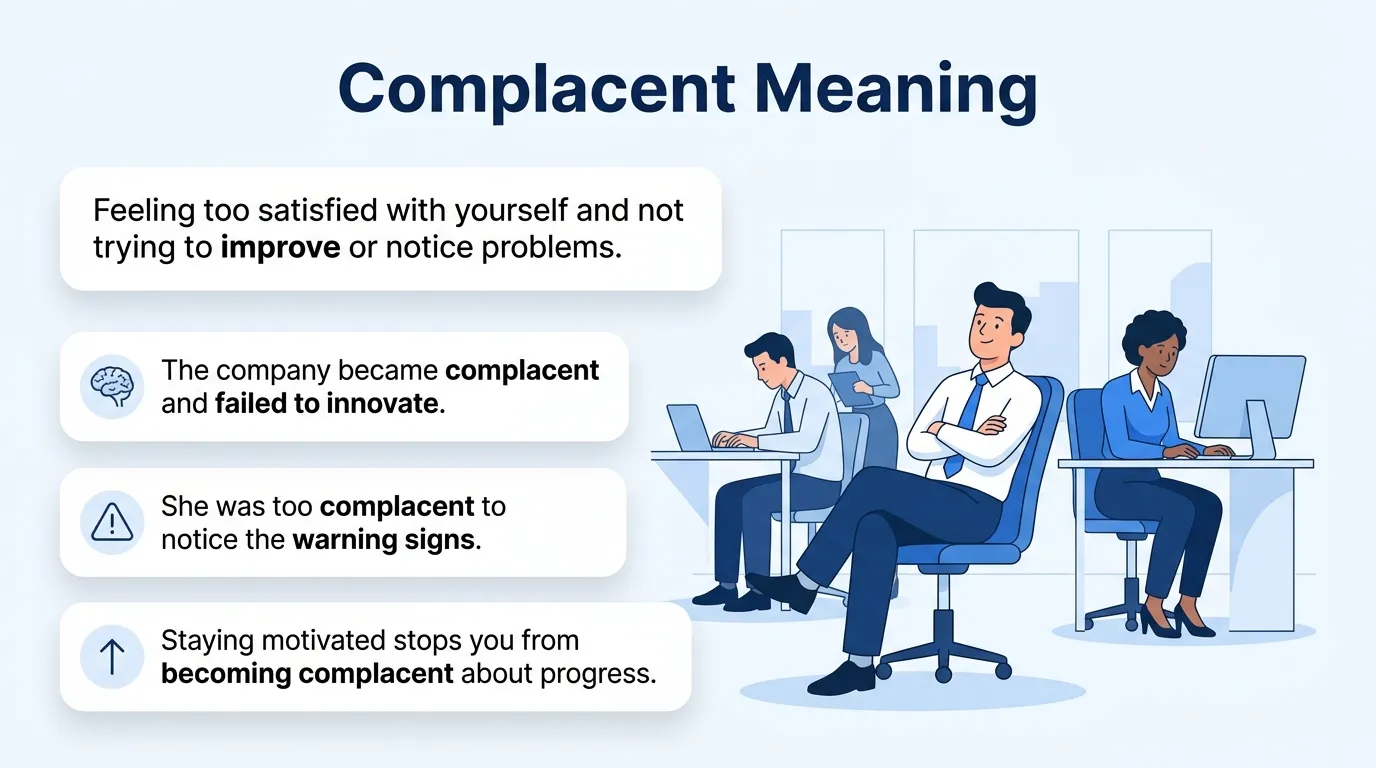
Complacent means feeling so satisfied with how things are going that you stop noticing risks or working to improve.
It’s a quiet kind of danger, because it doesn’t feel like a problem while it’s happening.
If you’ve ever wondered why a top employee got fired or a winning team suddenly lost, complacency is often the hidden reason.
This guide breaks down the complacent meaning in plain English, shows you real-life examples, and gives you practical ways to spot it in yourself before it causes real damage.
What Does Complacent Mean, Exactly
At its core, being complacent means you’re pleased with yourself or your situation to the point where you stop paying attention. You’re not lazy, exactly. You’re just coasting. The word comes from the Latin complacere, meaning to please greatly, which explains why complacency always starts with something good. A win. A promotion. A streak of good luck.
The problem is that complacency turns success into a blind spot. A driver who’s never had an accident starts checking mirrors less. A student who aced the last three tests stops reviewing notes. Neither person feels reckless. They feel confident. That’s exactly what makes complacency so easy to miss.
What Does Complacent Mean
Complacent describes a person who feels so satisfied with their current situation that they stop trying to improve or notice potential risks. It often carries a slightly negative tone, suggesting overconfidence or a lack of urgency. Someone complacent may ignore warning signs because everything seems fine on the surface. This attitude can quietly undermine progress in work, relationships, or personal growth. Recognizing complacency early helps people stay alert and motivated instead of settling into comfortable but limiting routines.
Examples:
- After winning the championship two years in a row, the team grew complacent and stopped practicing as hard.
- She felt complacent about her job security and never updated her skills, which later cost her opportunities.
Define Complacent
To define complacent is to describe a state of quiet self-satisfaction that reduces motivation for change or caution. A complacent person believes things are already good enough and therefore sees little need to push further or stay vigilant. The word highlights a subtle danger: comfort can turn into stagnation when effort fades. In everyday life, complacency often appears when success or routine creates a false sense of safety. Understanding this definition encourages continuous improvement and awareness of blind spots.
Examples:
- The manager became complacent after the company posted record profits and stopped listening to customer feedback.
- Living in a safe neighborhood made him complacent about locking doors at night.
What Does Complacency Mean
Complacency means a feeling of contentment with the status quo that leads to reduced effort or awareness of possible problems. It is the noun form of being complacent and often describes a collective or ongoing attitude rather than a single moment. When complacency sets in, people or groups may overlook risks because past success creates a sense of invulnerability. This mindset can slow innovation and invite setbacks. Spotting complacency helps individuals and teams stay proactive and growth-oriented.
Examples:
- Long periods of economic stability led to widespread complacency among investors who ignored market warning signs.
- The school’s high test scores created complacency, and teachers stopped trying new teaching methods.
Definition of Complacent
The definition of complacent centers on an uncritical satisfaction with one’s achievements or circumstances that reduces drive for further progress. It describes someone who feels secure enough to ease up on effort or caution. Unlike healthy confidence, this attitude often includes a quiet dismissal of potential challenges. In professional and personal settings, recognizing the definition of complacent helps people avoid the trap of resting on past results and instead maintain steady improvement.
Examples:
- After years of strong sales, the sales team grew complacent and failed to adapt to new customer needs.
- He became complacent in his fitness routine once he reached his goal weight and slowly regained the pounds.
Complacent Definition
Complacent definition refers to a self-satisfied mindset in which a person feels no urgent need to improve or remain alert to risks. It captures a sense of ease that can quietly erode ambition and vigilance. People described this way often believe their current level of success or safety is permanent. A clear complacent definition reminds us that lasting achievement usually requires ongoing effort rather than simple contentment with past wins.
Examples:
- The software company became complacent after dominating the market and stopped innovating, allowing competitors to catch up.
- She felt so complacent about her relationship that she stopped putting in the small daily efforts that kept it strong.
Complacent Meaning
Complacent meaning points to a comfortable but potentially dangerous sense of satisfaction that reduces motivation and awareness. It describes an attitude where someone rests on earlier success or stability and stops pushing forward. The meaning carries a gentle warning: feeling too secure can open the door to decline. Grasping the full complacent meaning encourages people to stay curious, proactive, and open to growth even when things appear to be going well.
Examples:
- Years of smooth operations made the factory management complacent about safety protocols until a near-miss occurred.
- After receiving praise for one project, the student grew complacent and put less effort into the next assignment.
Complacent vs Complacency vs Complaisant
People mix these words up constantly, and it’s worth clearing up.
Complacent is the adjective describing a person or attitude. Complacency is the noun, the state of being complacent. Complaisant looks almost identical but means something totally different: eager to please others. A complaisant employee says yes to everything. A complacent employee stops caring whether they need to say yes at all.
Real-World Examples of Complacency
Seeing the word in action makes the meaning stick far better than any definition alone.
- A restaurant with five-star reviews stops training new staff properly, figuring the reputation will carry it.
- A software company skips security updates because nothing bad has happened yet.
- A couple stops having real conversations because the relationship has felt stable for years.
- A factory worker skips a safety check because the machine always works fine.
- A student stops studying two weeks before finals because midterms went well.
Notice the pattern. Every example starts with a genuine success. Complacency doesn’t grow from failure. It grows from comfort.
Why Complacency Is Dangerous
Complacency feels harmless because nothing bad happens right away. That delay is the trap. Risks and small problems pile up quietly while confidence stays high. By the time something breaks, whether it’s a missed deadline, a health scare, or a lost client, it feels sudden. In reality, it was building the whole time.
Airlines, hospitals, and factories study this exact pattern because complacency is one of the leading causes of preventable accidents. Experienced professionals, not beginners, are usually the ones who get complacent, because experience is what builds the false sense of safety in the first place.
Signs You Might Be Complacent
Complacency rarely announces itself. Watch for these quiet signals instead.
- You stop asking what could go wrong because things have gone right for a while.
- You skip steps you used to follow carefully.
- Feedback starts to annoy you instead of interest you.
- You describe your routine as fine more than you describe it as good.
- You haven’t learned anything new in your field in months.
If two or more of these sound familiar, it’s worth a closer look at your habits.
How to Stop Being Complacent
Breaking complacency doesn’t require a crisis. It requires small, deliberate friction.
- Ask a harder question than usual before finishing a task.
- Set a new, slightly uncomfortable goal every few months.
- Invite honest feedback instead of waiting for it.
- Track one metric that keeps you honest, like error rate or response time.
- Treat every streak of success as a reason to check your blind spots, not celebrate them.
None of these require dramatic change. They just require staying a little uncomfortable on purpose.
Complacent Habits vs Engaged Habits
| Complacent Behavior | Engaged Behavior |
| Skips double-checking work because it’s always been fine | Reviews work even when confident, out of habit |
| Avoids feedback to protect a good mood | Actively seeks feedback to catch blind spots |
| Coasts on past wins | Sets new goals after every win |
| Assumes routine equals safe | Questions routine regularly |
| Stops learning once good enough | Keeps learning even at a high skill level |
Quick Reference: Complacency Checklist
| Question | Yes/No |
| Have I skipped a safety or quality step recently because it’s always fine? | |
| Do I get defensive when someone questions my process? | |
| Has it been over a month since I learned something new in my role? | |
| Do I assume future results will match past results without checking? | |
| Have I stopped setting new goals after a recent win? |
Three or more yes answers is a solid sign that complacency has crept in.
FAQs
Q: Complacent meaning in farsi
A: In Farsi, complacent means someone who is overly satisfied with themselves and ignores possible problems.
Q: Complacent synonym
A: Common synonyms for complacent include self-satisfied, smug, overconfident, and unconcerned.
Q: Complacent meaning Examples
A: An example is: He became complacent after his success and stopped working hard.
Q: Complacent Meaning in relationship
A: In a relationship, complacent means becoming too comfortable and no longer making an effort to keep the relationship strong.
Q: Complacent meaning in Chinese
A: In Chinese, complacent is commonly translated as 自满 (zìmǎn), meaning overly satisfied with oneself.
Q: Complacent meaning for kids
A: For kids, complacent means feeling so happy with yourself that you stop trying to improve.
Q: Don t be complacent meaning
A: Don’t be complacent means don’t become too comfortable or overconfident, and always keep trying your best.
Q: Complicit meaning
A: Complicit means being involved in or helping with something wrong or illegal, even if you did not do it yourself.
Conclusion
The complacent meaning boils down to one simple idea: comfort that turns into carelessness. It sneaks in after success, not failure, which is exactly why it’s so easy to miss yourself. The fix isn’t complicated. Stay a little uncomfortable, keep asking questions, and treat every win as a reason to look closer, not relax. Start by running through the checklist above today, and catch complacency before it catches you.

Hi, I’m Benjamin Dreyer. I enjoy exploring the English language and making difficult words simple to understand. At Defineexa.com, I write about word meanings, text abbreviations, acronyms, and internet slang. My goal is to give readers clear, accurate, and easy-to-read explanations that help them learn something new and use English with greater confidence every day.