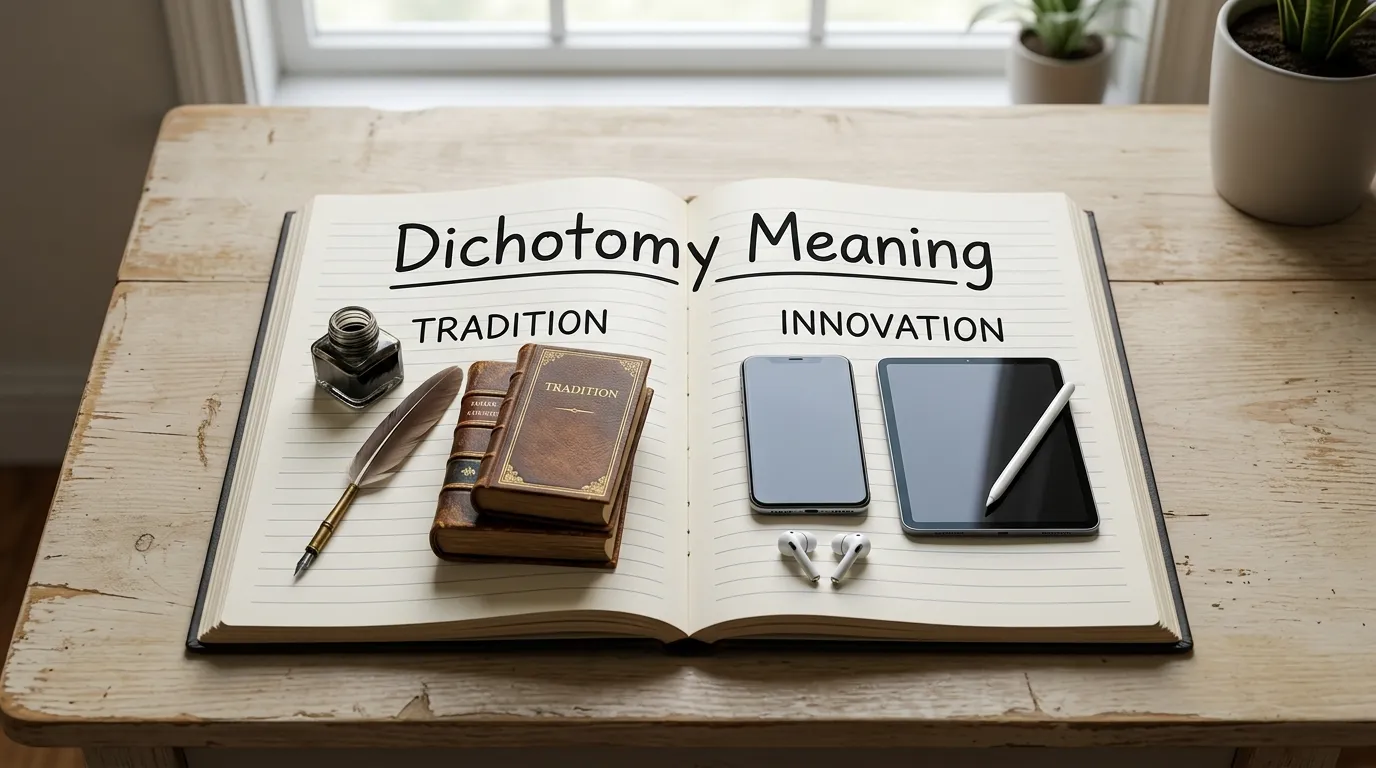
The word dichotomy means a clear split between two things. The two sides are often very different. They can also be opposite in some way.
For example, good and evil can form a dichotomy. So I can work and rest.
The word may sound hard at first. But its main idea is simple. It points to two clear sides of an issue.
You may see this word in books, news, school work, and talks. It is also used in debates and essays.
This guide explains the word in plain English. You’ll learn what it means and how to use it. You’ll also see easy examples, common phrases, and similar words.
By the end, you should feel more sure about the word.
What Does Dichotomy Mean?
Dichotomy means a split between two distinct sides.
Those sides can be ideas, groups, choices, or things. The word puts focus on the gap between them.
Think of a road that splits into two paths. Each path goes in a different direction. A dichotomy works in much the same way.
Here are two easy examples:
- The story shows a dichotomy between good and evil.
- The debate showed a dichotomy between freedom and control.
In both cases, there are two clear sides.
The word does not always mean that one side is right. It only points out the split.
Dichotomy Meaning in Simple English
In simple English, you can think of dichotomy as a two-way split.
It is used when two sides stand apart. Those sides may have different goals, views, or traits.
For example, a person may want both a busy career and more free time. These needs can create a split between work and life.
You could describe this as a dichotomy between work and personal life.
Here are two more examples:
- The film shows a dichotomy between wealth and poverty.
- The book explores a dichotomy between fear and courage.
A simple rule can help:
Dichotomy = two clear and separate sides.
What Are Some Examples of Dichotomy?
You can find this idea in many parts of life.
People often compare two sides without using the word dichotomy. The word simply gives that split a name.
For example, think about these pairs:
- Old and new
- Public and private
- City and country
- Work and rest
- Freedom and control
- Hope and fear
Each pair has two sides.
Here are two examples:
- The show creates a dichotomy between old and new ideas.
- Her life shows a dichotomy between public success and private stress.
The two sides do not need to be exact opposites. They only need to be clearly different.
Is Dichotomy Always About Opposites?
No. This is a common point of confusion.
A dichotomy often shows two opposite ideas. But the two sides do not have to be exact opposites.
They can simply be very different.
For example, city life and country life are different. But they are not true opposites.
You could say:
- The book shows a dichotomy between city life and country life.
- The story explores a dichotomy between youth and old age.
The main point is the clear split.
So, do not think that every dichotomy must have an opposite pair. A strong difference can also create one.
What Is a Dichotomy in Everyday Life?
The idea of a dichotomy is not rare. We see two-sided choices all the time.
A person may want to save money but also enjoy life. A student may want good grades but also more free time.
These needs can pull in different directions.
For example:
- The student faces a dichotomy between study time and free time.
- The family sees a dichotomy between saving money and spending money.
These examples show how the word can describe real life.
It can also describe two views on the same issue.
One person may want strict rules. Another may want fewer rules. That creates a clear split between two views.
How Do You Use Dichotomy in a Sentence?
Dichotomy is a noun.
One common form is:
a dichotomy between A and B
For example:
- There is a dichotomy between work and rest.
- The story shows a dichotomy between love and duty.
You can also use the word after verbs such as show, create, or present.
For example:
- The film shows a dichotomy between two worlds.
- The speech creates a dichotomy between two views.
Another useful form is:
the dichotomy of A and B
For example:
- The poem explores the dichotomy of light and dark.
- The story shows the dichotomy of hope and fear.
These patterns can help you use the word with ease.
What Does “Dichotomy Between” Mean?
Dichotomy between is one of the most common ways to use the word.
It points to a split between two things.
For example:
- The article looks at the dichotomy between rich and poor.
- The film shows the dichotomy between truth and lies.
The word between makes the two sides clear.
You can use this form in essays, reports, reviews, and other writing. It may sound more formal than simply saying difference between.
That does not make it better in every case. Choose the word that fits your sentence.
What Is a False Dichotomy?
A false dichotomy is a split that gives only two choices. It leaves out other choices that may exist.
This can make an issue seem too simple.
For example, someone may say:
“You either love the job or hate it.”
But there is another option. You may like some parts and dislike others.
That is a false dichotomy.
Another example is:
“You must choose work or family.”
A person may be able to balance both.
So, a false dichotomy can hide the middle ground.
Here are two clear examples:
- Saying “You are either with us or against us” may create a false dichotomy.
- Saying “You can study or have fun” creates a false dichotomy.
Real life often has more than two choices.
Dichotomy vs. Contrast
Contrast means a clear difference. Dichotomy points more strongly to a split between two sides.
Contrast is a wider word.
You can compare two things or more than two things. A dichotomy is built around two main sides.
Compare these examples:
- The contrast between summer and winter is easy to see.
- The story has a dichotomy between good and evil.
The first sentence only points out a difference.
The second focuses on two clear sides.
So, use contrast for a general difference. Use dichotomy when the two-sided split matters.
Dichotomy vs. Difference
Difference is a very broad word.
It can describe almost any way that two things are not the same. It does not need a strong split.
For example:
- There is a difference between red and blue.
- The debate shows a dichotomy between freedom and control.
The first sentence simply compares two colors.
The second points to two different ideas.
This is why dichotomy has a more specific use than difference.
Dichotomy vs. Duality
Duality and dichotomy can have close meanings.
Both words can involve two sides.
But there is a small difference.
Dichotomy often stresses the split between two sides. Duality can point to two sides that exist within one thing.
For example:
- The story shows a dichotomy between heroes and villains.
- The character has a duality of kindness and anger.
The first example separates two groups.
The second shows two traits in one person.
The words can overlap, but they are not always interchangeable.
Is Dichotomy a Formal Word?
Yes. Dichotomy is more formal than words like difference, split, or divide.
You may see it more often in essays and serious writing.
It can still be used in normal speech. But a simple word may sound more natural in casual talk.
For example, with a friend, you might say:
“There is a big split between the two groups.”
In formal writing, you might say:
“There is a clear dichotomy between the two groups.”
Both sentences can work.
The best choice depends on your audience and the tone you want.
Is Dichotomy Positive or Negative?
The word dichotomy is usually neutral.
It does not mean something is good or bad.
The words around it give the sentence its tone.
For example:
- The artist uses a dichotomy between light and shadow.
- The argument creates a false dichotomy between two groups.
The first sentence sounds neutral.
The second points out a problem with the argument.
Here are two more examples:
- The story uses the dichotomy between fear and hope.
- The speaker’s claim creates a false dichotomy.
So, the word itself has no fixed positive or negative meaning.
What Is the Adjective Form of Dichotomy?
The adjective form is dichotomous.
It describes something that has two clear or separate sides.
For example:
- The writer gives a dichotomous view of the issue.
- The question creates a dichotomous choice between two options.
The word dichotomous is less common in daily speech.
Most people use dichotomy more often.
If you are writing for a general audience, simple words may be easier to understand.
How Do You Pronounce Dichotomy?
Dichotomy is usually said like:
dye-KOT-uh-mee
The middle part gets the most stress.
You can break it into smaller parts:
di-chot-o-my
The spelling may look hard. The sound is much easier once you hear it.
Here are two sentence examples:
- We discussed the dichotomy in class.
- The book explores a clear dichotomy.
What Are Common Mistakes With Dichotomy?
One common mistake is using dichotomy for every difference.
A small difference does not always create a dichotomy.
For example, two shirts can have different colors. That does not always need the word dichotomy.
Another mistake is thinking that the two sides must be exact opposites.
They do not.
A third mistake is using the word when there are many main choices.
A dichotomy focuses on two sides.
For example:
Clear: The debate created a dichotomy between two main views.
Less clear: The meeting showed a dichotomy among six different views.
The second sentence does not fit the basic idea as well.
Always check if your sentence has two clear sides.
When Should You Use the Word Dichotomy?
Use dichotomy when a clear two-sided split is important.
It works well when you want to compare two views, groups, or ideas.
It can fit topics such as:
- Work and family
- Freedom and control
- Nature and technology
- Public and private life
- Hope and fear
For example:
- The book explores the dichotomy between nature and technology.
- The debate centers on the dichotomy between freedom and safety.
If you only mean difference, you may not need this word.
Simple writing is often better when a simple word works.
How Is Dichotomy Used in Essays and Writing?
Writers often use dichotomy to show two sides of an issue.
It can help readers see the main conflict in a story or debate.
For example, a writer may compare freedom and safety. The two ideas can pull people in different directions.
Another writer may compare tradition and change.
Examples include:
- The essay explores the dichotomy between tradition and change.
- The novel builds a dichotomy between appearance and truth.
The word can make a comparison clear.
Still, do not use it just to sound smart. If split or difference says the same thing, a simpler word may be better.
Common Phrases With Dichotomy
A few phrases appear often with this word.
Dichotomy between
This points to two separate sides.
- The film shows a dichotomy between rich and poor.
- The story explores a dichotomy between hope and fear.
Dichotomy of
This can also introduce two sides.
- The poem uses the dichotomy of light and darkness.
- The story explores the dichotomy of life and death.
False dichotomy
This describes a two-choice split that may not be fair.
- The claim creates a false dichotomy.
- The question presents a false dichotomy between two choices.
These phrases are useful, but natural writing should always come first.
Simple Examples of Dichotomy
Here are some fresh examples from different settings.
- The movie shows a dichotomy between good and evil.
- The town has a dichotomy between old homes and new buildings.
- Her story shows a dichotomy between public success and private worry.
- The debate created a dichotomy between two strong opinions.
- The book explores a dichotomy between nature and machines.
- His life reflects a dichotomy between work and rest.
Each example has two clear sides.
That is the main clue that dichotomy may fit.
Quick Comparison of Similar Words
| Word | Simple Meaning | Main Idea |
| Dichotomy | A split into two sides | Two clear sides |
| Contrast | A clear difference | Things are different |
| Difference | A way things are unlike | General difference |
| Duality | Two sides of one thing | Two qualities or parts |
| Division | A separation | Parts are split |
| False dichotomy | A misleading two-way split | Other choices are ignored |
Dichotomy Meaning Quick Guide
| Question | Simple Answer |
| What does dichotomy mean? | A clear split between two sides |
| Is it a noun? | Yes |
| What is its adjective form? | Dichotomous |
| Must the sides be opposites? | No |
| What is a false dichotomy? | A two-choice split that leaves out other choices |
| Is dichotomy formal? | Yes, it is fairly formal |
| What is a common pattern? | “A dichotomy between A and B” |
| What is the main idea? | Two clear and separate sides |
FAQs
Q: Dichotomy meaning in farsi
A: In Farsi, “dichotomy” means a division or contrast between two distinct and opposite ideas.
Q: Dichotomy synonym
A: Common synonyms for dichotomy include division, contrast, separation, duality, and opposition.
Q: Dichotomy meaning in law
A: In law, dichotomy describes a clear division between two different legal categories, rights, or concepts.
Q: Dichotomy meaning examples
A: Examples include good versus evil, public versus private, and theory versus practice.
Q: False dichotomy meaning
A: A false dichotomy presents two choices as the only options when other possibilities exist.
Q: Dichotomy meaning in statistics
A: In statistics, dichotomy refers to a variable divided into two distinct categories or outcomes.
Q: Dichotomy meaning in a person
A: In a person, dichotomy can describe two contrasting traits, feelings, beliefs, or behaviors.
Q: Dichotomy meaning in relationship
A: In a relationship, dichotomy can describe two opposing feelings, views, needs, or experiences.
Conclusion
The dichotomy meaning is simple: it is a clear split between two sides. Those sides may be different or opposite.
You can use the word for ideas, groups, choices, or parts of life. A common pattern is “a dichotomy between A and B.”
Remember that not every difference is a dichotomy. The word works best when two main sides stand out.
It is also useful to know the phrase false dichotomy. This means a two-choice view that may leave out other options.

Hello, I’m Mark Nichol. I’ve always been passionate about English words and how they are used in everyday communication. At Defineexa.com, I share simple guides on word meanings, acronyms, texting abbreviations, and modern slang. I believe learning English should be easy, practical, and enjoyable, so every article is written with clarity and accuracy in mind.