
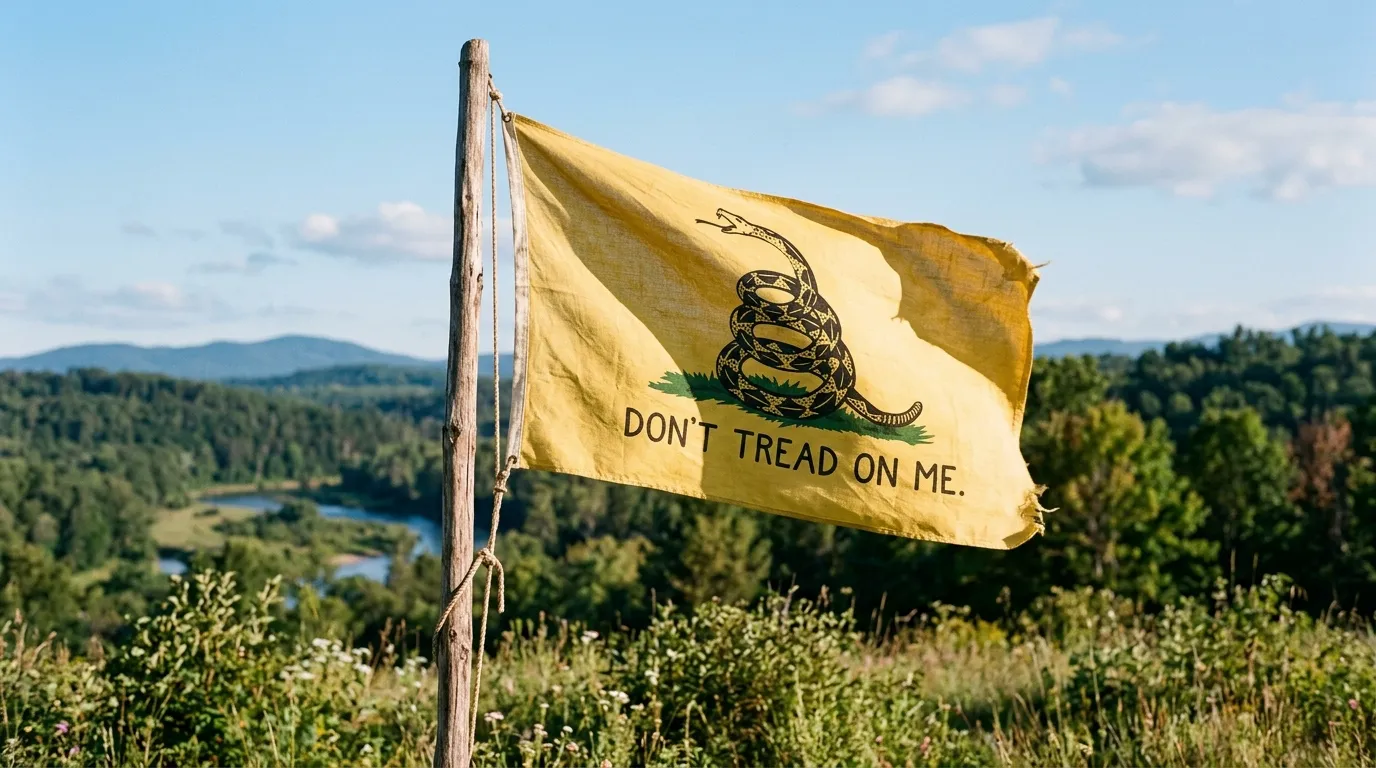
If you’ve seen a yellow flag with a coiled snake and the words Don’t Tread on Me on a truck bumper, a T-shirt, or a flagpole in someone’s yard, you’ve probably wondered what it actually means. The short answer: it’s a warning.
The phrase tells anyone who might threaten your freedom or safety that you won’t sit back and let it happen, you’ll defend yourself if provoked.
That simple message has carried the flag through 250 years of American history, from a Revolutionary War naval ensign to a modern symbol that means different things to different people.
This guide walks through where the phrase came from, what the snake represents, how the flag has been used and misused over time, and why it still shows up everywhere from military patches to political rallies today.
What Does Don’t Tread on Me Actually Mean?
At its core, Don’t Tread on Me is a statement of self-defense and independence. Tread on means to step on or trample so the phrase is essentially saying, Don’t step on me, or you’ll regret it. It’s not a threat of aggression; it’s a warning against being provoked.
That distinction matters. The flag isn’t meant to say I’m coming for you. It’s meant to say leave me alone, but don’t mistake that for weakness. This is exactly why the rattlesnake was chosen as the symbol instead of a more aggressive animal like a wolf or a bear. Rattlesnakes don’t hunt people. They warn before they strike, and only strike when cornered or threatened.
Where the Phrase Came From: A Quick History
The Snake Symbol Started With Benjamin Franklin
The idea of using a snake to represent the American colonies didn’t start with the Gadsden flag. It began in 1754, when Benjamin Franklin published a political cartoon in his newspaper showing a snake cut into eight segments, each labeled with a colony’s initials. The caption read Join, or Die. Franklin’s point was blunt: the colonies needed to unite against outside threats (originally the French and their Native allies during the French and Indian War) or they’d be picked off one by one.
That cartoon planted the idea that a snake could stand in for the American colonies separate but capable of joining together as one dangerous whole.
Christopher Gadsden and the Flag That Bears His Name
By the mid-1770s, tensions with Britain were boiling over, and the snake symbol resurfaced this time as a coiled rattlesnake rather than a cut-up one. In 1775, Christopher Gadsden, a South Carolina delegate to the Continental Congress, presented a flag design to the Provincial Congress of South Carolina: a coiled rattlesnake on a yellow field, poised to strike, with Don’t Tread on Me written beneath it.
Why a Rattlesnake?
The choice wasn’t random. Rattlesnakes are native to North America and weren’t found in Europe, which made the snake a natural symbol of a distinctly American identity.
From Revolutionary Symbol to Modern Icon
After the United States won independence and adopted the Stars and Stripes as its official flag in 1777, the Gadsden flag faded from everyday use. It didn’t disappear completely, though. It resurfaced periodically over the following two centuries, including brief use as an emblem tied to Confederate sentiment during the Civil War era, one of several episodes that shows how the flag’s meaning has shifted depending on who was flying it and why.
The flag saw a major revival in the 20th and 21st centuries:
- Military use: Several branches of the U.S. armed forces, including certain Navy and Coast Guard units, have used Gadsden flag imagery on patches, seals, or historical reenactments referencing the Continental Navy’s origins.
- Tea Party movement (2009 onward): The flag became closely associated with the Tea Party political movement, which used it to symbolize opposition to what members saw as excessive government spending and federal overreach.
- General patriotic and libertarian use: Many people fly the flag simply as a statement of individual liberty, self-reliance, and skepticism of big government, with no connection to any specific political movement.
- Everyday declarations of independence: Veterans, gun owners, small-business owners, and plenty of everyday Americans use the flag to express personal freedom and a leave me alone attitude that has nothing to do with any organized cause.
Why the Flag’s Meaning Is Contested
Here’s where things get more complicated, and where a lot of articles on this topic stop short. The Gadsden flag doesn’t have one fixed meaning anymore, it has several, and they don’t always sit comfortably together.
For most people who fly it, the flag represents individual liberty, historical pride, or general distrust of government overreaching the same spirit that motivated the original American Revolution. For others, particularly since the 2010s, the flag has also been adopted by certain extremist and anti-government groups, which has led some workplaces and institutions to treat it as a politically loaded symbol rather than a neutral historical one. This has occasionally caused friction, including workplace disputes over whether wearing Gadsden flag apparel is protected free expression or an implicit political statement.
It’s worth being upfront about this rather than pretending the flag exists in a historical vacuum. A symbol’s meaning isn’t fixed by its origin alone, it’s shaped by everyone who has used it since. The Gadsden flag’s core message hasn’t changed, but who invokes that message, and why, has expanded well beyond its original context.
Don’t Tread on Me: Quick Reference
| Element | Meaning |
| Yellow background | Represents the flag’s Revolutionary-era origin and visibility |
| Coiled rattlesnake | Readiness to defend, not to attack first |
| 13 rattles (in some versions) | Nods to the original 13 colonies |
| Don’t Tread on Me | A warning: leave me alone, but don’t underestimate me |
| Historical use | Continental Navy ensign, Revolutionary War symbol |
| Modern use | Patriotism, individual liberty, limited government, military heritage |
How the Flag Is Commonly Used Today
- Apparel and gear: T-shirts, hats, patches, and bumper stickers, often worn by veterans and active-duty service members
- Political rallies and movements: Used by groups emphasizing limited government or constitutional rights
- Vehicles and homes: Flown as a general statement of independence, separate from any specific political affiliation
- Historical education: Displayed in museums and reenactments as an artifact of Revolutionary War naval history
FAQs
Q: Don’t Tread on Me meaning snake?
A: It represents a warning that a peaceful person or group can defend itself when threatened.
Q: DON’T Tread on Me meaning controversy?
A: The phrase can be controversial because different groups use the symbol for different political and social views.
Q: Don’t tread on me meaning origin?
A: The phrase originated during the American Revolution and became linked to the Gadsden flag.
Q: Don’t tread on me meaning urban dictionary?
A: It generally means not to threaten, control, or mistreat someone who is willing to defend themselves.
Q: Don’t tread on me meaning meme?
A: As a meme, it is often used humorously to express independence, defiance, or resistance.
Q: Don’t tread on me meaning military?
A: In military contexts, it can symbolize strength, readiness, independence, and resistance to threats.
Q: DON’T Tread on Me flag?
A: The flag features a coiled rattlesnake with the words “DON’T TREAD ON ME” and symbolizes defiance and independence.
Q: Is DON’T Tread on Me political?
A: It can have political meanings, but its meaning depends on the person, group, and context in which it is used.
Conclusion
Don’t Tread on Me started as a Revolutionary War warning against British overreach, built on a symbol Benjamin Franklin popularized decades earlier. Christopher Gadsden’s rattlesnake flag turned that idea into one of the most recognizable images in American history, a message of readiness, independence, and self-defense rather than aggression.
Its meaning has broadened since 1775, picked up by different groups for different reasons, which is exactly why context matters when you see it today. If you’re flying the flag yourself or just trying to understand what it stands for, know both sides of the story: the Revolutionary roots and the modern debates that have grown up around it.

Hi, I’m Benjamin Dreyer. I enjoy exploring the English language and making difficult words simple to understand. At Defineexa.com, I write about word meanings, text abbreviations, acronyms, and internet slang. My goal is to give readers clear, accurate, and easy-to-read explanations that help them learn something new and use English with greater confidence every day.