
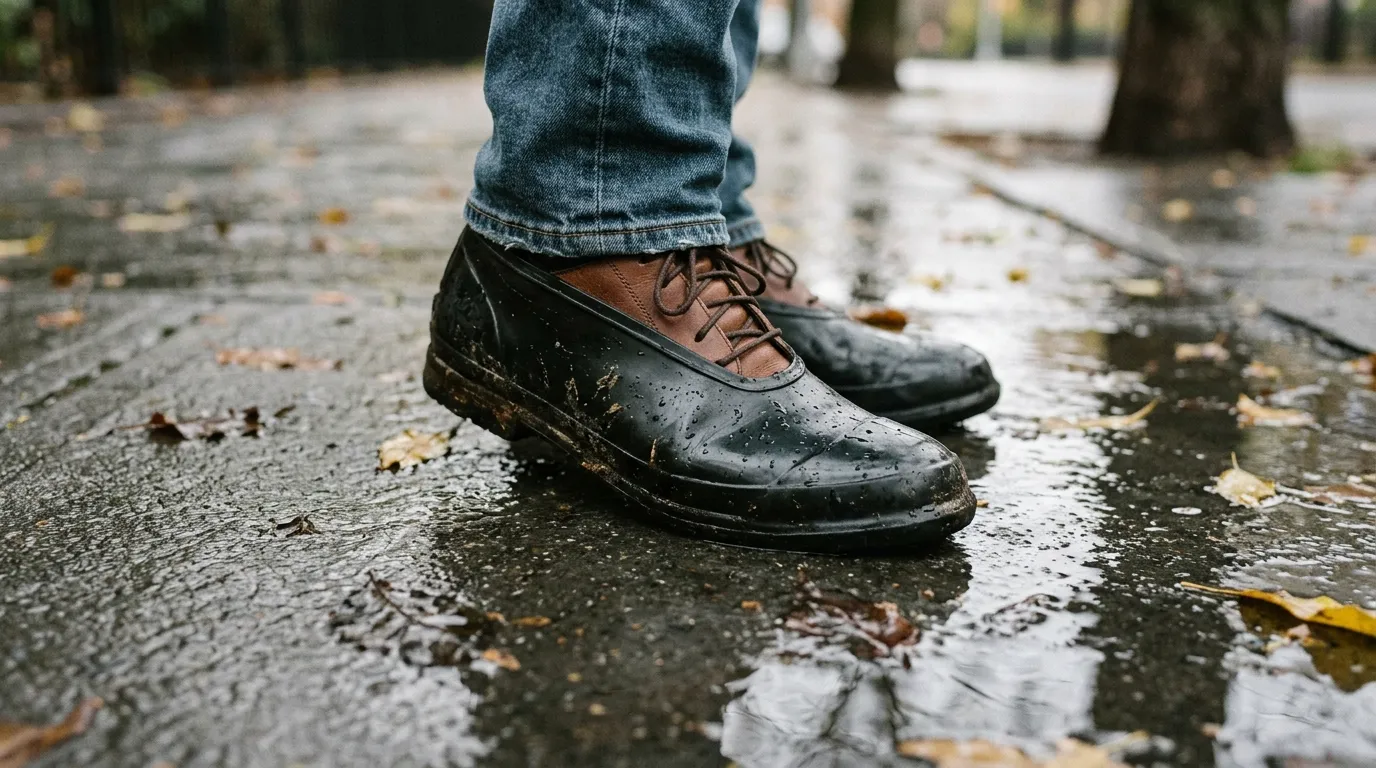
If you’ve ever heard your grandmother talk about putting her galoshes on before heading out in the rain, you’ve probably wondered what exactly she meant. Was she talking about rain boots? Something else entirely?
The galosh meaning is simple: a galosh is a waterproof overshoe, usually made of rubber, that you slip on over your regular shoes to protect them from rain, snow, or mud.
The word is almost always used in its plural form, galoshes, since you obviously need one for each foot.
By the end of this article, you’ll know exactly what galoshes are, where the word came from, how they’re different from rain boots and wellingtons, and whether the term is even still useful today.
What Does Galosh Mean, Exactly?
A galosh is a protective covering worn over a shoe, not instead of one. That distinction matters a lot, and it’s the biggest source of confusion around this word.
Picture a rubber shell that slips over your dress shoe or your sneaker. It has a low profile, usually stopping around the ankle, and its whole job is to keep your actual shoes dry and clean. Once you’re indoors, you pull the galoshes off and your shoes underneath are exactly as you left them.
This is different from a boot, which you wear on bare feet or with socks, and which is meant to be a complete piece of footwear on its own.
Where Does the Word Galosh Come From?
The word has a long and slightly murky history, which is part of what makes it interesting.
Galosh entered English through Old French galoche, a term for a type of wooden or leather-soled shoe. Language historians trace that further back to Late Latin gallicula, a diminutive of gallica, which referred to a Gallic sandal worn in Roman times. Some etymologists also point to a possible Greek root, kalopous, meaning shoemaker’s last (the foot-shaped form used to build shoes), though this connection is less certain.
By the medieval period, galoche in French referred to a wooden clog or pattern worn to lift the foot above wet or muddy ground. When the word crossed into English, it kept that core idea: something you strap or slip onto your foot for protection from the elements.
The modern rubber galosh, the kind most people picture today, didn’t show up until the 19th century, once rubber manufacturing made waterproof footwear practical and affordable. Charles Goodyear’s vulcanization process in the 1840s was a major turning point here, since it made rubber durable enough to hold its shape through repeated wear.
Galoshes vs. Rain Boots vs. Wellingtons: What’s the Real Difference?
This is where most confusion comes from, so it’s worth breaking down clearly.
| Term | What It Is | Worn Over Shoes? | Typical Height |
| Galoshes | Protective overshoe covering | Yes | Ankle to low-calf |
| Rain boots | Standalone waterproof footwear | No | Calf-height |
| Wellingtons | British term for rain boots | No | Calf to knee |
| Overshoes | Modern general term for galoshes | Yes | Ankle |
The short version: if you take your shoes off before putting the item on, it’s a boot. If you put the item on over your shoes, it’s a galosh.
In everyday American speech, though, galoshes has drifted. Plenty of people now use it loosely to mean any kind of rubber rain boot, especially kids’ rain boots with cartoon prints. That’s not technically accurate by the word’s original definition, but language shifts with common usage, and this is one of those cases where the informal meaning has become widely accepted.
Is Galosh Still Used Today?
Yes, but less than it used to be. A few things are true at once:
- The word is still understood by most English speakers, especially older generations.
- It shows up more often in British and Commonwealth English than in everyday American conversation.
- In the U.S., rain boots or rubber boots have largely taken over as the go-to term.
- The actual product (overshoes that slip over dress shoes) still exists and is sold, often under names like rubber overshoes or shoe covers.
If you search for galoshes while shopping online, you’ll often find two different product types: true overshoes meant to fit over dress shoes, and children’s or adult rain boots marketed with the vintage-sounding name because it has a certain charm to it.
Who Actually Wears True Galoshes?
Despite the word feeling old-fashioned, the actual product has a real, practical niche:
- Office workers who commute in dress shoes and don’t want to ruin leather in a downpour.
- People in snowy climates who need to protect nice shoes on the walk between the car and the office.
- Restaurant and hospital staff in some settings, where slip-resistant overshoes double as both weather protection and workplace safety gear.
- Travelers who pack a lightweight, foldable pair rather than bulky rain boots.
If your goal is to keep a specific pair of shoes dry rather than replace your footwear entirely, a true overshoe-style galosh is still one of the most practical options out there.
How to Choose Real Galoshes (If You Actually Need a Pair)
If you’re shopping for the traditional overshoe style rather than kids’ rain boots, here’s a quick checklist worth working through:
- Check the sizing against your shoe, not your foot. Galoshes are sized to slip over an existing shoe, so measure your shoe’s length and width, not your bare foot.
- Look at the sole grip. A smooth rubber sole looks fine in a store but can be dangerously slick on wet tile or stairs.
- Consider the closure style. Pull-on, zip, or buckle each affects how quickly you can get them on and off, which matters if you’re commuting.
- Think about storage. Foldable, packable versions exist for travel and are worth it if you’re not wearing them daily.
- Match the height to your risk. Ankle-height is fine for light rain; a taller shaft helps in slush or standing water.
FAQs
Q: Galosh meaning in english
A: A galosh is a waterproof shoe or overshoe worn to protect the feet from rain, snow, or mud.
Q: Galosh meaning slang
A: “Galosh” is not commonly used as a slang term and usually refers to protective footwear.
Q: Galosh meaning french
A: In French, “galoche” refers to a type of shoe or overshoe and is related to the English word “galosh.”
Q: Galoshes origin
A: The word “galosh” comes from French and has older roots linked to footwear.
Q: Galoshes singular
A: The singular form of “galoshes” is galosh.
Q: Galoshes pronunciation
A: “Galoshes” is commonly pronounced guh-LOSH-iz.
Q: Galoshes with buckles
A: Galoshes with buckles are traditional waterproof overshoes designed to cover and protect regular shoes.
Q: Vintage galoshes
A: Vintage galoshes are older-style waterproof overshoes, often made with classic designs and materials.
Conclusion
At its core, the galosh meaning comes down to this: a waterproof cover worn over a shoe, not a replacement for one.
The word traces back centuries through French and Latin, and while it’s less common in everyday American English now, the actual product still serves a real purpose for anyone who wants to protect their regular shoes from rain, snow, or mud without changing footwear entirely.
If you’re shopping for a pair, decide first whether you want true overshoes or standard rain boots, since online listings often blur the two. That one distinction will save you from ordering the wrong product.

Hello, I’m Mark Nichol. I’ve always been passionate about English words and how they are used in everyday communication. At Defineexa.com, I share simple guides on word meanings, acronyms, texting abbreviations, and modern slang. I believe learning English should be easy, practical, and enjoyable, so every article is written with clarity and accuracy in mind.