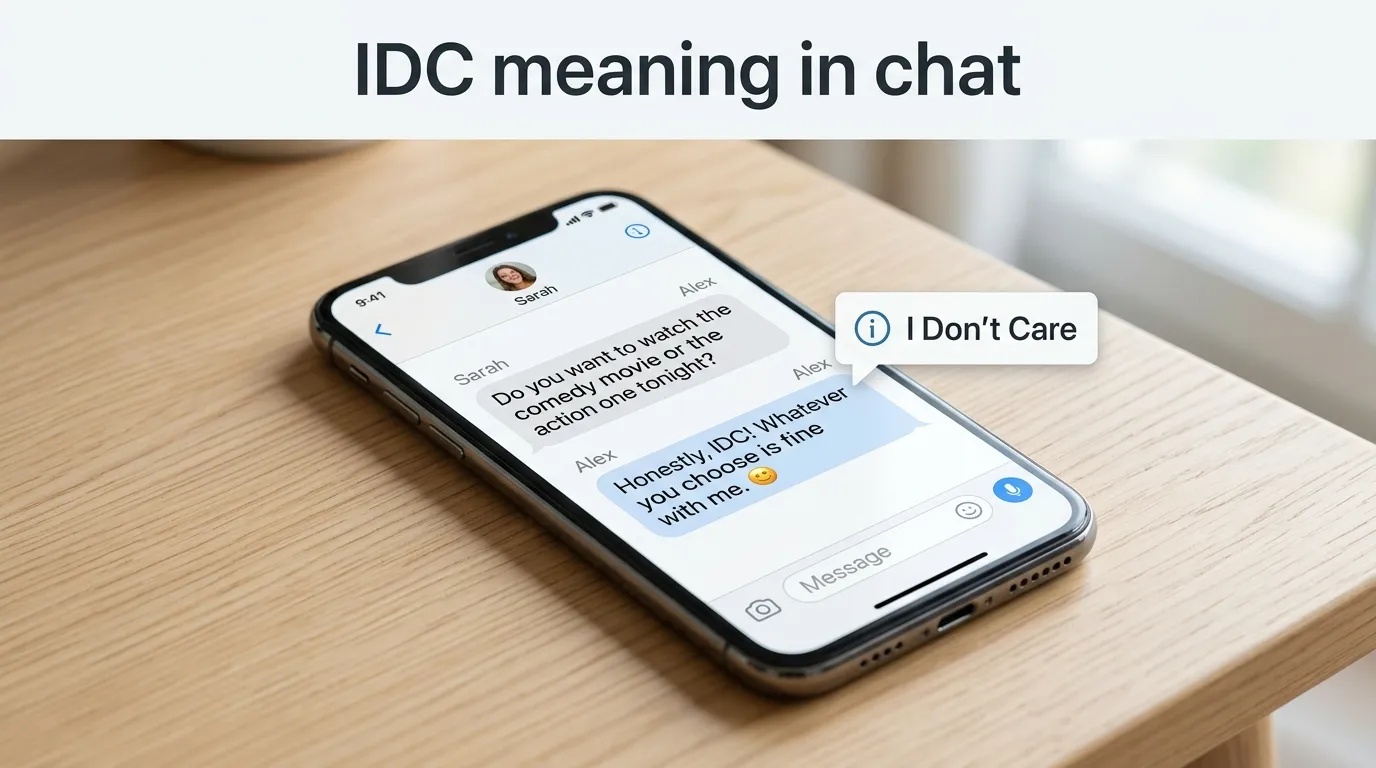
IDC stands for I don’t care. In texting, messaging apps, and online chats, people use it as a quick way to show they have no strong preference, aren’t interested in a topic, or want to step back from a conversation.
You’ll most often see it written in lowercase as idc, which itself signals low effort and casual tone.
This abbreviation is one of the most common pieces of internet slang. It shows up in texts, WhatsApp, Instagram DMs, Snapchat, Discord, TikTok comments, and group chats.
While the core meaning is straightforward, the way it lands depends heavily on context, relationship, and punctuation or capitalization.
Core Meaning of IDC in Everyday Chat
At its simplest, IDC is a shorthand for the phrase I don’t care. It functions as a fast response when someone asks for an opinion, a preference, or a reaction and the other person genuinely has noneor wants to signal that the subject isn’t worth their energy.
Neutral, preference-free use is the most common and least problematic version. A friend asks what to order for dinner or which movie to watch, and the reply is idc, you pick. Here the speaker is flexible and easygoing. The message removes decision-making pressure without shutting the other person down.
Dismissive or shut-down use carries more weight. When someone shares news, a complaint, or something personal and receives idc, the tone shifts. It can feel like the speaker is brushing off the other person rather than the topic. In arguments or emotionally charged talks, IDC often marks the point where one side is done engaging.
Low-effort signaling is another layer. Typing the full three words takes more time and visual space. Choosing the acronym, especially in all lowercase, can itself communicate that the speaker isn’t investing much effort. That visual cue is part of why the term sometimes reads as colder than intended.
Two realistic examples:
- Friend: Should we do Thai or Italian tonight?
You: idc, both sound good. - Group chat: Did you see what they posted about the party?
Reply: idc honestly.
In the first case the abbreviation keeps the conversation light. In the second it can close the door on further discussion.
How IDC Developed as Internet Slang
IDC belongs to the wave of early internet and SMS abbreviations that appeared in the 1990s and early 2000s. Chat rooms, instant messaging services like AIM and MSN Messenger, and character-limited text messages rewarded short forms. Typing fewer characters saved time and, in the days of paid SMS, money.
Urban Dictionary recorded an early definition around 2003, though the phrase was already circulating in forums and chatrooms before that formal entry. Like BRB, LOL, and IDK, IDC spread because it solved a practical problem: people wanted to express a common attitude quickly. Once smartphones and free messaging apps became universal, the need for extreme brevity lessened, yet the habit remained. The acronym is now recognized across age groups and platforms even though newer slang continues to appear.
It is not tied to one culture or generation. English-speaking users around the world adopted it, and many non-native speakers treat it as a fixed English chat term rather than translating it each time.
Tone, Capitalization, and Context: Why the Same Letters Feel Different
The letters themselves stay the same, but the emotional temperature changes with how they are written and where they appear.
Lowercase idc usually feels more casual and low-key. It often suggests the speaker is relaxed or mildly uninterested. Adding a softener such as idc, whatever you want or an emoji can keep it friendly.
Uppercase IDC can be read as stronger or more emphatic. In some conversations it signals annoyance or a deliberate cutoff. All-caps versions sometimes appear when someone is frustrated and wants the indifference to land harder.
Relationships matter as much as typing style. Among close friends who already share a blunt communication style, IDC rarely causes friction. Between partners, coworkers, or people who don’t know each other well, the same reply can feel cold or dismissive. Timing also counts. Dropping IDC right after someone opens up about a problem or shares excitement tends to land poorly. Using it during ordinary decision-making (food, plans, logistics) is usually safer.
Two contrasting examples:
- Casual: Movie or board games? → idc, I’m down for either.
- Sharper: I spent all afternoon fixing this and now it’s broken again. → IDC.
The first keeps the exchange moving. The second can end it.
Related Acronyms and Similar Expressions
Several other short forms sit near IDC in meaning or usage. Knowing the differences prevents mix-ups.
| Expression | Full Form | Typical Tone | Common Use Case |
| IDC | I don’t care | Neutral to dismissive | No preference or shutting down a topic |
| IDK | I don’t know | Neutral / uncertain | Lack of information |
| IDRC | I don’t really care | Softer indifference | Mild version of IDC |
| IDFC | I don’t freaking care | Stronger / frustrated | Emphatic shutdown |
| Whatever | (full word) | Casual or annoyed | Similar indifference, spoken or typed |
IDC and IDK are frequently combined: IDK and IDC is a compact way to say both I have no information and I have no interest. That pairing often signals the speaker wants the conversation to stop.
Whatever can serve a similar function but is a full word rather than an acronym. In speech it can sound more resigned; in text it sometimes feels less abrupt than pure IDC. IDRC softens the edge slightly by adding really. IDFC intensifies it.
Two usage examples:
- What time does the thing start? → IDK and IDC, I’m not going.
- Should I text them back? → idrc, do what feels right.
These nearby terms help readers place IDC on a spectrum of indifference rather than treating it as an isolated phrase.
When IDC Is Casual Versus When It Feels Rude
Not every use of IDC is rude. The line depends on three factors: the subject, the relationship, and the surrounding words.
Usually fine:
- Everyday choices with no emotional weight (food, media, timing of a low-stakes plan).
- Close friends who already joke or speak bluntly.
- Situations where the speaker has already shown flexibility and is simply handing the decision over.
Riskier or often perceived as rude:
- After someone shares personal news, feelings, or effort.
- During an ongoing disagreement.
- With people who expect more engagement (partners, family members, newer acquaintances).
- Standing alone without softening language (idc versus idc, you decide if you want).
Because text strips away vocal tone and facial expression, recipients fill in the blanks. A neutral idc can be read as colder than the sender intended. Softening phrases and emojis reduce that risk. idc tbh, both work for me or idc 🙂 you choose usually lands better than the bare acronym.
Two side-by-side examples:
- Softened: Where should we meet? → idc, wherever is easiest for you.
- Bare: I really needed to talk about this. → idc.
The first maintains goodwill. The second can damage it.
How to Use IDC Correctly and Naturally
If you want to use the term yourself, keep a few practical guidelines in mind.
Match the formality of the chat. IDC belongs in casual digital spaces. It is out of place in professional email, formal messages, or any setting where clear, complete sentences are expected.
Pair it with clarifying language when the stakes are higher than pure logistics. idc about the restaurant as long as it’s not too far gives the other person useful boundaries. A lone idc does not.
Watch for overuse. Relying on the acronym in every decision can make you seem disengaged even when you are simply flexible. Alternating with fuller phrases (I’m good with either, no preference here) keeps your communication varied.
Be ready for the reverse: if someone sends you IDC and you feel dismissed, a short clarifying question can help (Just checking do you mean you’re fine with anything or you’d rather not decide?). Not every instance needs follow-up, but in close relationships it can prevent small misunderstandings from growing.
Two natural sentence examples:
- I’m packing for the weekend if we take the big bag or the small one.
- They can post whatever they want; idc at this point.
Common Misconceptions About IDC
Several assumptions circulate around the term.
One is that IDC always equals hostility. In reality many uses are simply efficient preference statements. Treating every instance as an insult can create unnecessary tension.
Another is that lowercase versus uppercase changes the dictionary definition. It does not. The letters still expand so I don’t care. Capitalization mainly affects perceived intensity.
A third misconception is that IDC has a single fixed emotional weight across all platforms and age groups. Younger users on TikTok or Discord may deploy it more lightly or ironically than older users in family group chats. Context still rules.
Finally, some people assume the only alternative meanings of the letters IDC are irrelevant. In other domains the same three letters can stand for International Data Corporation (a market-research firm), insulation displacement connector (a technical term), or other specialized phrases. In ordinary chat and social media, however, the I don’t care that reading dominates by a wide margin.
Practical Takeaways for Readers
When you see IDC in a message, start by checking the surrounding conversation. Is the topic a low-stakes choice or something more personal? Is the sender usually blunt or usually careful with tone? That quick assessment prevents over-reading.
If you plan to use the abbreviation, default to the softer versions in relationships that matter. Add a short clarifying clause or an emoji when the message could be ambiguous. Save the bare idc for moments when you truly want minimal engagement and the other person is likely to understand the style.
Understanding the term also helps you decide how to reply. A neutral Sounds good, I’ll pick then keeps momentum after a flexible IDC. A more direct Everything okay? You sound done with this may be appropriate after a sharper one.
IDC is a small piece of digital language that carries outsized weight because indifference itself is socially loaded. Knowing both the dictionary expansion and the practical tone rules lets you read and write it more accurately.
FAQs
Q: IDC meaning medical
A: In medicine, IDC can refer to different terms, including invasive ductal carcinoma, depending on the context.
Q: Idc meaning in chat from a girl
A: In chat, “IDC” usually means “I don’t care,” and the exact tone depends on the conversation.
Q: Idc meaning in chat reddit
A: On Reddit and in casual chat, “IDC” usually means “I don’t care.”
Q: Idc meaning in chat urban dictionary
A: On Urban Dictionary, “IDC” commonly means “I don’t care” in informal online conversations.
Q: Idc meaning in email
A: In an email, “IDC” usually means “I don’t care,” but its meaning can vary by context.
Q: What does idc mean from a boy
A: From a boy, “IDC” usually means “I don’t care,” though his tone and context can change the meaning.
Q: IDC meaning Business
A: In business, IDC can refer to different organizations or terms, depending on the industry and context.
Q: Idc meaning in data center
A: In data centers, IDC can refer to an Internet Data Center, a facility that houses network and computing equipment.
Conclusion
IDC is a compact tool for expressing indifference or lack of preference in digital conversation. Its value lies in speed; its risk lies in how easily tone can be misread once facial cues and voice are removed.
By paying attention to context, relationship, and small softening choices, both senders and receivers can use or interpret the term more accurately. The next time the three letters appear on your screen, you will know exactly what they expand to and how much weight they are likely carrying in that particular exchange.

Hi, I’m Benjamin Dreyer. I enjoy exploring the English language and making difficult words simple to understand. At Defineexa.com, I write about word meanings, text abbreviations, acronyms, and internet slang. My goal is to give readers clear, accurate, and easy-to-read explanations that help them learn something new and use English with greater confidence every day.