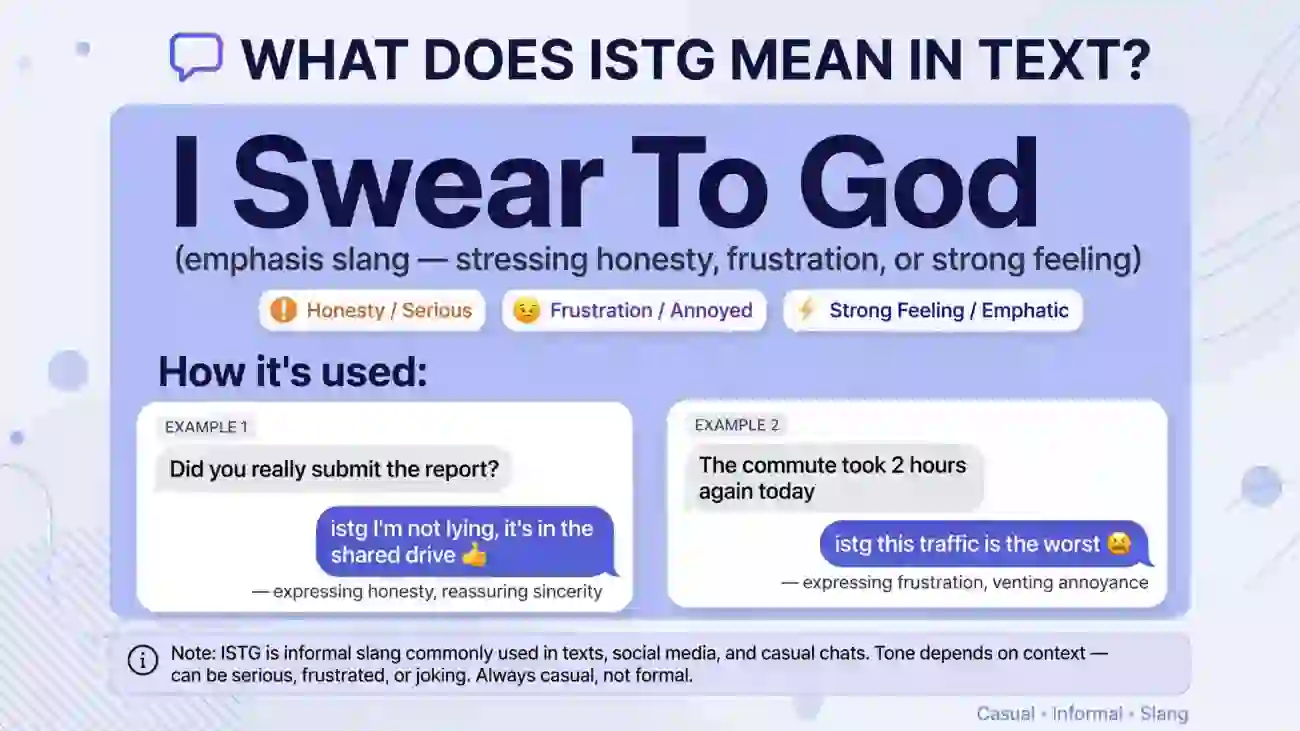
The ISTG meaning in the text is “I swear to God.” People use this popular texting abbreviation to show honesty, emphasize a statement, express frustration, or react strongly to something.
You may see ISTG in text messages, Snapchat chats, TikTok comments, Instagram DMs, and other casual online conversations. Its exact tone depends on the context.
Key Takeaways
- ISTG stands for “I swear to God.”
- People use it to express honesty, frustration, excitement, or disbelief.
- Its basic meaning stays the same across texting apps and social media platforms.
- ISTG can sound serious, playful, or annoyed depending on the message.
- It is informal slang, so neutral wording works better in professional communication.
What Does ISTG Stand For?
ISTG stands for “I swear to God.” It is a common internet abbreviation that helps people express strong feelings without typing the entire phrase.
The letters represent the first letters of each word:
- I = I
- S = Swear
- T = To
- G = God
In everyday texting, ISTG often works as a way to say “I’m serious,” “I promise,” or “I’m telling the truth.” People may use it without intending to make a literal religious oath.
What Does ISTG Mean?
+1
For example:
Text: “ISTG, I didn’t take your charger.”
Meaning: “I swear to God, I didn’t take your charger.”
Here, the sender uses ISTG to emphasize that they are telling the truth. The abbreviation adds emotion and makes the message feel more forceful than a simple denial.
You can write it as “ISTG” or “istg.” Both forms generally have the same meaning.
What Does ISTG Mean in Different Conversations?
ISTG can communicate several emotions. The words around it help you understand what the sender really means.
ISTG to Show Honesty
Someone might use ISTG when they want another person to believe them. It can make a statement sound more sincere or convincing.
Examples:
- “ISTG, I told you the truth.”
- “ISTG I saw him at the mall yesterday.”
- “I finished the assignment, ISTG.”
In these messages, the sender stresses that their statement is true. However, using ISTG does not automatically prove that someone is being honest. It simply shows how strongly they want to make their point.
ISTG to Express Frustration
People also use ISTG when something annoys them or when they have reached the end of their patience.
Examples:
- “ISTG, my internet keeps disconnecting.”
- “ISTG, you never listen to me.”
- “ISTG, if my alarm goes off one more time, I’m throwing my phone.”
These messages sound irritated or dramatic. The last example may be playful exaggeration rather than a genuine threat to throw away a phone.
If someone sends you ISTG during an argument, read the whole message before deciding how upset they are.
ISTG to Show Excitement or Humor
ISTG does not always express anger. Friends often use it to emphasize excitement, laughter, surprise, or an exaggerated reaction.
Examples:
- “ISTG, that movie was amazing.”
- “ISTG, this cat video made my entire day.”
- “ISTG, I could eat pizza every day.”
Here, the abbreviation adds emphasis and personality. The sender is sharing a strong reaction, not necessarily making a serious promise.
ISTG Meaning on Snapchat, TikTok, Instagram, and WhatsApp
The basic ISTG meaning stays the same across social media platforms. However, the tone can change depending on the conversation.
| Platform | Common use | Example |
| Snapchat | Casual messages and reactions | “ISTG, you look so funny 😂” |
| TikTok | Reactions to videos and relatable content | “ISTG, this is literally my life.” |
| Comments, captions, and direct messages | “ISTG, this picture is perfect.” | |
| Personal chats and group conversations | “ISTG, I already sent you the photo.” | |
| Regular text messages | Promises, complaints, and strong opinions | “ISTG, I’ll be there at 6.” |
These examples illustrate possible uses, not strict rules for each app.
If someone comments “ISTG, this song never gets old” on TikTok, they are probably expressing enthusiasm. If a friend texts “ISTG, I told you three times,” the message may communicate frustration.
The easiest way to understand ISTG is to focus on the surrounding words, the relationship, and the conversation’s tone.
ISTG Meaning From a Girl or a Guy
Does ISTG mean something different when a girl or a guy sends it? Usually, no. The abbreviation still stands for “I swear to God,” regardless of who uses it.
The message itself gives you more useful clues than the sender’s gender.
When a girl texts ISTG:
- “ISTG, you’re so funny 😂” may express amusement.
- “ISTG, I’m not talking to him anymore” may show frustration or determination.
- “ISTG, I miss you so much” may emphasize a genuine feeling.
When a guy texts ISTG:
- “ISTG, that game was amazing” may show excitement.
- “ISTG, I didn’t say that” may emphasize a denial.
- “ISTG, stop making me laugh” may be a playful reaction.
These meanings are not gender-specific. A girl or guy could use any of these expressions in the same way.
If you’re trying to understand a message from someone you like, don’t assume ISTG is romantic or angry on its own. Look at the rest of the conversation.
How to Use ISTG in a Text Message
You can use ISTG in casual conversations when you want to emphasize a statement or express a strong reaction.
Here are four simple ways to use it naturally.
1. To reassure someone
“ISTG, I didn’t forget your birthday.”
This emphasizes that you are being sincere.
2. To show frustration
“ISTG, this traffic is never going to end.”
This communicates annoyance with a situation.
3. To react to something funny
“ISTG, I can’t stop laughing at that video.”
This adds emotion to a humorous reaction.
4. To emphasize a promise
“ISTG, I’ll pay you back tomorrow.”
This makes the promise sound more serious, although the abbreviation does not guarantee that the person will follow through.
Use ISTG when the other person understands casual internet slang. If you are unsure whether they will understand it, simply write “I swear” or “I’m serious.”
How to Respond to ISTG
Your response should match the sender’s tone. You do not need to use another abbreviation if a simple reply feels more natural.
Here are some useful examples.
| If they say… | You could reply… |
| “ISTG, I’m not lying.” | “Okay, I believe you.” |
| “ISTG, that was hilarious.” | “Right? 😂” |
| “ISTG, I’m so tired.” | “Same, I need a nap.” |
| “ISTG, you’re annoying me.” | “Sorry, what’s bothering you?” |
| “ISTG, I’ll be there soon.” | “Okay, see you soon!” |
| “ISTG, I miss you.” | “I miss you too ❤️” |
If the sender seems upset, avoid assuming they are joking. A calm question such as “Are you serious, or are you joking?” can help clear up confusion.
If the message is playful, a funny response or emoji may be enough.
ISTG vs. Similar Texting Abbreviations
ISTG belongs to a larger group of internet slang expressions. Although some of these terms overlap, they do not all mean the same thing.
| Slang | Full form | Main purpose |
| ISTG | I swear to God | Emphasizes honesty or a strong reaction |
| OMG | Oh my God | Expresses surprise, excitement, or disbelief |
| FR | For real | Shows agreement or emphasizes sincerity |
| TBH | To be honest | Introduces an honest opinion |
| NGL | Not gonna lie | Introduces a candid statement |
| SMH | Shaking my head | Expresses disappointment or disbelief |
For example, “ISTG, this movie is amazing” emphasizes how strongly you feel about the movie.
By contrast, “FR, this movie is amazing” stresses that you genuinely agree or mean what you say.
Likewise, “TBH, I didn’t enjoy the movie” introduces a personal opinion. Each abbreviation serves a slightly different purpose, even though all can appear in casual online conversations.
When Should You Avoid Using ISTG?
ISTG is generally suitable for casual conversations with friends, family members, or people who understand texting slang. However, it may not fit every situation.
Consider avoiding it in these circumstances:
- Professional emails: Write “I can confirm” instead of “ISTG.”
- Formal school assignments: Use complete sentences and standard English.
- Serious disagreements: The phrase may sound aggressive or overly dramatic when someone is already upset.
- Conversations with people who dislike religious expressions: Choose “I promise” or “I’m being honest” instead.
Remember that “I swear to God” includes religious wording. Some people use it casually, while others may consider it inappropriate. If you know someone prefers a different language, respect that preference.
The goal is to communicate clearly without making the other person uncomfortable.
Frequently Asked Questions About ISTG
Does ISTG Always Mean Someone Is Angry?
No. ISTG can express honesty, frustration, excitement, surprise, or humor. For example, “ISTG, you’re hilarious” sounds playful, while “ISTG, stop doing that” may express annoyance. Read the surrounding message and consider your relationship with the sender before deciding what they mean.
Is ISTG a Rude Word?
ISTG is not automatically rude, but it can sound harsh in certain situations. Friends may use it casually or humorously. During an argument, however, it can make a message sound impatient or intense. Because it includes the phrase “I swear to God,” some people may also find it inappropriate for personal or religious reasons.
Is ISTG the Same as “I Swear”?
They are closely related, but they are not always identical in tone. ISTG is an abbreviation of “I swear to God,” while “I swear” is a shorter expression that can emphasize honesty, a promise, or a strong reaction. In many casual messages, both communicate a similar idea.
Should You Write ISTG in Capital or Lowercase Letters?
Both “ISTG” and “istg” are commonly understood. Capital letters may make the abbreviation stand out, while lowercase letters can feel more relaxed in a casual chat. Neither spelling changes the basic meaning. Choose whichever style feels natural for your conversation.
Conclusion
The ISTG meaning in the text is “I swear to God.” People use this abbreviation to emphasize honesty, express frustration, make a strong statement, or react to something funny or surprising.
You may encounter it in text messages, Snapchat chats, TikTok comments, Instagram DMs, and WhatsApp conversations. Although the meaning stays consistent, the tone depends on context.
When you see ISTG in a message, read the entire sentence before interpreting it. That small step can help you tell whether the sender is being serious, playful, or annoyed.

Hello, I’m Mark Nichol. I’ve always been passionate about English words and how they are used in everyday communication. At Defineexa.com, I share simple guides on word meanings, acronyms, texting abbreviations, and modern slang. I believe learning English should be easy, practical, and enjoyable, so every article is written with clarity and accuracy in mind.