
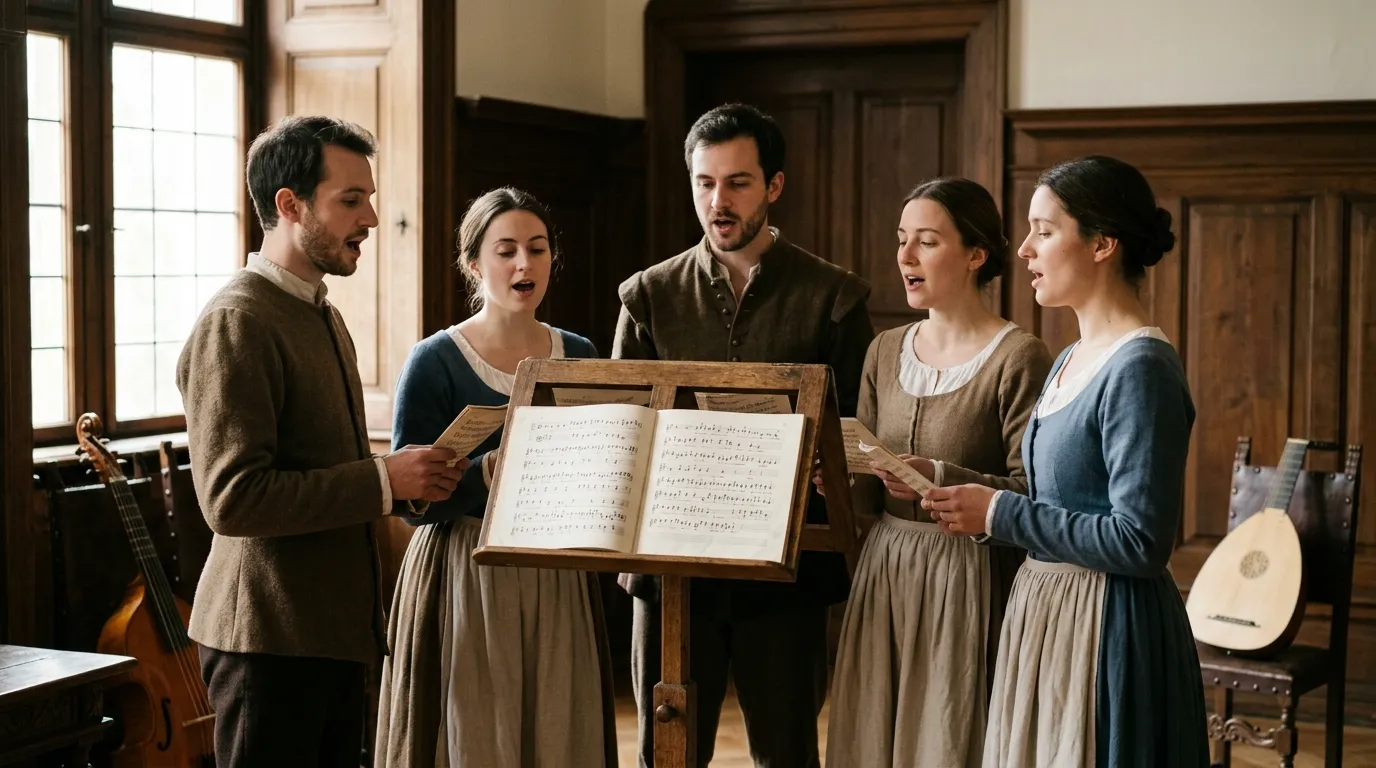
The madrigal meaning is a short poem or a type of song written for several voices. In music, the word usually means a secular song for multiple singers, especially one linked to Renaissance music.
Madrigals often use several voice parts at the same time, with each part adding to the whole sound.
The word can seem hard at first because it has both a music meaning and a poetry meaning. But the main idea is simple: a madrigal connects words, voices, and music.
In this guide, you will learn what a madrigal is, where the form came from, how Renaissance composers used it, what makes a madrigal different from other songs, and why madrigals still matter today.
You will also see simple examples and quick comparisons that make the term easy to remember.
What Does Madrigal Mean?
A madrigal has two main meanings.
In poetry, a madrigal is a short lyrical poem. It may express love, feelings, nature, or another personal idea. The poem can have a song-like quality.
In music, a madrigal is a secular vocal work for several singers. The word secular means that the music is not written for religious worship. Renaissance madrigals often used several independent voice parts.
So, in simple words:
Madrigal means a short lyrical poem or a multi-part secular song, especially one from the Renaissance period.
When you see the word in a music lesson, the musical meaning is usually the one you need.
Madrigal Meaning in Music
The musical meaning of madrigal is the most common one today.
A madrigal is made for several singers. Instead of having one main singer while everyone else simply supports that singer, several voices can have their own musical lines.
These lines work together to create one complete piece.
For example, one singer may start a musical idea. Another singer may answer with a similar idea. A third voice may enter with a new line. The parts then blend together.
This style is called polyphony. Polyphony means that two or more independent melodies happen at the same time.
Many early madrigals were also sung without instruments. This style is called a cappella. However, not every madrigal from every period followed exactly the same performance style.
Madrigals were often based on short poems. This allowed composers to connect the music closely with the words.
What Is a Madrigal in Poetry?
The word madrigal also has a literary meaning.
In poetry, it can describe a short lyrical poem. Such a poem often has a personal or emotional subject. Love is a common theme, but it is not the only one.
A madrigal poem may describe beauty, nature, sadness, affection, or a personal thought.
The poetic and musical meanings are connected because madrigals often used poetry as their text. A composer could take a short poem and turn it into music for several voices.
This close link between poetry and music became one of the most important parts of the Renaissance madrigal.
So, if you see madrigal in a poetry book, it may refer to the poem itself. If you see it in a music history book, it will usually refer to the vocal music form.
Where Did Madrigals Come From?
The early history of the madrigal goes back to Italy.
An early form appeared during the 14th century. These early Italian madrigals were connected with poetry and singing. They were different from the later madrigals that became famous during the Renaissance.
During the 16th century, the madrigal changed a lot.
Italian composers began creating more detailed and expressive music from short poems. The form became one of the most important types of secular vocal music in Renaissance Europe.
Composers did not simply place a melody under the words. They looked for ways to make the music match the meaning of the poem.
This gave the madrigal a strong emotional quality.
The form later spread from Italy to other parts of Europe. England became especially important in the history of the madrigal.
What Makes a Madrigal Different?
Several features can help you recognize a madrigal.
First, it normally uses several singers. The voices can have separate musical parts.
Second, traditional madrigals usually have secular words. The text may talk about love, nature, sadness, beauty, humor, or other human ideas.
Third, madrigals often use polyphony. The voices do not always sing the same melody together.
Fourth, the music may change to match the words. A composer might make the music sound happy, sad, fast, slow, high, or low depending on what the poem says.
Fifth, many Renaissance madrigals were written for voices without required instrumental support.
These features do not mean every madrigal sounds exactly the same. Composers used the form in different ways.
What Is Word Painting?
One of the most interesting features of Renaissance madrigals is called word painting.
Word painting happens when the music copies or reflects the meaning of the words.
Imagine a poem that says, “I climb the mountain.”
A composer might use notes that move upward when the singers say the word “climb.”
Now imagine the poem says, “My tears fall.”
The music might move downward to create the feeling of falling.
This gives the listener more than words alone. The music helps show the meaning.
Word painting became an important tool for Renaissance composers because they wanted the music to express the poem.
Not every madrigal uses word painting, but many famous examples show this close connection between words and music.
Why Were Madrigals Popular?
Madrigals became popular because they gave people a new way to enjoy poetry and music together.
They were also useful for small groups of singers. A group could perform a madrigal without needing a large orchestra.
The music could be emotional, playful, romantic, or dramatic.
The text also mattered. People could hear a poem while listening to several voices create a rich musical sound.
During the Renaissance, interest in human feelings, language, art, and learning grew. The madrigal fit well with this cultural change.
It allowed composers to explore human emotions through music.
Famous Madrigal Composers
Many composers helped make the madrigal important.
Claudio Monteverdi was a major Italian composer who worked during the late Renaissance and early Baroque periods. His madrigals show how the form could become more dramatic and expressive.
Carlo Gesualdo is another well-known Italian madrigal composer. His music is famous for strong emotions and unusual harmonies.
England also developed a rich madrigal tradition.
Thomas Morley, Thomas Weelkes, and John Wilbye are among the English composers linked with this tradition.
Their works helped make the madrigal an important part of English music.
These composers did not all write in the same style. Their music shows how the madrigal could change as composers tried new ideas.
Madrigal vs. a Regular Song
A madrigal is a song in a broad sense, but it does not work like many modern songs.
A modern pop song often has one main singer. The singer usually has a clear melody, while instruments provide the background.
A Renaissance madrigal can work very differently. Several singers may have important parts, and the voices may move independently.
Here is a simple comparison:
| Feature | Madrigal | Typical Modern Song |
| Singers | Often several singers | Often one lead singer |
| Music | Several vocal lines may work together | Usually one main melody |
| Text | Often short poetry | Lyrics can have many forms |
| Instruments | Often not required in early madrigals | Usually common |
| Main subjects | Love, nature, feelings, humor | Almost any topic |
| History | Strongly linked to Renaissance music | Mostly modern |
| Vocal texture | Often polyphonic | Often melody with accompaniment |
This table gives a basic idea. Music has changed over time, so there are exceptions to these patterns.
Madrigal vs. Motet
People sometimes confuse a madrigal with a motet because both can use several singers.
The biggest difference is usually the type of text.
A traditional madrigal is generally secular. A motet is usually connected with sacred or religious music, especially in the Renaissance tradition.
Both forms can use polyphony. Both can sound complex. Both can use several vocal parts.
The subject of the text is therefore an important clue.
If the singers are performing a love poem, a madrigal may be the better answer.
If they are performing a religious text, a motet may be more likely.
Madrigal vs. Other Vocal Forms
Renaissance Europe had many types of vocal music.
A madrigal was mainly secular and often used Italian or other European poetry.
A motet was commonly connected with sacred texts.
A mass was a large sacred musical setting used in Christian worship.
A chanson was a type of French song with a long history.
These forms can share musical features. For example, more than one form may use several independent voices.
The difference often comes from the language, text, purpose, and musical tradition.
| Musical Form | Main Type | Common Text | Simple Way to Remember |
| Madrigal | Secular vocal music | Love, nature, feelings | Secular Renaissance song |
| Motet | Sacred vocal music | Religious text | Sacred multi-voice work |
| Mass | Sacred music | Christian liturgy | Large church setting |
| Chanson | Secular song tradition | Often French poetry | French song tradition |
| Part-song | Vocal music for parts | Varies | Several vocal parts |
This is a simple guide rather than a strict rule for every piece in music history.
What Subjects Do Madrigals Use?
Madrigals can cover many subjects.
Love is one of the most common themes. A poem may describe love, desire, beauty, or heartbreak.
Nature can also appear. A composer might set a poem about flowers, birds, spring, or the countryside.
Sadness is another common subject. The music can use a darker sound to match the poem.
Humor can also play a role. Some madrigals are light and playful instead of serious.
This variety is one reason the madrigal became so useful to composers. They could choose a short poem and shape the music around its mood.
How to Recognize a Madrigal
If you need to identify a madrigal for school or study, use a few simple questions.
First, ask whether the piece uses several singers.
Next, check the words. Are they about love, nature, emotions, humor, or another secular subject?
Then listen to the voices. Do different singers have different melodies?
Finally, consider the historical period. If the piece comes from Renaissance Europe, especially Italy or England, it may be a madrigal.
Use this quick checklist:
| Question | What to Look For |
| Are several singers involved? | Multiple vocal parts |
| Is the text secular? | Love, nature, feelings, humor |
| Do voices have separate lines? | Polyphonic texture |
| Does the music follow the words? | Possible word painting |
| Is it linked to Renaissance music? | Strong clue |
| Is it a short lyrical poem? | Possible poetic madrigal |
You do not need to memorize every musical detail. These clues can help you understand the basic form.
Common Mistakes About Madrigals
One common mistake is saying that every madrigal is a love song.
Love was a popular subject, but madrigals could cover many topics.
Another mistake is saying that all madrigals are always sung without instruments. Many early madrigals were designed for voices alone, but performance practices changed over time.
Some people also think the word only means a type of Renaissance music.
That is not fully correct. The word can also refer to a short lyrical poem.
Another mistake is thinking that every multi-voice song is a madrigal. Several other musical forms can use multiple voices. You should look at the text, period, purpose, and style before deciding.
Why Madrigals Still Matter Today
Madrigals may come from hundreds of years ago, but they still have value.
Music students study them to learn about polyphony, harmony, vocal writing, and Renaissance music.
Singers also perform madrigals because the music can be challenging and rewarding. Each singer has to listen carefully to the other parts.
Madrigals also show how closely music and language can work together.
A composer can take a simple poem and use melody, rhythm, harmony, and several voices to make the words feel stronger.
That idea still matters in music today.
Modern composers and songwriters also think about how music should match the feeling of their words.
A Simple Example of Madrigal Meaning
Imagine four singers performing a short poem about spring.
The first singer begins with a melody about flowers.
The second singer enters with another line.
The third singer adds a new musical idea.
The fourth singer completes the sound.
If the music is secular, uses several vocal parts, and sets a short lyrical text, it may fit the basic idea of a madrigal.
Now imagine the same four singers performing a religious prayer as part of church music. The fact that there are four singers does not automatically make it a madrigal.
The text and musical tradition matter.
This simple example shows why you should not identify a madrigal only by the number of singers.
FAQs
Q: Madrigal meaning Spanish?
A: In Spanish, “madrigal” refers to a type of lyrical poem or song, especially one about love.
Q: Madrigal meaning in english?
A: In English, “madrigal” means a short lyrical poem or a style of Renaissance vocal music.
Q: Madrigal meaning in Encanto?
A: In Encanto, Madrigal is the family name of the magical family at the center of the story.
Q: Madrigal meaning slang?
A: “Madrigal” does not have a widely recognized slang meaning in standard English.
Q: Madrigal meaning german?
A: In German, “Madrigal” refers to the same musical form or lyrical composition known as a madrigal.
Q: Madrigal meaning in french?
A: In French, “madrigal” refers to a short poetic compliment or a Renaissance-style musical composition.
Q: Madrigal meaning in music?
A: In music, a madrigal is a secular vocal piece that became popular during the Renaissance.
Q: Madrigal meaning in Breaking Bad?
A: In Breaking Bad, Madrigal refers to Madrigal Electromotive GmbH, a large German company connected to the criminal network.
Conclusion
The madrigal meaning is simple once you know its two main uses. A madrigal can be a short lyrical poem or a secular vocal composition for several singers. In music history, it is strongly connected with Renaissance Europe, especially Italy and England.
Madrigals often use several independent voices, expressive melodies, and texts about love, nature, feelings, or other human experiences. Some also use word painting to make the music reflect the words.
When you need to identify a madrigal, look at the voices, text, musical style, and historical period. These clues will help you understand the form without needing to memorize difficult music terms.

Hi, I’m Benjamin Dreyer. I enjoy exploring the English language and making difficult words simple to understand. At Defineexa.com, I write about word meanings, text abbreviations, acronyms, and internet slang. My goal is to give readers clear, accurate, and easy-to-read explanations that help them learn something new and use English with greater confidence every day.