
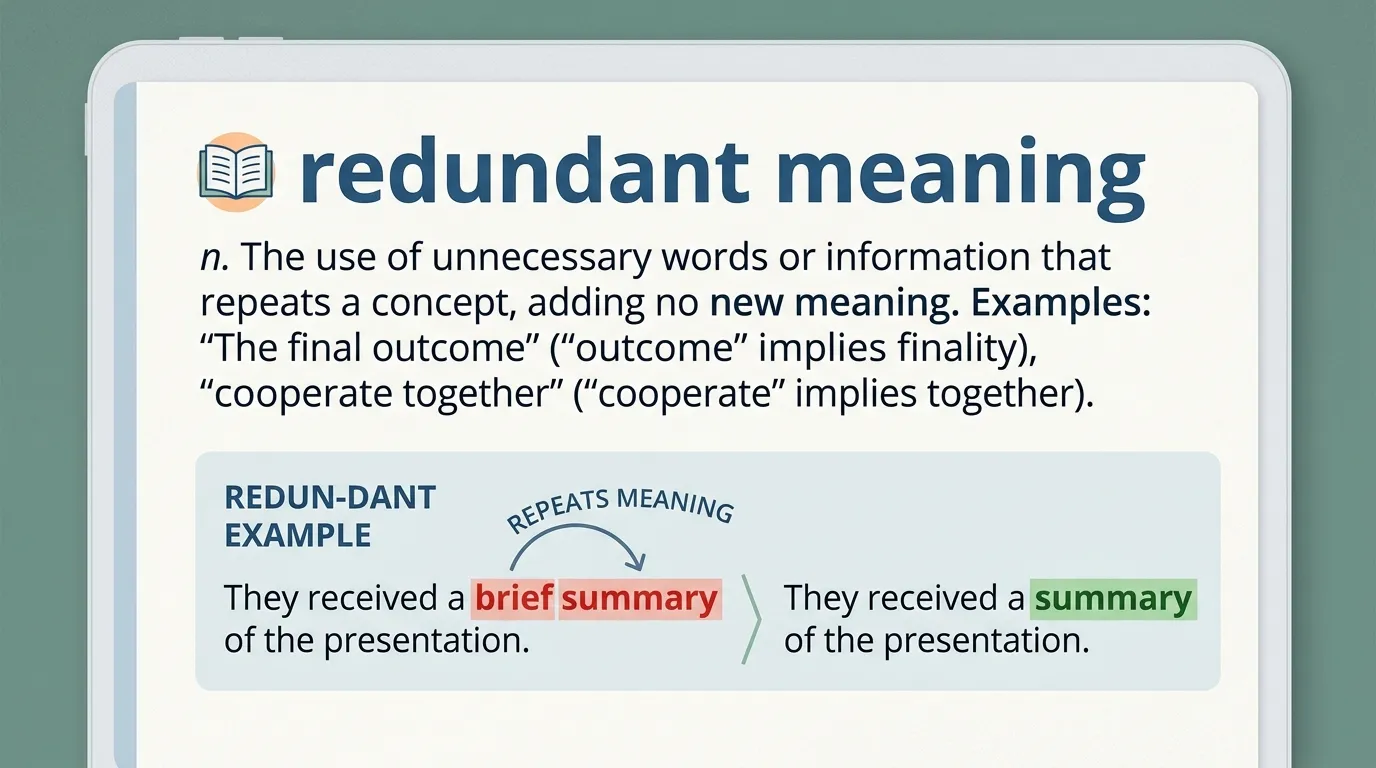
When something is redundant, it goes beyond what is needed or useful. In everyday English, the word usually refers to excess extra words, extra parts, or something no longer required.
You will see it most often describing unnecessary repetition in writing or speech, backup systems in technology, and, in British English, workers who have been laid off because their roles are no longer needed.
This article breaks down every major sense of the word, shows how people actually use it, highlights common mistakes, and gives you practical ways to spot and avoid needless redundancy.
By the end, you will understand the different meanings, recognize them in context, and use the word accurately yourself.
What Does Redundant Mean?
At its core, redundant is an adjective that means exceeding what is necessary or normal. Something redundant is superfluous, extra, or no longer required for the job at hand.
The word comes from the Latin redundare, meaning to overflow or to be in abundance. That origin still shapes how we use it today. When information, parts, or people overflow past the point of usefulness, we call them redundant.
Two everyday examples:
- The report repeated the same sales figures three times. Those repeated paragraphs were redundant.
- After the company installed a new automated system, two of the old manual checklists became redundant.
In both cases, the extra material or steps no longer added value.
Least Redundant Meaning
“Least redundant” means the option that has the least unnecessary repetition or duplication. Something is redundant when it adds no useful value because the same idea or function already exists. So, the least redundant choice is usually the clearest and most efficient one. This phrase can describe writing, information, tasks, systems, or even workplace roles. It helps people choose what adds the most value without repeating what is already available.
Example 1: “Choose the least redundant sentence in the paragraph.”
Example 2: “This design removes the least useful duplicate feature.”
Context and how people use it: People use this phrase when comparing options and looking for the one with the least repetition or overlap.
Being Made Redundant Meaning
“Being made redundant” means losing your job because your employer no longer needs your role. It usually does not mean the employee did something wrong. A company may remove a position because of cost cuts, restructuring, technology, or a change in business needs. This term is especially common in British English. In American English, people often say “being laid off” instead. The key idea is that the job itself is being removed.
Example 1: “She is being made redundant after the company closed the department.”
Example 2: “Several workers are being made redundant during the restructuring.”
Context and how people use it: People commonly use this phrase when discussing workplace changes, job losses, or company restructuring.
Made Redundant Meaning
“Made redundant” means being dismissed from a job because the employer no longer needs that position. It usually refers to a business decision rather than poor employee performance. A company might make positions redundant after downsizing, merging departments, introducing new technology, or reducing expenses. The phrase is widely used in British and other varieties of English. In simple terms, the worker leaves because the role is no longer required.
Example 1: “Tom was made redundant when his department was closed.”
Example 2: “My friend was made redundant after the company reduced its staff.”
Context and how people use it: People use “made redundant” when explaining why someone lost a job due to changes within an organization.
Least Redundant Meaning Act
“Least redundant” in the context of an act means the action that involves the least unnecessary repetition or duplication. The exact meaning depends on the situation. An act may be considered redundant when it repeats something that has already been done or adds no useful result. Choosing the least redundant act means selecting an action that serves a clear purpose without wasting time or effort.
Example 1: “Sending another identical email would be redundant, so the least redundant act is to wait.”
Example 2: “Repeating the same test is redundant when the result is already confirmed.”
Context and how people use it: People may use this idea when discussing efficient actions, processes, decisions, or tasks.
Been Made Redundant Meaning
“Been made redundant” means someone has lost their job because their position is no longer needed. The word “been” is normally used with a form of “have” or “has,” such as “I have been made redundant.” It describes a completed workplace decision. It does not normally suggest that the employee was fired for misconduct. Instead, the employer has removed the role because of business changes or reduced demand.
Example 1: “He has been made redundant after the factory reduced production.”
Example 2: “Several employees have been made redundant this year.”
Context and how people use it: People use this phrase when talking about job losses caused by restructuring, downsizing, or changes in business needs.
I’ve Been Made Redundant Meaning
“I’ve been made redundant” means “I have lost my job because my employer no longer needs my position.” It is a common British English expression for a type of job loss. The speaker is usually explaining that their role has been removed, rather than saying they were dismissed because of poor behavior. The reason may involve company cuts, restructuring, automation, or a business closure. In American English, “I’ve been laid off” is often more natural.
Example 1: “I’ve been made redundant, so I’m looking for a new job.”
Example 2: “I’ve been made redundant after our office merged with another branch.”
Context and how people use it: People often say this when telling friends, family, or colleagues about an unexpected job change.
Redundant Meaning Example
A simple example of redundant is something that is unnecessary because it repeats or duplicates something already present. The word can describe language, information, tasks, equipment, or jobs. For example, saying “advance planning ahead” can sound redundant because “planning” already suggests preparing beforehand. In another setting, an extra computer server may be called redundant if another server already performs the same needed function. The meaning changes slightly by context, but the main idea is unnecessary repetition or duplication.
Example 1: “The extra sentence was redundant because it repeated the same point.”
Example 2: “The company removed a redundant position.”
Context and how people use it: People use “redundant” when something adds little or no new value because it duplicates existing work or information.
Redundant Meaning in a Job
“Redundant” in a job context means a position is no longer needed by an employer. If someone is “made redundant,” they usually lose their job because the role has been removed. Common reasons include downsizing, automation, company restructuring, falling demand, or business closure. It is different from being fired for misconduct or poor performance. The term is especially common in British English, while American English often uses “laid off.”
Example 1: “Her position became redundant after the company automated the process.”
Example 2: “He was made redundant when two departments were combined.”
Context and how people use it: People use this meaning in workplace conversations, employment news, company announcements, and discussions about layoffs.
Redundant Meaning in Hindi
“Redundant” can have different Hindi meanings depending on the context. In general English, it can mean अनावश्यक (anavashyak), meaning unnecessary, or दोहराव वाला, meaning repetitive. In a job context, “made redundant” can mean नौकरी से हटा दिया गया क्योंकि पद की जरूरत नहीं रही. The best Hindi translation therefore depends on whether you are discussing writing, technology, or employment.
Example 1: “This sentence is redundant” = “यह वाक्य अनावश्यक है।”
Example 2: “He was made redundant” = “उसे नौकरी से हटा दिया गया क्योंकि उसके पद की जरूरत नहीं रही।”
Context and how people use it: Hindi speakers often understand “redundant” differently based on whether the topic is language, work, or technology.
Redundant Meaning in Computer
In computing, “redundant” usually means extra or duplicate resources kept available for reliability, backup, or protection against failure. Unlike ordinary redundancy, computer redundancy is often useful rather than wasteful. For example, a system may use two servers so one can continue working if the other fails. Redundant storage, power supplies, and network connections can help prevent downtime. Therefore, the meaning depends on purpose: unnecessary duplication may be wasteful, while planned redundancy can improve system reliability.
Example 1: “The company uses redundant servers to keep its website running.”
Example 2: “A redundant power supply can keep the computer system operating after one unit fails.”
Context and how people use it: IT professionals use “redundant” when discussing backups, fault tolerance, servers, storage, networks, and system reliability.
You have not enough Humanizer words left. Upgrade your Surfer plan.
Redundant Meaning
Redundant means something is unnecessary because it repeats an idea, serves no useful purpose, or is no longer needed. The word often describes extra words, tasks, items, or information that could be removed without changing the main meaning. In simple terms, if something is redundant, it adds little or nothing useful. The term can also describe a worker whose job is no longer needed, especially in British English.
Example 1: The sentence had a redundant phrase that could be deleted.
Example 2: We removed the redundant files to save storage space.
Context and how people use it: People commonly use “redundant” when discussing writing, work, systems, or repeated information.
Redundant
Redundant describes something that is extra, repeated, or no longer necessary. Its meaning can change slightly based on context. In writing, a redundant word repeats information already understood. In everyday situations, a redundant object may be something you do not need anymore. At work, especially in British English, being made redundant means losing a job because the position is no longer required. So, the word usually points to something unnecessary rather than something harmful or incorrect.
Example 1: The second explanation was redundant because the first was clear.
Example 2: That old cable is redundant after the upgrade.
Context and how people use it: People use “redundant” to describe unnecessary words, equipment, roles, or repeated ideas.
What Does Redundant Mean
What does redundant mean? It means unnecessary, excessive, repeated, or no longer needed. The exact meaning depends on how the word is used. For example, a writer may call a repeated phrase redundant because it does not add new information. A company may describe a position as redundant when it no longer needs that role. The word can therefore apply to language, objects, systems, jobs, and ideas. It generally suggests that something can be removed without causing a meaningful loss.
Example 1: “Free gift” can be called redundant because gifts are already free.
Example 2: The company removed several redundant procedures.
Context and how people use it: People use the term when something repeats information or has become unnecessary.
Redundent
Redundent is a common misspelling of redundant. The correct spelling is “redundant,” with an a before the final “nt.” It refers to something unnecessary, repeated, excessive, or no longer needed. If you are searching for “redundent meaning,” you are most likely looking for the definition of “redundant.” Using the correct spelling is important when writing, searching online, or checking professional documents.
Example 1: Instead of “The sentence is redundent,” write “The sentence is redundant.”
Example 2: A search for “redundent definition” should lead you to “redundant.”
Context and how people use it: “Redundent” usually appears in searches because people are unsure about the spelling of “redundant.”
Meaning of Redundant
The meaning of redundant is something that is unnecessary, repeated, or no longer useful. It can describe language, information, equipment, procedures, or even jobs. When a word or phrase does not add anything new, it may be considered redundant. In a workplace context, the word can also mean that a job is no longer required. The main idea stays the same: something has become extra because it is not needed.
Example 1: The editor removed redundant words from the paragraph.
Example 2: The company replaced the redundant system with newer software.
Context and how people use it: People use “redundant” when explaining that something is extra, repeated, outdated, or unnecessary.
Redundant Definition
The redundant definition is: something that is unnecessary because it repeats information, provides no extra value, or is no longer needed. The word can be used in several settings. In writing, redundant wording repeats an idea. In technology, redundant equipment may be extra equipment kept as backup. In employment, particularly in British English, someone can be made redundant when their job is no longer required. The meaning depends on the situation, but the idea of being unnecessary remains central.
Example 1: The final sentence was redundant and added nothing new.
Example 2: The server has a redundant backup system for safety.
Context and how people use it: People use “redundant” differently in writing, technology, business, and everyday conversation.
Definition of Redundant
The definition of redundant is “not needed or useful because something else already serves the same purpose.” It can also mean repeated or excessive. For instance, repeating the same fact several times may make the information redundant. However, redundancy is not always bad. In technology, extra systems can provide protection if the main system fails. This shows why context matters when understanding the word.
Example 1: The repeated sentence was redundant in the final article.
Example 2: The airplane uses redundant systems to improve reliability.
Context and how people use it: People use the word for repetition, unnecessary items, extra systems, and roles that are no longer needed.
Define Redundant
To define redundant simply, it means “unnecessary, extra, repeated, or no longer required.” Something can be redundant because another thing already performs the same function. The word is common in writing, business, technology, and everyday speech. It can describe a sentence, task, device, job, or piece of information. While redundant often has a negative meaning, extra systems can sometimes be useful when they provide backup or protection.
Example 1: The editor said the repeated paragraph was redundant.
Example 2: The company removed a redundant step from its process.
Context and how people use it: People use “redundant” when something can be removed because it adds little value or is no longer required.
Redudant
Redudant is a misspelling of the word redundant. The correct spelling is “redundant.” It means unnecessary, excessive, repeated, or no longer needed. Many people type “redudant” when searching for the word’s meaning because the spelling can be easy to mix up. If you see “redudant meaning,” the intended word is almost always “redundant.” Learning the correct spelling helps make your writing clearer and more professional.
Example 1: “Redudant information” should be written as “redundant information.”
Example 2: “Redudant job” should be corrected to “redundant job.”
Context and how people use it: “Redudant” is mainly used as a search misspelling, while “redundant” is the correct form.
Different Meanings of Redundant
The word carries several related but distinct senses depending on context.
In language and writing
Redundant often describes unnecessary repetition or wordiness. A phrase that says the same idea twice is a classic example.
- Past history is redundant because history is already in the past.
- Free gift is redundant because a gift is free by definition.
In technology and engineering
Here the meaning turns positive. Redundant systems or components provide deliberate backup so that if one part fails, another can take over.
- Airplanes use redundant hydraulic systems so a single failure does not ground the aircraft.
- Data centers keep redundant power supplies and network paths to prevent downtime.
In British English employment
When a worker is made redundant, the employer has eliminated the job itself, usually because of restructuring, cost-cutting, or technological change. It is the British equivalent of being laid off for reasons unrelated to personal performance.
- The factory closed one production line and made 40 staff redundant.
- After the merger, several middle-management roles became redundant.
In biology and genetics
Scientists speak of redundant genes or codon redundancy when multiple elements perform the same function, offering a safety net.
These senses share the idea of excess, but the value of that excess changes with the setting. In writing it is usually a flaw; in engineering it is often a strength.
Does Redundant Always Mean the Same Thing?
No. Context decides whether the excess is unwanted or intentional.
In casual conversation and most writing advice, redundant carries a mildly negative tone. It signals waste or carelessness. In technical fields, the same word can be neutral or even praiseworthy because intentional redundancy increases reliability.
Compare these two sentences:
- The essay was full of redundant phrases that slowed the reader down. (negative)
- The spacecraft design includes multiple redundant sensors for safety. (positive)
The word itself does not change; the judgment around the excess does.
How to Use Redundant Correctly in Sentences
Place the word before a noun or after a linking verb. It works smoothly with both concrete and abstract nouns.
Natural examples:
- Many of the old procedures became redundant once the software update rolled out.
- The second explanation felt redundant after the first clear example.
- Engineers deliberately built redundant cooling systems into the reactor.
- After the store closed, the entire sales team was made redundant.
Avoid forcing the word into places where unnecessary or extra would sound more natural. Redundant works best when the excess relates to function, purpose, or information that is already covered.
Common Phrases and Expressions with Redundant
Certain fixed expressions appear regularly:
- Made redundant (British English for laid off)
- Redundant system / redundant backup
- Redundant information / redundant detail
- Rendered redundant (made unnecessary by change)
You will also hear people say that’s a bit redundant when pointing out repetition in conversation.
Examples in context:
- The software update rendered the old paper forms redundant.
- The IT team insisted on a fully redundant network architecture.
Redundant vs. Similar Words
People often mix up redundant with close cousins. Here is a clear comparison:
| Word | Core Idea | Typical Tone | Example |
| Redundant | Excess that is no longer needed or is deliberately duplicated | Negative in writing; positive in engineering | The extra paragraph was redundant. / The system has redundant power supplies. |
| Superfluous | More than is needed; often elegant excess | Usually negative or formal | The decorations were beautiful but superfluous. |
| Unnecessary | Not required at all | Neutral to negative | Further discussion seemed unnecessary. |
| Repetitious | Repeating the same thing | Negative | The speech grew repetitious after the third example. |
Two more distinguishing examples:
- Adding a third lock to a door that already has two working locks may be redundant (backup) or superfluous (pointless show).
- Saying I myself personally is both redundant and repetitious.
Common Mistakes People Make with Redundant
Many writers treat every repeated idea as automatically bad. Yet some repetition strengthens clarity or emphasis. The mistake is failing to distinguish useful reinforcement from empty overlap.
Another frequent error is using redundant only for writing problems and forgetting its technical and employment senses. A third is confusing American and British usage. In American English, made redundant is rare; speakers usually say laid off or let go.
Two corrected examples:
- Incorrect: ATM machine is always wrong. Better: In technical contexts the repetition is widely accepted and rarely confuses anyone.
- Incorrect: Calling a backup server redundant means it is useless. Better: In systems design, calling it redundant signals intentional safety.
Related Word Forms
- Redundancy (noun): the state of being redundant, or the extra component itself. The design includes several layers of redundancy.
- Redundantly (adverb): He explained the point redundantly.
- Redound (verb, related root): to contribute or lead to something, usually positive. Less common in everyday speech.
Practical Tips for Avoiding Unwanted Redundancy in Writing
When you edit, ask two questions: Does this word or sentence add new information? Does the reader already understand the point from earlier material?
Useful checklist:
- Cut pairs that say the same thing twice (end result, advance planning, basic fundamentals).
- Remove repeated numbers or facts that appear only a few sentences apart.
- Keep intentional repetition when it creates rhythm or emphasis.
- In technical documents, label deliberate redundancy clearly so readers understand its purpose.
Two before-and-after examples:
- Before: In my personal opinion, I think we should proceed carefully. After: I think we should proceed carefully.
- Before: The final outcome of the project was a complete success. After: The project was a complete success.
FAQs
Q: Redundancy meaning?
A: Redundancy means something that is repeated, unnecessary, or no longer needed.
Q: Redundant meaning in a job?
A: In a job, redundant usually means a position is no longer needed, so the employee may lose the job.
Q: Redundant meaning in a person?
A: For a person, redundant can mean their role, skills, or presence is no longer needed in a situation.
Q: Redundant meaning in biology?
A: In biology, redundant refers to genes, traits, or biological systems that can perform similar or overlapping functions.
Q: Redundant meaning In computer?
A: In computers, redundant means having extra systems or components to prevent failure and improve reliability.
Q: Redundant meaning in Medical?
A: In medical terms, redundant describes an extra or repeated body structure or tissue that may not be necessary.
Q: Redundant meaning business?
A: In business, redundant usually means something is unnecessary, duplicated, or no longer useful to the organization.
Q: Redundant synonym?
A: Common synonyms for redundant include unnecessary, excessive, repetitive, superfluous, and surplus.
Conclusion
Redundant simply means excess, sometimes unwanted, sometimes carefully planned. Understanding the different contexts helps you use the word accurately and edit your own writing more effectively. Watch for unnecessary repetition in everyday language, appreciate intentional backups in technical settings, and remember the British employment sense when you encounter it.
The next time you revise a document or design a system, ask whether each element still earns its place. That single habit removes clutter and strengthens clarity.

Hello, I’m Mark Nichol. I’ve always been passionate about English words and how they are used in everyday communication. At Defineexa.com, I share simple guides on word meanings, acronyms, texting abbreviations, and modern slang. I believe learning English should be easy, practical, and enjoyable, so every article is written with clarity and accuracy in mind.