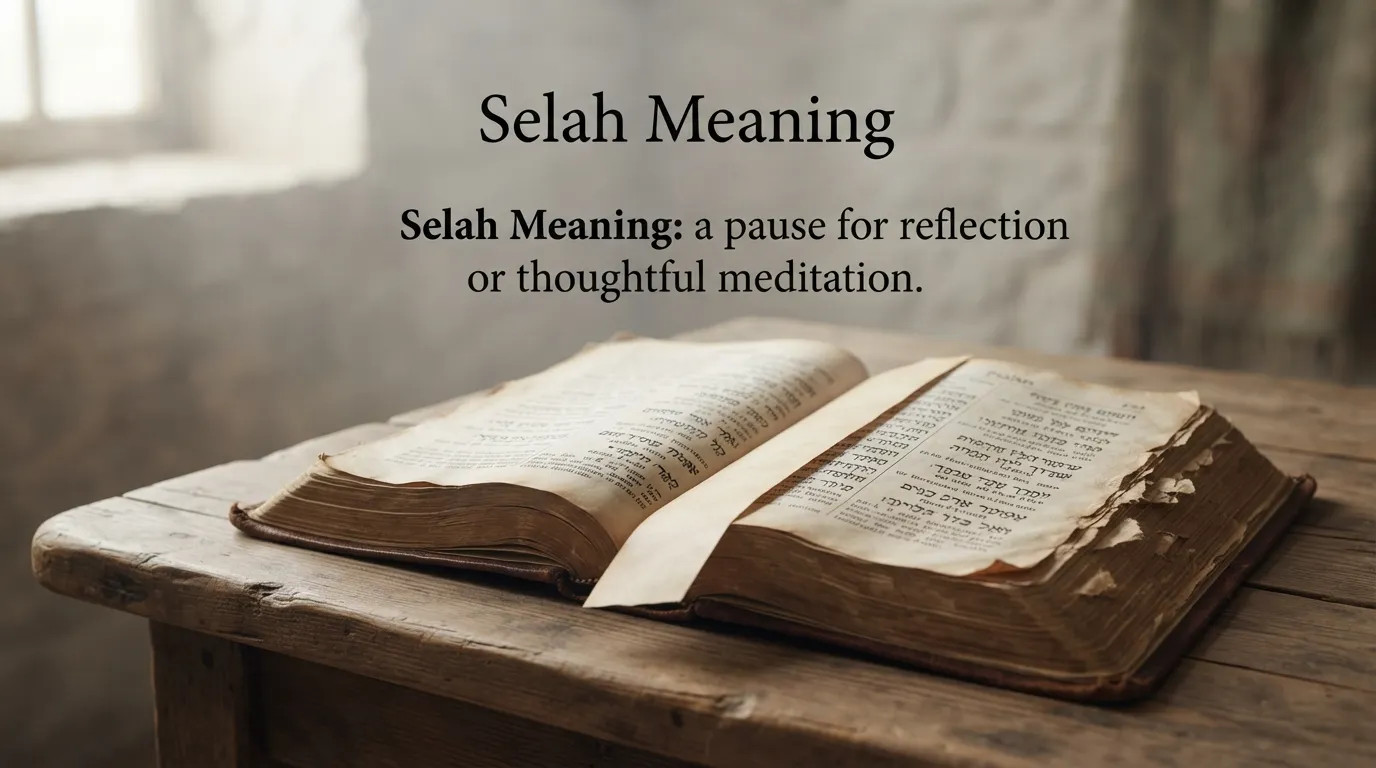
Have you seen the word Selah while reading the Bible? You may have wondered what this short word means. Selah is found many times in the Book of Psalms.
It also appears in Habakkuk. Its exact old meaning is not fully known. Still, many Bible scholars link it to a pause, a musical break, or a moment to reflect.
The word often comes after a strong thought about God, fear, faith, help, or praise. It may tell the reader to stop and take in those words.
Today, many people use Selah as a simple reminder to slow down and think. So, while we cannot give one sure meaning, Selah points us toward a quiet break with a deeper purpose.
What Does Selah Mean?
Selah is a Bible word linked with a pause, music, or reflection.
The exact meaning is not certain. This is because the old Hebrew text does not give us a clear note that explains the word.
Many experts think Selah had something to do with music. The Psalms were often songs. They were made for worship and were linked with music.
So, Selah may have told singers or musicians to pause. It may have marked a change in the music.
Another view is that Selah tells the reader to stop and think about the words.
This gives us a simple way to understand it:
Selah = pause and take in what you just read.
This is not a word-for-word translation. It is a simple way to grasp its use.
For example:
- A Psalm may speak about God’s power, then say Selah.
- A verse may talk about fear, then mark a pause.
- A song may praise God and then stop for a moment.
The word makes the reader notice the thought before moving on.
What Is the Meaning of Selah in the Bible?
In the Bible, Selah is mainly found in the Psalms.
It also appears in Habakkuk 3. That chapter is written like a prayer or song.
Selah often appears after a strong line or group of lines. The words may speak about God, danger, trust, praise, or hope.
This has led to several views about its use.
One view says it was a music sign. It may have told the person playing music to stop or change the sound.
Another view says it was a sign to lift up the voice or music.
A third view connects it with thought and reflection.
We cannot say that one view is proven beyond doubt.
That is why it is better to use careful words when explaining Selah.
The word has a clear place in the Bible. Its exact old use is less clear.
This small detail is important. It keeps the meaning honest and avoids making a guess sound like a fact.
Where Does Selah Appear in the Bible?
Selah appears most often in the Book of Psalms.
It is seen in many Psalms. You may notice it after a strong statement or at the end of a short thought.
It also appears in Habakkuk 3.
The Psalms were not just normal text. Many were songs or poems. They were used in worship.
This helps explain why Selah may have been linked to music.
Think of a song. A singer says something important. Then the music stops for a short time.
That break can make the words stand out.
Selah may have worked in a similar way.
For example:
- A Psalm may describe God as a safe place.
- Another may speak about God’s great power.
- Another may move from fear to trust.
A pause after such words could give the listener time to take them in.
Many Bible versions keep the word Selah instead of translating it.
This is mainly because its exact meaning is still not fully clear.
What Does Selah Mean in Simple English?
In simple English, you can think of Selah as:
“Pause and think about this.”
That short idea helps explain why the word feels meaningful to many readers.
But it is important to know that this is an easy explanation, not a proven word-for-word meaning.
Selah may have been used as a music sign. It may also have helped mark an important point in a song.
For a modern reader, the idea of a pause can still be useful.
Imagine reading a verse about hope.
You finish the line and stop.
You think about what it says.
That small break can help the message stay with you.
Here are three simple examples:
- “God is my help. Selah.” Pause and think about that hope.
- “The Lord is strong and good. Selah.” Take a moment to consider it.
- “I will trust God in fear. Selah.” Stop and reflect on those words.
Again, these examples show a modern way to understand the idea. They are not direct translations of the word.
Is Selah a Hebrew Word?
Yes, Selah comes from the Hebrew Bible.
The word is written in Hebrew as סֶלָה.
Its exact root and old use are still debated. This is one reason it can be hard to give one simple translation.
The Psalms give us an important clue.
Many Psalms were made for singing and worship. This makes a musical use of Selah possible.
Still, we should not claim more than the evidence shows.
We know that Selah is part of the Hebrew text. We also know that it appears in places where the words can carry strong weight.
This is why many people connect it with a pause.
The word also has a rich life today. People use Selah in writing, art, music, and personal faith.
Its modern use often points to quiet time and thought.
That meaning comes from how people understand the word today. It should not be confused with a certain ancient translation.
What Does Selah Mean in the Psalms?
In the Psalms, Selah often appears near words that feel important.
The Psalms talk about many parts of life. They include joy, fear, pain, trust, praise, and hope.
A pause can give such words more time to sink in.
For example, a Psalm may talk about danger. Then it may turn toward trust in God.
A Selah after that thought may mark a natural break.
It can feel like the song is saying:
Stop here. Let these words stay with you.
This is one reason Selah has become so well known among Bible readers.
It is not just the word itself that matters. Its place in the text matters too.
The surrounding words help us understand why the word may be there.
For example:
- A passage about God’s care may lead to reflection.
- A passage about fear may lead to a quiet pause.
- A passage about praise may invite deeper thought.
The word adds a sense of space to the song.
What Does Selah Mean Spiritually?
Today, many people use Selah to mean a quiet time to pause and reflect.
This idea is common in Christian writing and worship.
Someone may use the word after a Bible verse. They may mean that the reader should stop and think about the message.
A person may also call a quiet time a “Selah moment.”
For example, someone might take a few minutes to:
- Think about a Bible verse.
- Pray about a hard choice.
- Be thankful for something good.
These are modern uses of the word.
The Bible does not give a direct sentence saying that Selah means “stop and pray.”
So, it is best to call this a modern spiritual use.
Still, the idea can be meaningful.
A short pause can help people focus. It can also help an important thought stay in the mind.
That is why Selah has become more than an old Bible term for many people.
What Does Selah Mean in Modern Use?
Today, Selah is often used as a word for rest, thought, and quiet.
You may see it in:
- Books
- Songs
- Artwork
- Jewelry
- Social media posts
- Personal faith messages
A person may write, “Take a Selah moment.”
They may simply mean:
Slow down. Stop. Think.
Modern use can be wider than the word’s old use.
For example, a person may use Selah after talking about a life lesson. They may want the reader to think about it.
Another person may use it as a reminder to take a break during a busy day.
These uses are not proof of the ancient meaning.
They show how people have applied the word in a new setting.
This difference matters when writing about Bible words. A modern meaning and an old meaning are not always the same.
How Do You Pronounce Selah?
Selah is often pronounced SEE-lah in English.
You may hear other pronunciations too.
The ancient Hebrew pronunciation is not known with complete certainty.
When reading a Psalm aloud, many people treat Selah like a short pause.
For example:
“God is our refuge and strength. Selah.”
You can pause after the word.
This can help you feel the break in the passage.
The exact pronunciation is less important than knowing that Selah is a special word in biblical poetry.
If you are reading the Psalms for study, you can also check the notes in your Bible. Some Bible versions give extra information about the word.
Selah vs. Amen
Selah and Amen do not mean the same thing.
They are both common Bible words, but they have different uses.
Amen is often used to show agreement or strong belief. It can also mean “so be it” in some settings.
Selah is linked with biblical songs and poetry. Its exact use is not certain.
Here is a simple comparison:
| Word | Simple idea | Common setting |
| Selah | Pause, music, or reflection | Psalms and songs |
| Amen | Agreement or affirmation | Prayers and statements |
For example, a person may say “Amen” after a prayer.
Selah is different. It appears inside certain Bible passages.
So, while both words have religious meaning, they should not be used as if they were the same word.
Common Misunderstandings About Selah
There are a few common mistakes about Selah.
The first is saying that Selah definitely means “pause and think.”
That is a useful explanation, but the exact old meaning is not certain.
The second is saying that Selah simply means peace.
Many people connect the word with peace today. But peace is not a proven direct translation.
Another mistake is saying that Selah always had one exact music instruction.
We do not have enough evidence to make that claim with full confidence.
It is also not correct to say that Selah is one of God’s names.
It is a term found in biblical poetry.
A clear way to remember it is:
Old use: Not fully known.
Bible use: A marker found mainly in songs and Psalms.
Modern use: Often linked with pause and reflection.
This view keeps the explanation simple and accurate.
Why Is Selah Still Meaningful Today?
The idea of a pause still matters.
Modern life can feel fast. People move from one task to the next with little time to stop.
A word connected with a pause can offer a simple reminder.
You can read something meaningful and take a moment.
You can think about what you learned.
You can sit quietly before moving on.
For Bible readers, this can make the Psalms feel more personal.
For others, Selah can simply represent a short break for thought.
The important thing is not to claim that every modern use is the exact ancient meaning.
Instead, see Selah as a word with a long history and a useful modern idea.
Sometimes, stopping for a moment helps us understand a message better.
FAQs
Spiritual meaning of Selah
Selah spiritually invites a pause to reflect, meditate, and lift up praise or exalt God for the truth just shared.
Selah meaning Arabic
Selah has no direct Arabic meaning as a biblical term, though the similar name Saleh/Salih means “righteous” or “pious.”
Selah meaning in Hebrew
In Hebrew, Selah (סֶלָה) is of uncertain origin but is commonly linked to roots meaning “to lift up,” “exalt,” or “pause.”
Selah meaning in Bible
In the Bible, Selah is a term found mainly in the Psalms that most scholars view as a musical or liturgical marker meaning “pause and reflect.”
Selah meaning in Greek
The ancient Greek Septuagint translates Selah as “diapsalma,” which means a musical interlude or pause within the psalm.
Selah meaning pronunciation
Selah is typically pronounced “SEE-luh” or “SAY-lah.”
Selah meaning in Psalms
In the Psalms, Selah appears 71 times and signals a pause for contemplation, musical interlude, or lifting up praise.
Selah meaning in spanish
In Spanish, Selah is usually left untranslated or rendered as “pausa,” meaning a pause for reflection.
Conclusion
Selah is a Hebrew Bible term with an uncertain exact meaning. It appears mainly in the Psalms and may have been used as a music or pause marker. Many people now understand it as a reminder to stop and reflect.
The safest meaning is not a single fixed English word. Instead, Selah is best understood through its place in biblical songs and poems.
Its modern message is simple: slow down, pause, and take in the words.
If you’re exploring Bible words, [learn more about biblical meanings] to see how language and context can shape the way we understand Scripture.
Discover More Post
- Jezebel Meaning: The Surprising Story Behind the Word
- What Does TLC Mean? TLC Meaning in Text, Chat & More
- What Does Gyat Mean? Full Gyat Meaning in Simple Words
- IG Meaning: The Complete Guide to Its Meaning in Chat

Hello, I’m Mark Nichol. I’ve always been passionate about English words and how they are used in everyday communication. At Defineexa.com, I share simple guides on word meanings, acronyms, texting abbreviations, and modern slang. I believe learning English should be easy, practical, and enjoyable, so every article is written with clarity and accuracy in mind.