You just got a text that said I’m totally smitten or saw someone caption a photo smitten with this view, and now you’re stuck wondering what it actually means.
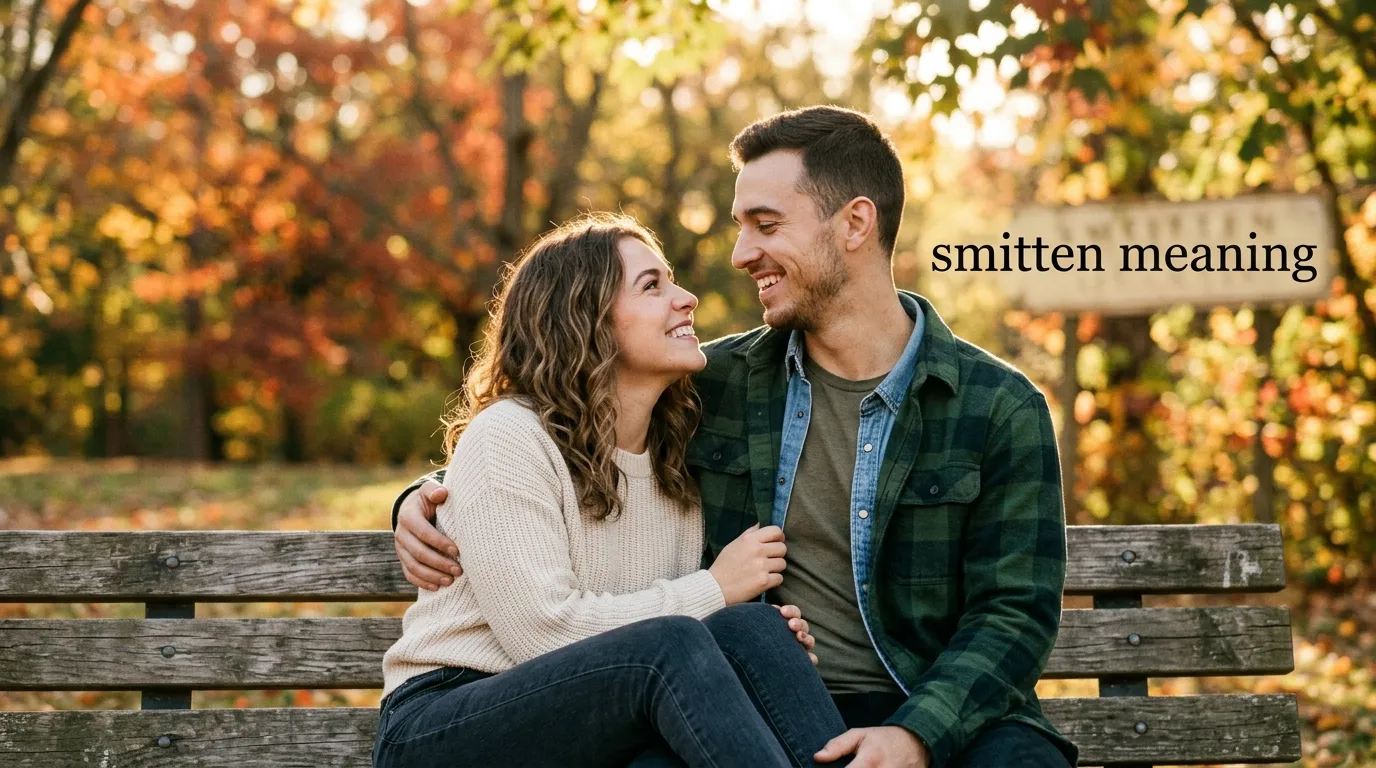
Smitten most often means deeply attracted to, infatuated with, or completely taken by someone or something. It’s the feeling of being hit hard by liking or loving a person, place, or even an idea.
This article breaks down the main meaning, where people use it, clear examples, common mix-ups, related words, and answers to the questions people actually ask.
Quick Answer
Smitten is an adjective that means you are strongly attracted to or in love with someone (or something). People usually say smitten with or smitten by.
The word also works as the past form of smite, which means struck or affected sometimes by an emotion or illness. In everyday talk, the romantic or captivated meaning is by far the most common.
What Smitten Actually Means
The dominant meaning today is emotional: you feel a strong pull toward a person. You might feel butterflies, think about them often, or light up when they appear. It’s stronger than a mild like but can still be lighter than deep, long-term love. Many people use it for the early, intense stage of attraction.
You can also be smitten with non-people things. Someone might say they are smitten with a new city, a song, a style of coffee, or even a pet. The idea stays the same: something has struck you in a positive, powerful way.
A secondary, older meaning still appears in books and formal writing. Because smitten comes from the verb smite (to hit or strike), it can mean suddenly affected by something harshlike being smitten with guilt, fear, or an illness. This use is less common in casual conversation but still correct.
Both meanings share the core image of being struck. In the romantic sense, it is as if Cupid’s arrow or a sudden wave of feeling has hit you.
Where It’s Used
People use smitten across everyday speech, texting, social media, books, and movies. The tone is usually warm and a little playful.
In texting and messaging apps, someone might reply to a cute photo or story with I’m smitten or You’re making me smitten. It feels more expressive than simply saying I like you.
On Instagram, TikTok, and similar platforms, captions often read smitten with this place, smitten by her smile, or still smitten after all these years. It works well with photos of partners, travel spots, food, or even new outfits.
In conversation and storytelling, friends might tease each other: Look at you completely smitten. Writers and movie dialogue use it to show quick, strong attraction without long explanations.
In older literature or more formal writing, the struck by hardship sense still appears. You might read that a character was smitten with fever or remorse. Most modern readers meet the word first in the love or attraction sense.
The word travels easily between platforms because it is already standard English, not a brand-new internet invention. That makes it feel natural whether you are texting a crush or posting a travel photo.
Examples of Smitten in Real Use
Here are realistic ways the word shows up:
- Text exchange: Friend: How was the date? You: Honestly? I’m smitten. Can’t stop thinking about her.
- Caption: First time seeing the ocean at sunrise. Completely smitten with this view.
- Conversation: He’s been smitten with that old motorcycle for years. Finally bought it last weekend.
- Storytelling: From the moment they met at the coffee shop, she was smitten.
- Older or more serious use: He was smitten with a sudden sense of regret after the argument.
Notice the prepositions. Most people say smitten with or smitten by. Both are correct. Smitten on is less common and can sound off to many ears.
Common Mistakes and How to Avoid Them
People sometimes treat smitten as only a cute, light word. While it often feels playful, it can also describe serious feelings. Using it for a mild preference (I’m smitten with this sandwich) is fine and common, but the strongest version still points to real emotional impact.
Another mix-up is thinking the word always means permanent love. Being smitten can be the beginning of something lasting, or it can fade. It describes the intensity of the feeling in the moment more than a guaranteed future.
Spelling is usually straightforward, but some people confuse it with similar-looking words or try to force it into every romantic sentence. Overusing any strong word weakens it. Save smitten for times when the attraction actually feels striking.
Finally, the literal struck meaning can surprise readers if the context is modern and casual. If you mean illness or disaster, make the rest of the sentence clear so no one assumes romance.
Related and Confused Terms
Smitten sits near several other words that describe attraction. Here is a simple comparison:
| Term | How it feels | Typical length or intensity | Example use |
| Crush | Strong interest, often one-sided or secret | Usually short-term | I have a crush on my coworker. |
| Infatuated | Intense, sometimes foolish attraction | Can be short and overwhelming | She was infatuated with the idea of him. |
| Smitten | Struck by strong liking or love | Can be sudden and deep | He’s completely smitten with her. |
| Enamored | Charmed or delighted by | Often positive and warm | I’m enamored with this city. |
| Besotted | Foolishly or excessively in love | Stronger, sometimes negative | He was besotted and ignored the red flags. |
Smitten often feels warmer and less critical than infatuated or besotted. It sits comfortably between a casual crush and deeper attachment.
Other nearby words include captivated, enchanted, and taken with. Each carries a slightly different shade, but smitten stands out because of the struck image baked into its history.
Origin of the Word
Smitten comes from the verb smite, which originally meant to hit, strike, or smear. The past form smitten has been around since Middle English.
By the 1600s, people began using the idea of being struck for strong feelings of love or attraction. The image is similar to being hit by lightning or by Cupid’s arrowsudden and powerful. That romantic sense has stayed popular ever since, while the older afflicted by hardship sense continues mainly in formal or literary writing.
Knowing the origin helps explain why the word feels both gentle and forceful at the same time.
How to Use Smitten Correctly
When you want to express strong attraction, try these patterns:
- I’m smitten with [person or thing].
- She’s completely smitten by him.
- We were both smitten from the first conversation.
It works well in both light and more serious tones. You can pair it with intensifiers like totally, completely, or hopelessly when the feeling is strong. In writing, it often appears after linking verbs: is, was, am, seems, looks.
If you are answering someone who used the word about you, a simple That’s sweetI’m a little smitten too keeps the conversation open and honest.
FAQs
Q: Smitten synonym
A: Common synonyms for smitten include infatuated, enamored, captivated, and lovestruck.
Q: Smitten meaning in farsi
A: In Farsi, smitten can mean عاشق، شیفته، یا دلباخته depending on the context.
Q: Smitten meaning slang
A: In slang, smitten usually describes someone who is strongly attracted to or deeply interested in someone.
Q: Smitten meaning in french
A: In French, smitten can be translated as épris, amoureux, or séduit, depending on the context.
Q: Smitten meaning in Bible
A: In the Bible, smitten can mean struck, afflicted, or deeply affected, depending on the passage.
Q: Smitten meaning baby
A: Smitten can describe a person who is very fond of or charmed by a baby.
Q: Smitten meaning in chinese
A: In Chinese, smitten can mean 着迷的、倾心的, or 深深迷恋的.
Q: Smitten meaning past tense
A: Smitten is the past participle of “smite,” while the simple past form is usually smote.
Conclusion
Smitten meaning centers on being deeply affected by attraction or affection most often the warm, sudden feeling of liking or loving someone or something. It comes from the older idea of being struck, which is why the emotion feels powerful.
You see it in a text, a caption, or a story, the word usually signals strong positive interest. Use it when the feeling truly lands hard, keep the prepositions natural (with or by), and you will sound clear and genuine. Now you can read or reply with confidence the next time smitten shows up.

Hi, I’m Benjamin Dreyer. I enjoy exploring the English language and making difficult words simple to understand. At Defineexa.com, I write about word meanings, text abbreviations, acronyms, and internet slang. My goal is to give readers clear, accurate, and easy-to-read explanations that help them learn something new and use English with greater confidence every day.