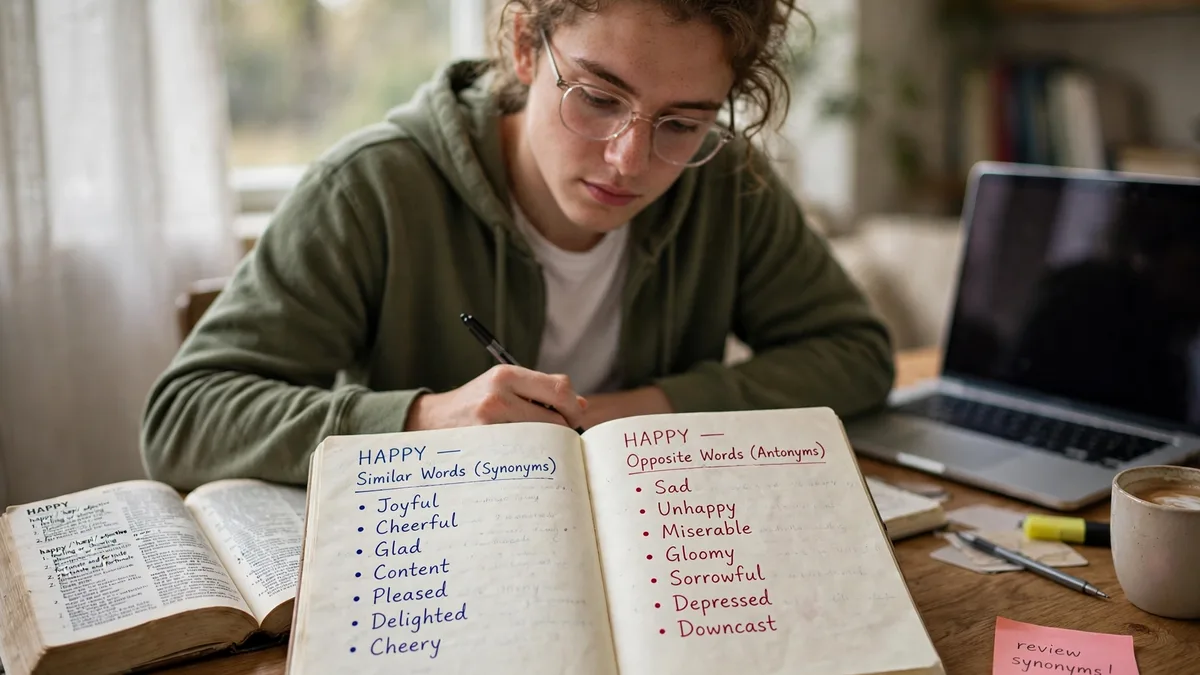
Two of the first word skills every English learner meets are synonyms and antonyms. They sound similar, they are often taught in the same lesson, and they both help you talk about word meanings. Yet they do opposite jobs. A synonym moves a word sideways, to another word with nearly the same meaning. An antonym turns it around completely, to a word with the opposite meaning.
Confusing the two is easy at the start, but the difference is actually simple once you see enough examples side by side. This guide explains what synonyms are, what antonyms are, how they differ, and when to reach for each one, so you can choose the right word with confidence instead of guessing.
What Are Synonyms?
Synonyms are words that have the same or nearly the same meaning. ‘Happy’ and ‘glad’ are synonyms. So are ‘begin’ and ‘start’, ‘fast’ and ‘quick’, and ‘big’ and ‘large’. When you swap one synonym for another, the sentence keeps its meaning, even if the feeling or the level of formality changes slightly. That is why synonyms are the writer’s main tool for avoiding repetition.
Learning synonyms in groups is one of the fastest ways to expand your vocabulary, because each new word attaches itself to a word you already know. Instead of memorising long lists with no connection, you build small families of related words: ‘easy, simple, effortless’, or ‘rich, wealthy, well-off’. It is much easier to grow your word power with simple English lessons like these, one word family at a time, than to attack a dictionary from the first page.
Synonyms Are Similar, Not Always Identical
One warning before you start swapping words freely: synonyms are rarely perfect copies of each other. ‘Slim’, ‘thin’ and ‘skinny’ all describe someone who is not fat, but ‘skinny’ can sound rude while ‘slim’ sounds like a compliment. ‘Buy’ and ‘purchase’ mean the same action, yet ‘purchase’ belongs in formal writing. A good learner checks the tone and the situation before choosing which synonym to use.
What Are Antonyms?
Antonyms are words with opposite meanings. ‘Hot’ and ‘cold’ are antonyms. So are ‘begin’ and ‘finish’, ‘brave’ and ‘cowardly’, and ‘easy’ and ‘difficult’. Where a synonym keeps you in the same area of meaning, an antonym takes you to the far end of the scale. If a synonym is a step sideways, an antonym is a turn of 180 degrees.
Antonyms are surprisingly useful for learning, because opposites define each other. It is easier to remember what ‘generous’ means when you can contrast it with ‘selfish’, and ‘ancient’ sticks in your memory faster when you place it against ‘modern’. Many learners find that they can understand English vocabulary with easy examples when each new word arrives with its opposite attached, like two ends of the same string.
The Three Main Types of Antonyms
Not all opposites work in the same way. Gradable antonyms, such as ‘hot’ and ‘cold’, sit at the ends of a scale with room in the middle: warm, cool, lukewarm. Complementary antonyms, such as ‘alive’ and ‘dead’ or ‘true’ and ‘false’, leave no middle ground; something must be one or the other. Relational antonyms, such as ‘teacher’ and ‘student’ or ‘buy’ and ‘sell’, describe two sides of the same relationship, and one cannot exist without the other.
The Key Differences Between Synonyms and Antonyms
With both definitions in place, the differences become easy to see. They come down to direction, effect and purpose:
Direction of Meaning
A synonym keeps the direction of the original word: ‘joyful’ points the same way as ‘happy’. An antonym reverses the direction: ‘miserable’ points exactly against it. If you replace a word with its synonym, a reader who never saw the original would still receive the same message. Replace it with an antonym, and the message flips into its opposite.
Effect on the Sentence
Watch what happens to one sentence. ‘The road was dangerous’ becomes ‘The road was risky’ with a synonym: the warning survives. With an antonym it becomes ‘The road was safe’: the warning disappears and the meaning turns into its opposite. This is why choosing the wrong one is not a small style mistake; it changes what you are actually saying.
Purpose in Writing and Speaking
Writers use synonyms to add variety, precision and style without repeating the same word ten times. They use antonyms to create contrast, to argue, and to make descriptions sharper: ‘It was not a small problem but a huge one’ hits harder because of the opposition. In short, synonyms help you say the same thing better, while antonyms help you show a difference clearly.
When to Use Each One
Both tools earn their place in your English. The trick is knowing which job you are doing:
- Reach for a synonym when you are repeating yourself. If ‘important’ appears three times in one paragraph, ‘key’ or ‘essential’ keeps the meaning and saves the style.
- Reach for a synonym when you need a more precise or more formal word: ‘ask for’ becomes ‘request’ in a business email.
- Reach for an antonym when you want contrast: ‘The hotel was not cheap but expensive’ makes your opinion unmistakable.
- Reach for an antonym when you explain a new word. Defining ‘ancient’ as ‘the opposite of modern’ is often faster than a long description.
A practical habit is to learn words in threes: the word itself, one synonym and one antonym. ‘Brave, bold, cowardly’ is a small set, but it gives you three tools instead of one, and the contrasts between them make all three easier to remember.
Everyday Words with Their Synonyms and Antonyms
The table below puts everything together. Read each row across: the word, a synonym that moves sideways, an antonym that turns the meaning around, and a sentence that shows the word in real use:
| Word | Synonym | Antonym | Example Sentence |
| Happy | Glad | Sad | The children felt happy and glad as they played in the garden. |
| Big | Large | Small | They moved into a big house after years in a small flat. |
| Fast | Quick | Slow | The fast train arrived early, while the slow bus was late again. |
| Brave | Bold | Cowardly | The brave firefighter stayed calm and bold during the rescue. |
| Easy | Simple | Difficult | The instructions were easy to follow because each step was simple. |
| Hot | Boiling | Cold | On a hot afternoon, nothing beats a cold drink with ice. |
| Begin | Start | Finish | We begin the lesson at nine and finish at ten. |
| Rich | Wealthy | Poor | The wealthy merchant helped poor families in his village. |
A Quick Practice Exercise
Try this short exercise before you move on. For each word, say one synonym and one antonym out loud, then use the word in a sentence of your own:
- Strong: synonym ‘powerful’, antonym ‘weak’. Now try ‘ancient’, ‘polite’ and ‘noisy’ by yourself.
- Check your answers in a dictionary afterwards. If your synonym changes the meaning even a little, note the difference beside it.
- Write one sentence with the synonym and one with the antonym. Feeling the contrast in your own sentences fixes the pair in your memory far better than reading a list.
Frequently Asked Questions
Can a word have more than one synonym and antonym?
Yes, most common words have several of each. ‘Happy’ has the synonyms ‘glad’, ‘pleased’ and ‘joyful’, and the antonyms ‘sad’, ‘unhappy’ and ‘miserable’. The exact list depends on the sense of the word you mean, because a word with several meanings can have different partners for each meaning.
Are synonyms always interchangeable?
No. They share a core meaning, but they differ in tone, formality and the words they naturally sit beside. ‘Begin’ and ‘commence’ are synonyms, yet ‘commence’ sounds too formal for everyday speech. Always check how a synonym behaves in a real sentence before you adopt it.
Do all words have antonyms?
No. Concrete nouns such as ‘table’, ‘apple’ or ‘Wednesday’ have no true opposite. Antonyms mostly belong to adjectives, verbs and adverbs that describe qualities, actions or directions that can be reversed, such as ‘high’ and ‘low’ or ‘arrive’ and ‘depart’.
Which should a beginner learn first, synonyms or antonyms?
Learn them together, in small sets. A synonym widens your choice of words, and an antonym sharpens your understanding of where a word’s meaning stops. Studied as pairs and triples, each one makes the other easier to remember.
Conclusion
Synonyms and antonyms are two sides of the same skill: understanding exactly what a word means. A synonym moves you sideways to a word with a similar meaning, useful for variety and precision. An antonym turns you around to the opposite meaning, useful for contrast and clear definitions. Learn common words with one of each beside them, test them in your own sentences, and the difference will soon feel automatic every time you read, write or speak.