
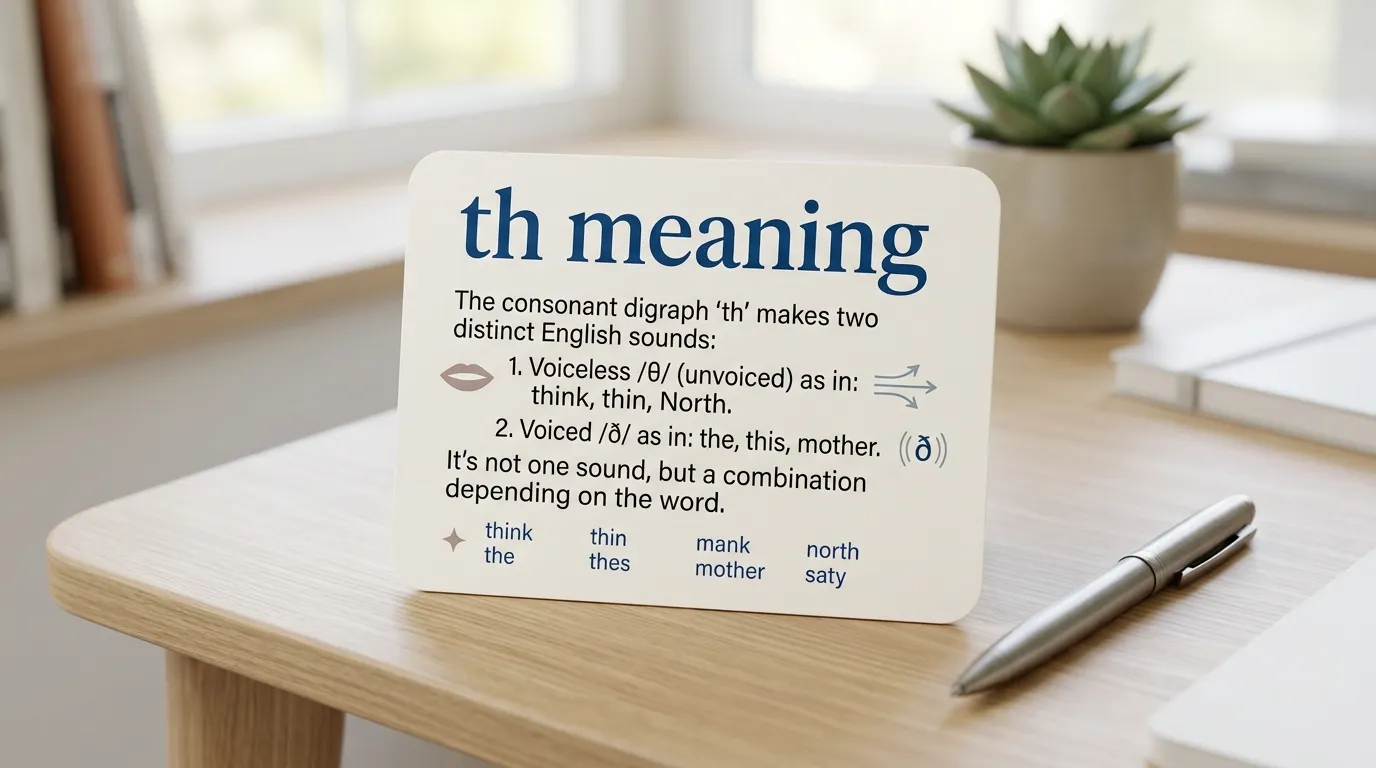
You typed Th into a search bar expecting a quick answer, and instead you got a mess of contradictory baby-name sites. Here’s the truth nobody’s giving you straight: Th isn’t a name at all. It’s a shortcut that’s been hiding two much bigger stories for centuries.
Sometimes it’s shorthand for Thomas, the Aramaic name meaning twin, carried by an apostle who doubted first and believed second.
Other times it’s the front door to Greek names built on theos, meaning god Theodore, Theo, Theodora.
Once you know which one you’re looking at, everything clicks into place.
Quick Answer
Th isn’t a standalone name it’s an abbreviation. It almost always stands in for Thomas (Aramaic, meaning twin) or acts as the front half of Greek Theo- names like Theodore, Theo, and Theodora, which come from theos, meaning god. You’ll see it on old records, monograms, and nickname tags.
So Wait, Is Th Actually a Name?
Not really. And honestly, you deserve a straight answer on that before anything else.
A few baby-name sites list Th as if it’s its own name with its own meaning. It isn’t. There’s no birth record, no ancient text, no language dictionary that treats Th as a first name on its own. What those sites are picking up on is real, though: Th shows up constantly as a short form, an initial, or the opening sound of a huge family of names.
Here’s the useful part. Once you know what Th is actually standing in for, the whole thing makes a lot more sense. Most of the time, it’s doing one of two jobs.
Job One: Th. as Short for Thomas
Old church registries, ship manifests, and family Bibles loved abbreviations. Scribes were often working fast, sometimes by candlelight, and long names got chopped down. Th. was a common stand-in for Thomas, one of the most enduring names in the English-speaking world.
Thomas comes from Aramaic, not Greek or Latin like a lot of people guess. The original word is ta’oma (תאומא), and it means twin. The name got its huge boost from Saint Thomas the Apostle, yes, the Doubting Thomas of the Bible, the one who wouldn’t believe the resurrection until he touched the wounds himself. That story is exactly why doubting Thomas became an everyday phrase, centuries after the fact.
Thomas travelled well. It became Tomás in Spanish and Portuguese, Tommaso in Italian, Tomasz in Polish, and Foma in Russian. Nicknames spun off in every direction too: Tom, Tommy, Thom, and in Ireland, the affectionate Tomaisín. If you’ve ever seen Th. scrawled next to a name on an old document, there’s a decent chance it’s shorthand for one of these.
Job Two: Th- as the Front of the Greek Theos Root
This is the other big source, and it’s arguably more interesting. In Greek, theos means god. Names built on that root use Th- as their opening sound, and there are a lot of them:
- Theodore / Theo gift of god
- Theodora / Dorothea the feminine flip of the same idea
- Theophilus friend of god
- Theophanes manifestation of god
Theo has quietly become one of the most popular short forms in the English-speaking world on its own, not just as a nickname. Parents like it because it’s warm, easy to say, and doesn’t feel dated the way some vintage names can.
A Worked Example: Reading an Old Family Record
Say you’re digging through a genealogy site and you find a christening record from the 1800s that reads Th. Whitfield, b. 1847. How do you know which Th you’re looking at?
Context does most of the work. Check the region and the era first. In 19th-century England, Th. was overwhelmingly Thomas; it was one of the top ten boys’ names of the century, so the odds favor it heavily. If the record is Greek Orthodox, or the surname has Greek roots, Theodoros becomes far more likely. And if there’s a middle name or a mother’s maiden name attached, cross-reference it; families often repeated naming patterns generation to generation, so a grandfather named Thomas is a strong clue for a grandson tagged Th. too.
[VERIFY: exact 19th-century England Thomas ranking by decade cite a specific genealogical database if this claim needs a hard number.]
Pronunciation and Everyday Use
There’s no single pronunciation for Th as a unit, since it isn’t a spoken name by itself. But the names it represents are simple:
- Thomas TOM-us
- Theo THEE-oh
- Theodore THEE-oh-dor
- Theodora thee-oh-DOR-uh
The th sound itself, the voiceless or voiced fricative you make with your tongue between your teeth, is one of the trickier sounds in English for non-native speakers. That’s a separate linguistics point, but it does explain why Th names sometimes get softened to a T sound in other languages, like Tomás or Tomasz.
Popularity Right Now
Real numbers beat vague claims, so here’s what current data actually shows. According to Social Security Administration figures for 2025, <cite index=12-1>the top four boys’ names in the US held steady at Liam, Noah, Oliver, and Theodore</cite>. Theodore sitting at number four means the Theo- root is having a real moment, not just a nostalgic one.
Thomas itself has settled into a steadier, more classic spot. As of mid-2026 tracking, <cite index=11-1>Thomas sits around rank 34 in the US, with stronger standing in Canada, Australia, and Ireland</cite>. It’s not the trendiest pick on the list, but it’s nowhere near forgotten either; it’s the kind of name that just keeps showing up, decade after decade, without needing a marketing push.
Quick Facts
| Category | Details |
| Meaning | Not a standalone name; Th abbreviates Thomas (twin, Aramaic) or the Greek root Theos (god) |
| Origin/Language | Aramaic (Thomas) or Greek (Theo- names) |
| Gender | Thomas: boy. Theo-root names: both (Theodore/Theo for boys, Theodora/Dorothea for girls) |
| Pronunciation | Varies by full name TOM-us (Thomas), THEE-oh (Theo) |
| Popularity (2025–26, US) | Theodore: top 4 boys’ names (SSA, 2025). Thomas: roughly #34 (mid-2026 tracking) |
| Religious/Cultural Significance | Thomas: Saint Thomas the Apostle, Christian tradition. Theo- names: rooted in ancient Greek reverence for theos (god) |
Related and Similar Names
| Name | Meaning | Origin | Note |
| Thomas | Twin | Aramaic | The name Th. most often abbreviates; hugely common across centuries |
| Theo | Short for Theodore, gift of god | Greek | Now popular as a standalone first name, not just a nickname |
| Theodore | Gift of god | Greek | Currently a top-5 US boys’ name (SSA, 2025) |
| Theodora | Gift of god (feminine) | Greek | Regal, historically tied to Byzantine empresses |
| Dorothea | Gift of god (root flipped: dora + theo) | Greek | Same meaning as Theodora, elements reversed |
| Tomás | Twin | Spanish/Portuguese (from Thomas) | Common across Spanish- and Portuguese-speaking countries |
| Thibaut | Brave people | French (from Theobald) | Different root entirely Germanic, not Greek theos |
FAQs
Q: Th meaning in chat
A: Th in chat often means that, the, or thanks, depending on the context.
Q: TH meaning in social media
A: TH on social media can have different meanings, but its meaning depends on how it is used.
Q: TH meaning In love
A: TH in love-related messages can have a personal meaning, so the surrounding conversation matters.
Q: Th meaning medical
A: In medical terms, TH can stand for several things, including thyroid hormone or other medical terms.
Q: Th meaning in Old English
A: In Old English, th represents sounds that later developed into the modern English letters and sounds th.
Q: Th meaning in result
A: TH in a result can be an abbreviation whose meaning depends on the type and context of the result.
Q: Th meaning in numbers
A: TH after a number is commonly used as an ordinal ending, such as fourth or sixth.
Q: Th meaning tone tag
A: /th is not a widely standardized tone tag, so its meaning can vary by online community.
Conclusion
The honest takeaway is simple: Th by itself doesn’t carry a meaning, but the names hiding behind it absolutely do.
You’re tracing an old family record, choosing between Thomas and Theodore for a baby, or just curious why so many names circle back to the idea of god, the real story is in the full names, not the abbreviation.
If you’re picking a name rather than researching one, start with Thomas or Theo and work outward from there. Both carry centuries of use and neither one is going anywhere soon.

Hello, I’m Mark Nichol. I’ve always been passionate about English words and how they are used in everyday communication. At Defineexa.com, I share simple guides on word meanings, acronyms, texting abbreviations, and modern slang. I believe learning English should be easy, practical, and enjoyable, so every article is written with clarity and accuracy in mind.