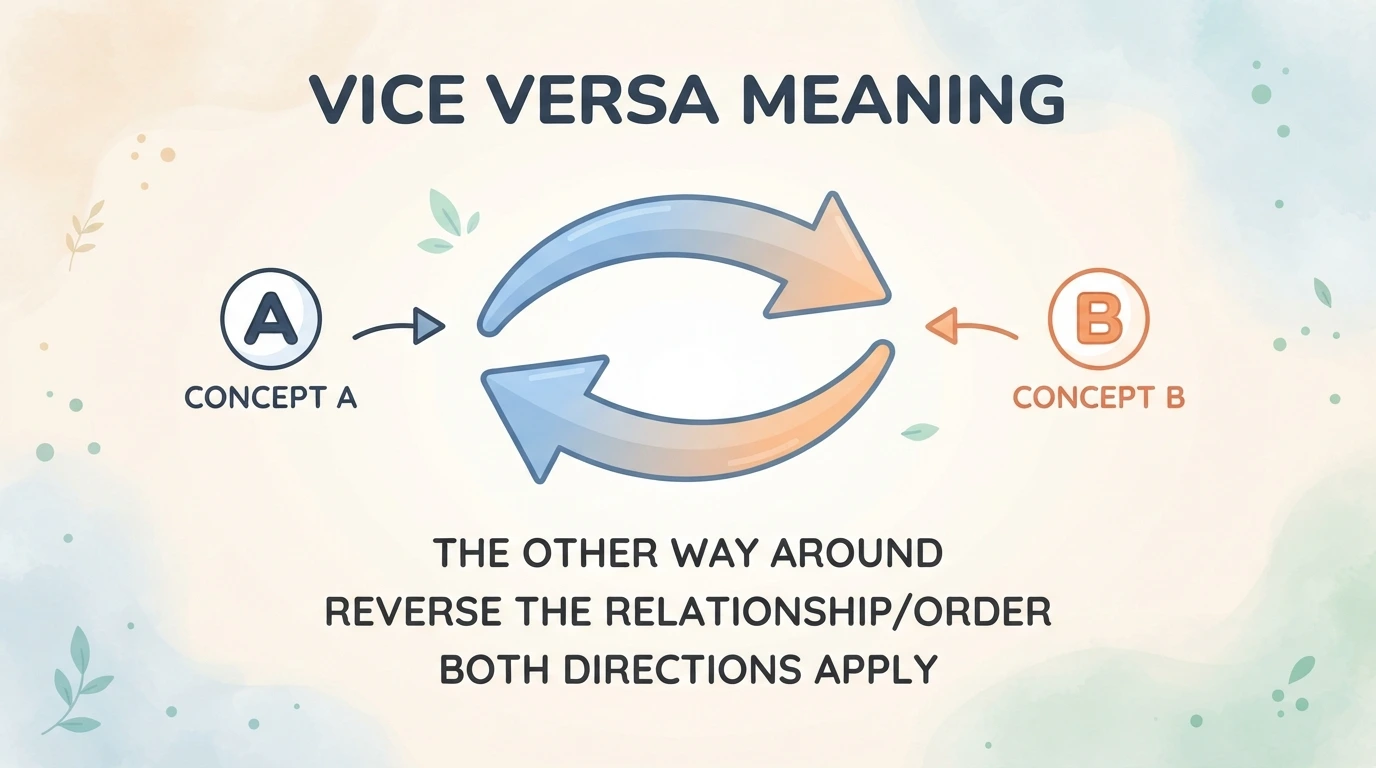
Quick Answer: Vice versa means the other way around when you say one thing, the reverse of it is also true. Example: I help my brother, and vice versa means he helps me too.
You have probably heard someone end a sentence with and vice versa and wondered what those two little words actually add.
The good news is that the idea is simple: once you understand it, you can use it in everyday speech, writing, emails, and even formal documents with full confidence.
In this guide, you will learn the exact meaning of vice versa in plain English, where the phrase comes from, how to pronounce and use it correctly, plenty of natural sentence examples, the mistakes people commonly make, and the best synonyms for every situation.
What Does Vice Versa Mean?
Vice versa is used when a statement works in both directions. You say the first direction, and vice versa quietly adds the second, reversed direction so you do not have to repeat the whole sentence.
Without vice versa, you would have to say this: Ahmed teaches Sara English, and Sara teaches Ahmed English. With it, the sentence becomes short and smooth: Ahmed teaches Sara English, and vice versa.
For example:
You can send money from the app to your bank account, and vice versa. (Money also moves from the bank account to the app.)
The teacher respects the students, and vice versa. (The students also respect the teacher.)
Vice Versa Meaning in Simple English
In simple words, vice versa means and the opposite is also true or and the same thing in reverse. Think of it as a two way street. If something travels from A to B, vice versa tells you it also travels from B to A.
For example:
Cats are afraid of dogs in this house, and vice versa. (Simple meaning: the dogs are also afraid of the cats.)
We work well together: I handle the writing, she handles the design, and vice versa when one of us is busy. (Simple meaning: we swap roles too.)
If a person has never seen the phrase before, the easiest explanation is this: vice versa is a shortcut that saves you from saying the same sentence twice, backwards.
Where Does Vice Versa Come From?
The phrase comes from Latin, the language of ancient Rome. Vice meant in place of or in turn, and versa meant turned or changed. Put together, the literal sense is the order being turned around.
English borrowed the phrase in the early 1600s, and it has been common ever since because English simply has no single word that does the same job as elegantly.
How to pronounce it: Say it as VYSS VERsuh. The first word rhymes with ice, and the stress falls on VER. You may also hear vysuh VERsuh, which is accepted, but vice versa is a mistake. There is no sound at the end of vice.
For example:
Correct: The two offices share files, and vice (VYSS) versa.
Wrong: The two offices share files, and visa versa.
How to Use Vice Versa in a Sentence
Vice versa almost always comes at the end of a sentence or clause, usually after and. It refers back to the statement you just made and flips it. Here is the pattern:
Statement + and vice versa = the reverse is also true
Follow these three rules and you will never use it wrongly:
1. There must be two sides that can genuinely swap (two people, two places, two things).
2. The reverse must actually be true, not just possible.
3. Keep it at the end of the sentence; it does not work in the middle or at the start.
For example:
Flights run daily from Dubai to Karachi and vice versa. (Karachi to Dubai is also true.)
Good managers listen to their teams, and vice versa. (Good teams also listen to their managers.)
10 Natural Examples of Vice Versa in Everyday English
1. I trust my business partner completely, and vice versa.
2. You can convert dollars to euros at this counter, and vice versa.
3. She calls me when she is in trouble, and vice versa.
4. The software works on Windows and Mac, and files move between them vice versa without any issue.
5. If the price of oil rises, transport costs rise, and vice versa.
6. He learns fast when I explain slowly, and vice versa when he teaches me.
7. The hotel provides a shuttle from the airport, and vice versa.
8. Parents learn patience from their children, and vice versa.
9. You cannot have rights without duties, and vice versa.
10. Their friendship survived because they supported each other, and vice versa in every hard year.
Notice that in every example, the second half is genuinely true in reverse. That is the whole secret of using this phrase well.
Vice Versa vs. Similar Words (Conversely, Likewise, and Others)
Several English phrases look close to vice versa but do different jobs. Using the wrong one is the most common reason sentences with these words sound off.
| Phrase | Real meaning | Direction | Example |
|||||
| Vice versa | The reverse is also true | Twoway swap | I cover his shifts, and vice versa. |
| Conversely | The opposite case is true (contrast) | Opposite, not a swap | Cities are crowded. Conversely, villages are quiet. |
| Likewise | In the same way / me too | Same direction | She enjoyed the trip, and I likewise had a great time. |
| The other way around | Casual form of vice versa | Twoway swap | He helps me, and the other way around too. |
| Mutually | Both sides do it to each other | Twoway action | The decision was mutually agreed. |
For example:
I admire her discipline, and vice versa. (She admires mine too, a twoway swap.)
I admire her discipline, and likewise she inspires me. (Same direction, no swap likewise fits better.)
When NOT to Use Vice Versa
Vice versa is only correct when the reverse is truly possible and true. Avoid it in these cases:
When only one direction exists. The sun rises in the east, and vice versa is wrong, because the sun never rises in the west.
When you have already said to each other. They help each other, and vice versa repeats the same idea twice. Pick one.
In very casual chat, where it can sound stiff. With close friends, the other way around or the same goes the other way often sounds warmer.
For example:
Wrong: He is taller than his brother, and vice versa. (Both cannot be taller.)
Right: He is taller than his brother. (No vice versa needed.)
Common Mistakes People Make with Vice Versa
Mistake 1: Writing or saying visa versa. The phrase has nothing to do with a visa. It is always vice versa.
Mistake 2: Using it when the reverse is false. The teacher gives homework, and vice versa is wrong unless students also give the teacher homework.
Mistake 3: Splitting it apart. Vice and versa must stay together; I like vice, and she likes versa is meaningless.
Mistake 4: Overusing it. English speakers use it once in a while for smoothness. Putting it in every paragraph makes writing sound mechanical.
For example:
Wrong: My phone syncs with my laptop vice, and my laptop syncs versa.
Right: My phone syncs with my laptop, and vice versa.
Synonyms and Alternatives for Vice Versa
The best alternative depends on how formal your writing is:
Formal writing: conversely (for contrast only), in reverse, reciprocally, the reverse applies.
Neutral everyday use: the other way around, in the opposite direction, back and forth.
Casual speech: same the other way, both ways, and back again.
For example:
Formal: Export rules apply to both countries, and the reverse applies to imports.
Casual: I pick him up from work on Mondays, and the other way around on Fridays.
Antonyms of Vice Versa
Vice versa has no true single antonym. It points to a two-way swap, so the opposite idea is a one-way thing, where the reverse is not true.
Example: I help him, and vice versa, he helps me. Compare that with: I help him, but he never helps me. The second one is one-way, not vice versa.
FAQs
Vice versa meaning in english
Vice versa means the other way around or with the order or relationship reversed.
Vice versa meaning example
If A loves B, and vice versa, it means B also loves A.
Vice versa meaning in medical
In medical contexts, vice versa means the reverse order or opposite situation of what was just described.
Vice versa meaning in relationship
In relationships, vice versa means the feelings, roles, or actions apply equally in the opposite direction.
Not vice versa meaning
Not vice versa means the reverse is not true or does not apply.
Vice versa meaning in law
In law, vice versa means the reverse of a stated legal relationship or condition also holds true.
Vice versa meaning for kids
Vice versa means the same thing but switched around the other way.
Vice versa meaning in economics
In economics, vice versa means the opposite or reverse of a stated economic relationship or effect.
Conclusion
Vice versa is a small phrase with a clear job: it tells the listener that the reverse of your statement is also true, so you do not have to say everything twice. Just remember the three checks two sides that can swap, a reverse that is genuinely true, and the phrase placed at the end of the sentence. Next time you write an email or explain a two-way relationship, try one natural and vice versa and hear how much smoother your English sounds.

Hi, I’m Benjamin Dreyer. I enjoy exploring the English language and making difficult words simple to understand. At Defineexa.com, I write about word meanings, text abbreviations, acronyms, and internet slang. My goal is to give readers clear, accurate, and easy-to-read explanations that help them learn something new and use English with greater confidence every day.