
Cohesive means sticking together and working as one united whole. When a team, a family, a paragraph, or even an idea is cohesive, every part fits with the others and nothing feels loose or random. The word comes from a Latin root that means to stick together, and that picture still fits perfectly today. In this guide, you will learn the meaning of cohesive in very simple words, see it in real life examples, and finally understand how cohesive is different from its close cousin, coherent.
Key Takeaways
- Cohesive means united, connected, and holding together as one.
- A cohesive team, group, or text has parts that fit and support each other.
- Cohesive is about unity. Coherent is about clear sense and logic.
- You say it koh-HEE-siv, with the stress in the middle.
- The word comes from Latin roots that mean to stick together.
What Does Cohesive Mean in Simple Words?
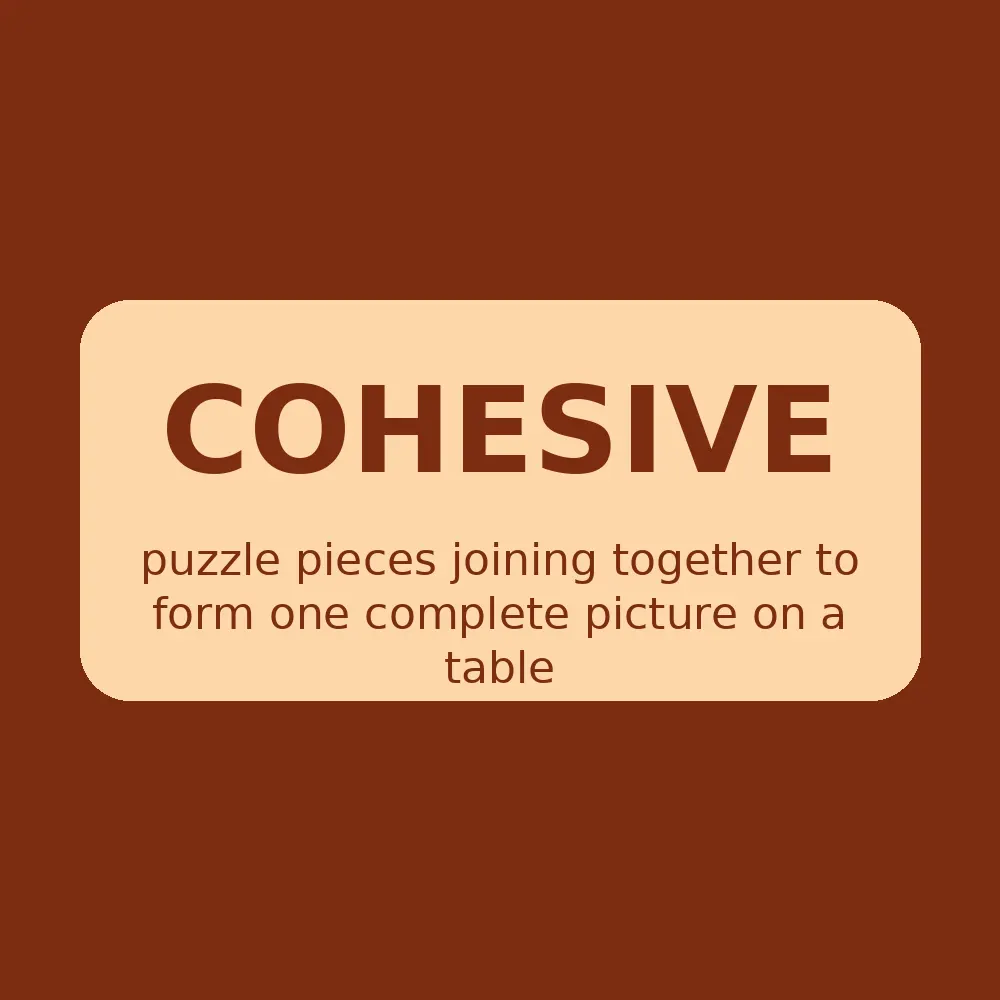
Let us start with the picture that makes this word click. Imagine a puzzle. When every piece locks into its place and the full picture appears, that puzzle is cohesive. Now imagine a handful of loose pieces from five different puzzles thrown on a table. Nothing connects. That pile is not cohesive.
That is all cohesive means. Something is cohesive when its parts hold together as one. The parts are not just near each other. They fit, they connect, and they work toward the same whole.
Dictionaries agree with this simple picture. Merriam-Webster says cohesive means exhibiting or producing cohesion, and cohesion is the act of sticking together tightly. When writers, coaches, and teachers praise something as cohesive, they mean it feels like one strong, united thing instead of scattered pieces.
You can use this word for people, for writing, for plans, and even for ideas. A cohesive family pulls together in hard times. A cohesive essay flows from point to point without jumps. A cohesive plan has steps that support one shared goal.
How Do You Say Cohesive?
Cohesive is pronounced koh-HEE-siv. It has three syllables: koh, HEE, siv. The middle syllable gets the strong beat, so the word sounds like it leans forward in the center.
The family of this word is easy to grow once you own the sound. The noun is cohesion, said koh-HEE-zhun, and it names the sticking together itself. The adverb is cohesively, which describes doing something in a united way. Learn one, and you have learned them all.
What Does a Cohesive Team Look Like?

The word cohesive shows up most often around teams, so let us watch one in action. A cohesive team is not just a group of talented people standing in the same room. Talent alone does not make cohesion. A cohesive team shares one goal, trusts each other, and moves like a single body.
Picture a small soccer team. The defenders know the midfield will cover them. The strikers trust that passes will come. Nobody plays for personal glory. When they lose, they lose together, and when they win, everyone feels the win. That is cohesion you can almost touch.
Now picture the opposite. Every player chases the ball alone. Nobody talks. Blame flies after every mistake. That team may have stars, but it is not cohesive, and it usually falls apart under pressure.
The same truth works in offices and families. A cohesive work team shares updates freely and covers for each other during busy weeks. A cohesive family makes decisions together and stands as one in public. In every case, the magic ingredient is the same: parts that choose to hold together.
Cohesive in Writing: What It Looks Like on the Page
Teachers and editors love the word cohesive too, because it names the glue inside good writing. A cohesive paragraph or essay is one where every sentence connects to the next, so the reader never feels lost or jolted.
Here is a paragraph that is not cohesive:
I like pizza. The moon is bright tonight. My shoes are red. Trains are fast.
Every sentence is true, but together they say nothing. The reader hops from topic to topic with no bridge. Now watch the same start grow cohesive:
I like pizza, especially on weekends with my friends. We order a large pepperoni and share it while we watch movies. Those slow Friday nights are the best part of my week.
Now each sentence holds hands with the one before it. Friends lead to sharing, sharing leads to movies, and movies lead to the feeling at the end. That smooth chain is cohesion on the page.
Writers build this glue with small tools. Linking words like first, then, also, and however guide the reader. Pronouns like she, they, and it point back to people already named. Repeating a key word or idea gently ties new sentences to old ones. None of these tools is fancy. Together, they make writing feel like one clear voice instead of noise.
If you enjoy word pairs like this, our guide on coherent meaning is the natural next stop.
Cohesive vs Coherent: What Is the Difference?
These two words travel together so often that many people swap them without knowing. They are close, but they do not mean the same thing. Here is the clean split:
| Word | Core Idea | Ask Yourself | Example |
| Cohesive | Parts stick together as one | Do the parts fit and unite? | A cohesive team wins together |
| Coherent | Ideas make clear sense | Can I follow the logic? | A coherent answer is easy to follow |
| Cohesion | The sticking together itself | How strong is the glue? | The group has real cohesion |
| Coherence | Clear, logical order | Does it all make sense? | The essay lacks coherence |
Here is a trick that locks it in. Cohesive is about unity, like glue. Coherent is about sense, like a clear road. A speech can be coherent, with every point in logical order, yet not cohesive, if the parts never join into one strong message. And a team chant can feel cohesive, full of unity, without saying anything coherent at all.
In school writing, teachers usually want both. Your essay should hang together as one piece, cohesive, and every step should make clear sense, coherent. When both show up, readers relax and trust you.
Cohesive Synonyms and Antonyms
A few friendly words live near cohesive, and knowing them makes your English richer.
Words with a similar meaning:
- United: joined together for one purpose.
- Connected: linked so parts touch and relate.
- Integrated: blended into a complete whole.
- Consistent: steady and not fighting itself.
- Unified: made into one.
Words with the opposite meaning:
- Divided: split into parts that pull apart.
- Scattered: spread out with no order.
- Disconnected: not joined, not relating.
- Loose: not held firmly together.
- Fragmented: broken into small pieces.
Swap tests help these stick. A divided team is the clear opposite of a cohesive team. Scattered notes are the opposite of a cohesive report. When you want to praise unity, cohesive is the precise word that does the job.
How to Use Cohesive in a Sentence
Seeing the word at work is the fastest way to own it. Here are natural examples from daily life:
Everyday examples:
The new players turned into a cohesive team by the end of the season.
Her essay was clear and cohesive from the first line to the last.
A cohesive family supports each other during hard times.
The manager built a cohesive plan that every department could follow.
Their songs sound cohesive because the band has played together for years.
Quick meanings:
- cohesive group → a group that sticks together and acts as one
- cohesive writing → writing where every part connects smoothly
- cohesive strategy → a plan whose steps support one shared goal
- cohesive design → a design whose colors and parts feel like one whole
- cohesive unit → a team that moves and decides together
Notice the pattern. Cohesive almost always praises the way parts join. If the parts fight, wander, or fall apart, cohesive is the wrong word, and divided or scattered will fit better.
Where Did the Word Cohesive Come From?
Cohesive grew from Latin roots. The verb cohaerere joins co, meaning together, with haerere, meaning to stick. So at its birth, the word family already meant to stick together. English shaped this into cohesion and cohesive, and the core picture never changed across the centuries.
That history explains why the word feels so physical. Long before it described teams and essays, it described things that literally cling, like wet clay or glued wood. When we call a group cohesive today, we borrow that old sticky picture and apply it to people and ideas. The parts cling. The whole holds.
Our explainer on unity meaning explores the bigger idea behind this word, if you want to go one step deeper.
Frequently Asked Questions
What does cohesive mean in simple words?
Cohesive means sticking together and working as one whole. If the parts of a team, a text, or a plan fit and support each other, that thing is cohesive.
How do you pronounce cohesive?
Say koh-HEE-siv. The word has three syllables, and the stress falls on the middle one, HEE. The related noun cohesion is said koh-HEE-zhun.
What is the difference between cohesive and coherent?
Cohesive means the parts unite and hold together, like glue. Coherent means the ideas make clear, logical sense, like a road you can follow. Good writing and good teams aim for both.
What is an example of a cohesive team?
A cohesive team shares one goal, trusts each other, and covers for each other under pressure. Every member plays for the group, not for personal glory, so the team moves like one body.
What is the opposite of cohesive?
Common opposites are divided, scattered, disconnected, and fragmented. Each one describes parts that pull apart instead of holding together as one.
What does cohesive mean in writing?
In writing, cohesive means every sentence and paragraph connects smoothly to the next. Linking words, pronouns, and repeated key ideas act as glue, so the reader never feels lost.
Conclusion
Cohesive means united, connected, and holding together as one whole. It comes from Latin words for sticking together, and it praises teams, families, texts, and plans whose parts truly fit.
Now you can spot cohesion anywhere. When every piece locks into place and the whole feels strong, you have the perfect word for it, and you can say it with confidence: koh-HEE-siv.

Hello, I’m Mark Nichol. I’ve always been passionate about English words and how they are used in everyday communication. At Defineexa.com, I share simple guides on word meanings, acronyms, texting abbreviations, and modern slang. I believe learning English should be easy, practical, and enjoyable, so every article is written with clarity and accuracy in mind.