You’re scrolling through a group chat, a Reddit thread, or a work Slack channel, and there it is: imo. No capital letters, no explanation, just three lowercase letters sitting in the middle of a sentence like everyone’s supposed to already know what it means.
Here’s the short answer: in 99% of text conversations, IMO stands for In My Opinion. But that’s really just the starting point because how people use IMO, where they use it, and what it means when it’s capitalized differently (or shows up outside of texting entirely) changes the story a lot.
This guide covers everything the quick answer leaves out: the abbreviation’s origin, every platform-specific way people use it, the non-texting meaning almost nobody explains properly, a side-by-side comparison with IMHO and similar slang, punctuation rules, what it means when it comes from a crush, and exactly how to reply so you don’t sound awkward or robotic.
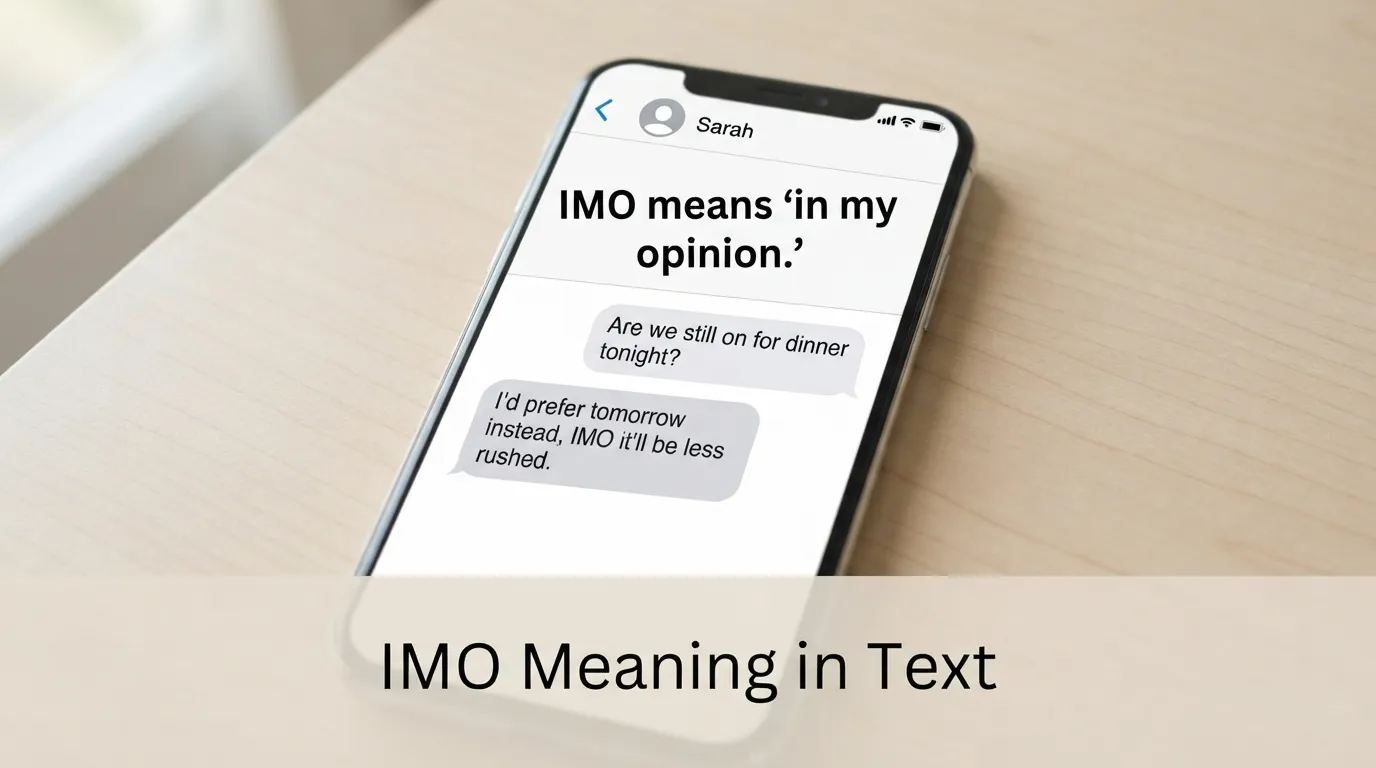
Quick Answer: IMO stands for In My Opinion. People use it in texts, DMs, and comments to share what they think without sounding like they’re stating a fact. Outside of texting, IMO can also mean the International Maritime Organization.
What Does IMO Mean in Text?
IMO = In My Opinion.
It’s a hedge, a small word (well, acronym) that people drop into a sentence to signal this is what I think, not a proven fact, so feel free to disagree. It softens statements, makes them feel less like a lecture, and keeps casual conversations low-pressure.
IMO, the new season was way better than the first one.
That sentence works exactly the same without IMO but adding it signals humility and openness, which is why it’s so common in texting, social media, and even professional messaging.
A less common variant you’ll occasionally see is In My Own [view/experience], usually shortened further in casual or older-style forum posts, but this is rare enough that if you see IMO today, it’s almost certainly In My Opinion.
Where Did IMO Come From? (A Quick History)
IMO isn’t a Gen Z invention, it’s actually one of the older internet acronyms still in active use.
- 1980s–1990s: IMO (along with IMHO) first appeared on Usenet newsgroups and early internet forums, where users debated topics and used the abbreviation to mark personal opinions apart from facts.
- 2000s: It carried over into AIM, MSN Messenger, and early text messaging, where character limits and typing speed made short forms valuable.
- 2010s–present: Social media (Twitter/X, Instagram, TikTok, Discord) cemented IMO as standard shorthand, and it now appears just as often in professional Slack messages as it does in Gen Z slang lists.
So while platforms have changed, the core function flagging a statement as opinion rather than fact has stayed identical for roughly 30 years.
Important: IMO Has a Second, Totally Different Meaning
This is the part most guides skip, and it matters if you’ve seen IMO in a news headline, a shipping context, or a legal/business document.
IMO also stands for the International Maritime Organization, a United Nations agency responsible for regulating international shipping, maritime safety, and marine pollution prevention.
| Context | What IMO Means |
| Texting, DMs, social media | In My Opinion |
| News, shipping, logistics, UN-related content | International Maritime Organization |
| Older or niche forum posts | Occasionally In My Own [opinion/experience] |
| Business/finance documents | Rarely, Interest Method or In Memory Of depending on industry |
How to tell which one is meant: context does all the work. If it shows up in a casual chat, caption, or comment section, it’s in my opinion. If it shows up next to words like vessel, shipping regulations, maritime law, or United Nations, it’s the organization.
IMO vs. imo vs. Imo Does Capitalization Matter?
Not really, but it does signal tone:
- imo (all lowercase) the most common casual form, used in texting and DMs. Feels relaxed and unbothered.
- IMO (all caps) used in formal writing, headlines, or when someone wants the abbreviation to stand out. Also the correct form in professional or edited writing.
- Imo (capitalized like a name) is usually just a phone’s autocapitalize feature kicking in at the start of a sentence; it doesn’t change the meaning.
There’s no rule requiring capitalization in casual texting; both imo and IMO are universally understood the same way.
How IMO Is Used, Platform by Platform
| Platform | Typical Use | Example |
| WhatsApp / iMessage | Softening personal takes with friends or family | IMO we should just order pizza tonight |
| Instagram/TikTok captions & comments | Sharing a hot take that invites discussion | IMO this is the best coffee spot in town ☕ |
| X (Twitter) | Prefacing opinions in threads, often before a debate-worthy take | IMO the sequel ruined the original story |
| Discord / gaming chats | Giving quick feedback on strategy, characters, or updates | IMO this hero is broken post-patch |
| Marking a comment as subjective before a longer explanation | IMO, and I know this is unpopular, the book is overrated | |
| Slack / workplace chat | Suggesting an idea without sounding like a directive | IMO we should push the deadline by a week |
| Dating apps (Tinder, Hinge, Bumble) | Softening a playful or slightly bold statement | IMO pineapple belongs on pizza, fight me 😏 |
The function stays consistent everywhere to soften an opinion but the tone shifts from playful (social media, dating apps) to professional (Slack, email-adjacent chat).
IMO in Real Conversations (With Examples)
Friend group chat:
Sara: are we doing the beach trip or the mountains? Ali: IMO beach, mountains are too cold rn Sara: fair lol, beach it is
Instagram comment:
@traveler_diaries: IMO Lahore has the best street food in the country, no debate 🔥
Dating app opener:
Match: you seem like a thriller movie person You: IMO horror > thriller any day, but I’ll allow the guess
Work Slack:
Colleague: should we launch the campaign Friday or wait till Monday? You: IMO Monday gives us more time to test, but open to other views
Discord gaming chat:
Player1: new update dropped Player2: IMO they nerfed the wrong character again lol
Each example shows the same pattern: IMO shows up right before a subjective claim, and it invites a reply rather than shutting the conversation down.
IMO vs. IMHO vs. Similar Abbreviations
| Abbreviation | Meaning | Tone | Best Used When |
| IMO | In My Opinion | Neutral, direct | Everyday opinions |
| IMHO | In My Humble Opinion | Slightly softer, self-deprecating | Sensitive topics, debates |
| FWIW | For What It’s Worth | Casual, low-confidence | Offering unsolicited input |
| TBH | To Be Honest | Blunt, sincere | Prefacing a hard truth |
| NGL | Not Gonna Lie | Honest, emphatic | Admitting something candidly |
| ICYMI | In Case You Missed It | Informational | Sharing news/updates |
| FYI | For Your Information | Neutral, factual | Sharing facts, not opinions |
| AFAIK | As Far As I Know | Uncertain | Sharing incomplete info |
| IIRC | If I Recall Correctly | Uncertain, memory-based | Recalling details loosely |
Key distinction: IMO and IMHO are nearly identical, but IMHO carries a slightly more polite, I could be wrong undertone useful in disagreements where you don’t want to sound combative.
Is IMO Rude, Flirty, or Passive-Aggressive?
IMO itself is tone-neutral; it doesn’t carry inherent rudeness or warmth. What surrounds it decides the vibe:
- Neutral/Respectful: IMO the meeting could’ve been an email. Just a take, no edge.
- Flirty: IMO you’d lose a trivia match against me 😏 Playful challenge, common on dating apps.
- Passive-aggressive: IMO some people should just listen more. The abbreviation isn’t the problem; the vague callout is.
- Blunt/Harsh: IMO that was a bad decision. Can sting in a professional setting if not softened further, even though IMO is technically doing the softening.
Rule of thumb: IMO lowers the temperature of a statement, but it can’t fully offset a genuinely harsh opinion. If the sentence would sound rude without IMO, adding IMO only helps a little.
How to Reply When Someone Texts You IMO
Casual / Friendly
- True, I hadn’t thought of it that way!
- Fair enough, I see your point
- Lol okay valid
Agreeing
- Same tbh
- 100%, agreed
- That’s exactly what I was thinking
Disagreeing (without conflict)
- Interesting, I actually see it differently
- I hear you, but I’d lean the other way
- Respect the take, still disagree tho lol
Funny / Playful
- IMO you’re wrong but I still love you
- Bold take, I like it
Professional
- Thanks for the input, let’s weigh both options
- Appreciate the perspective I’ll factor that in
- Good point, let’s discuss further in the meeting
Matching the register of the original message (casual vs. professional) is the easiest way to reply naturally.
What Does It Mean When a Crush Texts You IMO?
This is one of the most-searched variations of this whole topic: what does imo mean from a girl or what does imo mean when a guy says it and the honest answer is: it doesn’t automatically mean anything romantic. IMO it is still just in my opinion. What matters is the sentence around it.
- IMO you’re pretty cool, a compliment softened as an opinion; can be a mild flirt signal depending on the rest of the conversation.
- IMO we should hang out sometime, likely with genuine interest, since they’re using opinion language to float a low-pressure suggestion.
- IMO that’s just how I see it: neutral, no romantic undertone at all; just someone stating a view during a normal conversation.
How to actually tell if it’s flirty: look at the rest of the conversation response speed, emojis, follow-up questions, and whether they’re steering the chat toward personal topics. The IMO itself is rarely the signal; it’s just the sentence structure someone happens to use while flirting (or not).
Do Gen Z and Millennials Use IMO Differently?
Slightly, yes:
- Millennials tend to use IMO the traditional way as a straightforward hedge before an opinion, often in full sentences.
- Gen Z frequently pairs IMO with other slang (NGL, fr fr, lowkey) and uses it more for humor or exaggerated takes than genuine debate: IMO pineapple pizza is a war crime lowkey
- Gen Alpha / younger teens increasingly use it in voice-to-text and short-form video captions (TikTok, Reels) as a caption starter rather than mid-sentence.
None of these differences change the core meaning they just affect how casually or humorously it’s deployed.
When You Should NOT Use IMO
- Formal emails or documents spell out in my opinion or avoid the phrase structure entirely; abbreviations read as unprofessional in formal writing.
- Cross-cultural or non-native-English conversations not everyone recognizes internet acronyms, and it can cause confusion instead of clarity.
- Sensitive or serious topics (health, grief, legal matters) casual abbreviations can feel dismissive when the subject needs full sentences and care.
- First-time professional contacts until you know someone’s communication style, spelling things out avoids unintended casualness.
Common Mistakes People Make With IMO
- Reading it as a command. IMO signals opinion, not instruction IMO we should leave is a suggestion, not an order.
- Confusing it with IMHO. They’re close, but IMHO leans more humble/self-aware; swapping them in a tense conversation can change how blunt you sound.
- Missing tone in text form. Without vocal cues, IMO can read as more clipped or dismissive than intended; adding a follow-up sentence often helps.
- Assuming everyone knows it. Especially in international or older audiences, spelling it out the first time avoids confusion.
- Overusing it. Starting every sentence with IMO can come across as repetitive or as if you’re constantly hedging.
FAQs
Imo meaning in text from girl
IMO from a girl means “In My Opinion” and is used to share her personal view politely without sounding forceful.
Imo meaning in text funny
IMO is used humorously or sarcastically to express an exaggerated or light-hearted personal opinion.
Imo meaning in text urban dictionary
Urban Dictionary defines IMO as “In My Opinion,” a common internet abbreviation for sharing personal views.
Imo person meaning
There is no special “IMO person” meaning; it simply refers to someone using the acronym “In My Opinion.”
What does imo mean on snapchat
On Snapchat, IMO means “In My Opinion” and is used in chats or stories to share a personal viewpoint.
IMO meaning in shipping
In shipping, IMO stands for International Maritime Organization, the UN agency that regulates global maritime safety and pollution.
IMO meaning in business
In business contexts, IMO most often means “In My Opinion,” though it can occasionally refer to roles like Information Management Officer.
Imo meaning in healthcare
In healthcare, IMO commonly refers to Intelligent Medical Objects, a company that provides clinical terminology and data solutions.
Conclusion
IMO is a small abbreviation carrying a specific social function: it lets people share what they think without sounding like they’re stating a fact.
Once you know its main meaning (In My Opinion), its lesser-known meaning (International Maritime Organization), how it shifts across platforms, and how to reply to it naturally, you’ll never have to pause and guess again.
Next time imo shows up in your messages, you’ll know exactly what’s being said and exactly how to respond.
Discover More Post
- TFW Meaning Explained: Simple Definition With Examples
- Concur Meaning Explained: Definition, Uses, Synonyms & Examples
- Guarantor Meaning: Simple Definition, Examples, and Risks
- Boujee Meaning: Origin, Use, Examples & Real Meaning

Hello, I’m Mark Nichol. I’ve always been passionate about English words and how they are used in everyday communication. At Defineexa.com, I share simple guides on word meanings, acronyms, texting abbreviations, and modern slang. I believe learning English should be easy, practical, and enjoyable, so every article is written with clarity and accuracy in mind.