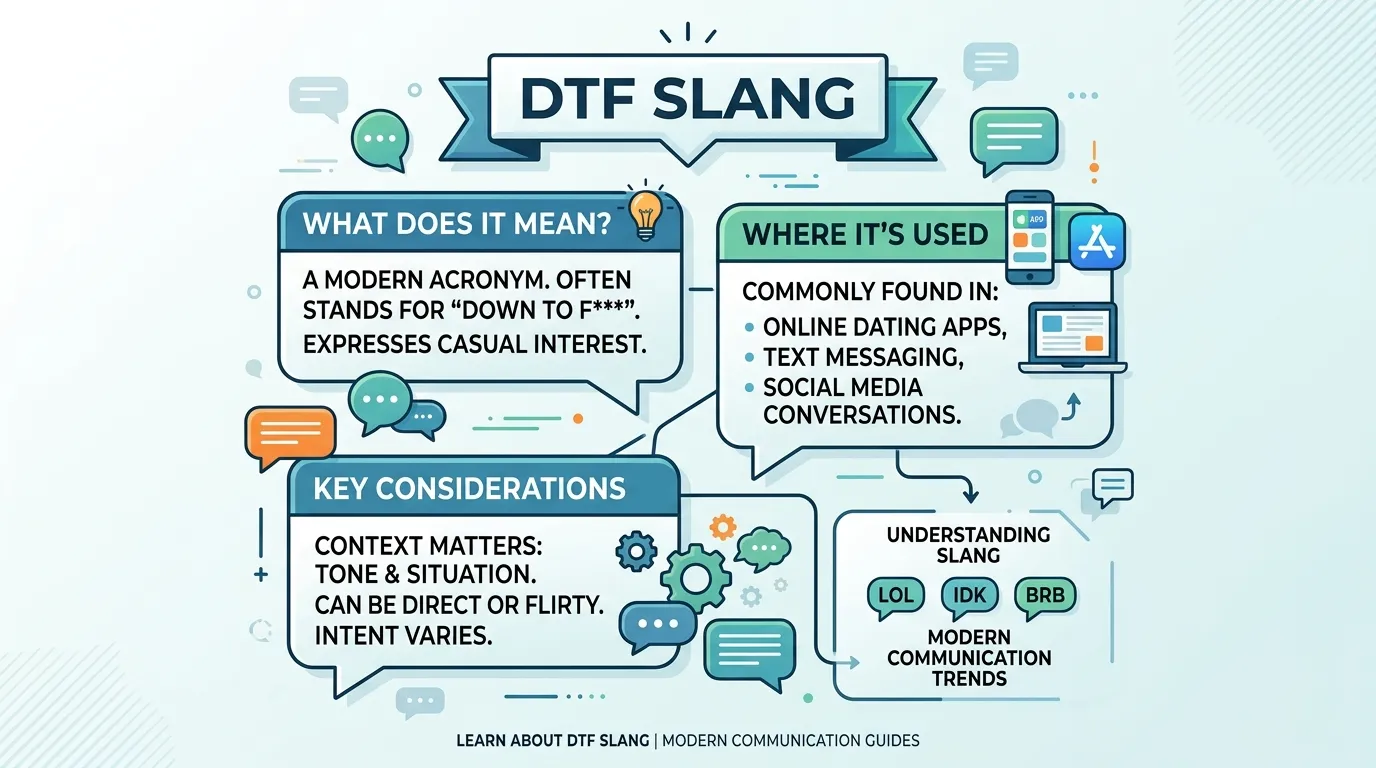
DTF is internet and dating slang that stands for “down to fuck.” It means someone is open to casual sex with no expectation of a relationship, romance, or ongoing commitment. The phrase is blunt, informal, and almost always used in sexual contexts among adults.
People use it to signal availability for a hookup, describe someone else’s intentions, or state their own preferences clearly. It is not a subtle invitation or a coded romantic gesture. When someone says they are DTF, they are stating a straightforward preference for physical intimacy without strings.
Where the Term Comes From
The building blocks of the phrase predate the acronym. In American English, “down” has meant “willing” or “ready” since at least the 1950s. People have long said they were “down” for something to show interest or agreement.
The full phrase “down to fuck” appeared in music before the short form took hold. Big Pun used a version of it in the 1998 track “Still Not a Player.” Town repeated a similar line in 2001’s “Revolving Door.” The initialism DTF itself shows up in early 2000s internet slang. Urban Dictionary recorded a definition in 2002, and Green’s Dictionary of Slang places the acronym in the same period.
Mainstream awareness arrived later. The 2007 film Superbad included an improvised line using the term. MTV’s Jersey Shore, which premiered in late 2009, pushed it into everyday conversation. Cast members used DTF regularly, and the phrase moved from niche online spaces into wider pop culture. By the early 2010s it was common enough that news outlets ran explainers for parents and general audiences.
In more recent years the term has stayed active on dating apps, texting, and social media while also inspiring joke reinterpretations. Some creators playfully expand it into “down to feast,” “down to fun,” or “down to fish” to soften or parody the original meaning.
How People Actually Use DTF
Context decides almost everything. In private messages, dating-app bios, or late-night group chats among adults, DTF almost always carries the sexual meaning. It can appear as a question, a statement about oneself, or a description of someone else.
Common patterns include:
- Direct questions: “Are you DTF tonight?”
- Self-description: “I’m not looking for anything serious. Just DTF.”
- Observation: “He was clearly DTF the second he walked in.”
On apps such as Tinder, Grindr, or similar platforms, some users put the acronym in their profile to filter matches. The message is efficiency: they want casual encounters and prefer not to spend time on mismatched expectations. In friend-group banter the same letters can land more lightly or as a running joke, but the underlying definition remains sexual.
Tone matters. Used between people who already know each other and share the same communication style, it can feel direct and honest. Dropped into a conversation with someone who prefers slower pacing or more romantic framing, it often comes across as abrupt or crude. Consent and mutual comfort still apply; the acronym does not override them.
Pronunciation and Variations
People say the letters individually—“D-T-F”—rather than as a single word. Lowercase “dtf” appears frequently in texts. Occasional alternate spellings such as D2F show up, but the three-letter form dominates.
Because the term is explicit, some speakers soften it in mixed company or public posts by substituting milder expansions. Those playful versions usually signal the speaker knows the original meaning and is deliberately sidestepping it.
Other Meanings of DTF
The same three letters carry completely different definitions outside slang. In the apparel and printing industry, DTF means “direct to film,” a method of printing designs onto a special film that is then heat-transferred onto fabric. That technical usage appears in conversations about equipment, supplies, and custom clothing production.
Other niche expansions exist in specific fields (for example, certain law-enforcement or organizational acronyms), but they are far less common in everyday digital conversation. When the setting is a dating profile, a flirty text, or casual social-media banter, the slang meaning is the default. When the setting is a print shop or manufacturing discussion, the technical meaning takes over. Context resolves the ambiguity quickly for most people.
Common Misunderstandings
Several misconceptions circulate around the term.
Some assume DTF always implies aggression or disrespect. In reality it is often used as a simple preference statement between adults who want the same thing. The word choice is crude by design, yet many people treat it as efficient rather than insulting.
Others believe the acronym is recent Gen Z invention. The evidence shows it has been circulating for more than twenty years and reached wide visibility through mid-2000s media.
A third misunderstanding is that the letters automatically signal interest in a relationship. They do the opposite. DTF typically marks a preference for no ongoing romantic expectation. People who want dating, exclusivity, or emotional connection usually choose a different language.
Finally, the joke expansions (“down to feast,” etc.) sometimes confuse readers who encounter the letters without context. Those versions are usually ironic or humorous and do not replace the primary definition.
Practical Considerations When You Encounter the Term
If you see DTF in a message or profile, the clearest response is honesty about your own preferences. Matching the directness can work when both people want the same outcome. Declining or clarifying is equally straightforward when the intention does not align.
Parents and educators who encounter the acronym in teen spaces often treat it as a signal that young people are absorbing adult sexual language from media and peers. The term itself is not age-appropriate for minors, and its presence can open conversations about consent, digital safety, and healthy boundaries.
In professional or mixed-age settings the safest assumption is that the sexual meaning will be recognized by most adults. Using the letters casually can create discomfort or misunderstanding, so many people simply avoid them outside private adult contexts.
FAQs
Q: Dtf slang meaning urban dictionary
A: On Urban Dictionary, DTF primarily means “Down To Fuck,” indicating willingness for casual sex.
Q: Dtf slang meaning from a girl
A: When a girl says DTF, it usually means she is open to a casual sexual hookup with no strings attached.
Q: DTF meaning in relationship
A: In a relationship context, DTF means “Down To Fuck,” signaling interest in casual sex rather than commitment.
Q: DTF printing meaning
A: In printing, DTF stands for Direct-to-Film, a method where designs are printed on film then heat-pressed onto fabric.
Q: DTF meaning in text from a guy
A: When a guy texts DTF, it typically means he is asking if you are “Down To Fuck” or open to a casual sexual encounter.
Q: DTF other meanings funny
A: Funny alternative meanings include “Down To Fish,” “Down To Fortnite,” or “Down To Forgive.”
Q: DTF meaning clothing
A: In clothing, DTF refers to Direct-to-Film printing, a popular way to apply full-color designs onto apparel.
Q: DTF meaning in food
A: In food contexts, DTF often stands for Din Tai Fung, the famous Taiwanese dumpling restaurant chain.
Conclusion
DTF is a short, explicit way for adults to say they are open to casual sex without commitment. Its roots reach back to mid-century slang for willingness, crystallized into an acronym in early internet culture, and spread through music and reality television. Today it functions as efficient signaling on dating apps and in private conversation. Context, consent, and clear communication determine whether the term lands as useful honesty or as an unwanted bluntness. Knowing the meaning simply removes the guesswork when the three letters appear.

Hi, I’m Benjamin Dreyer. I enjoy exploring the English language and making difficult words simple to understand. At Defineexa.com, I write about word meanings, text abbreviations, acronyms, and internet slang. My goal is to give readers clear, accurate, and easy-to-read explanations that help them learn something new and use English with greater confidence every day.