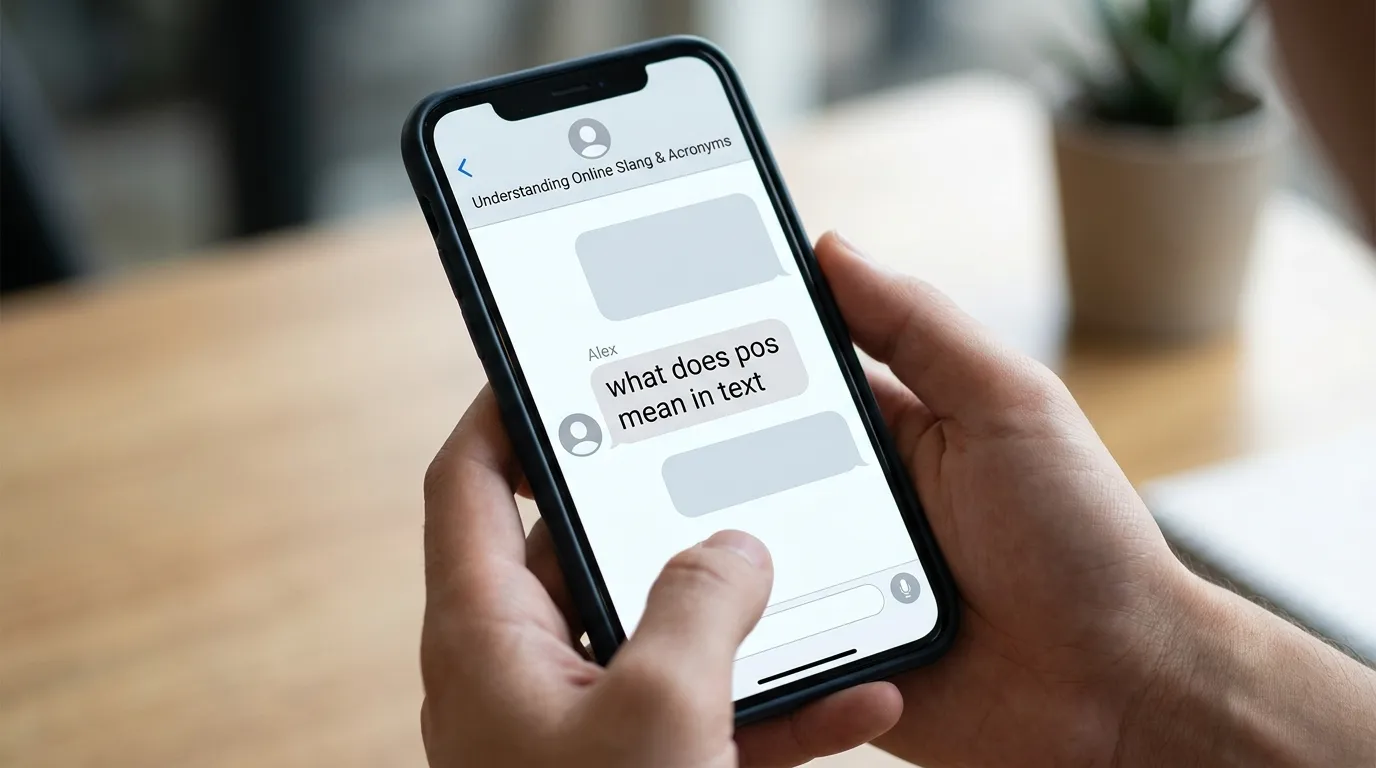
POS in text most often means “piece of shit,” a blunt slang insult for a person, object, or situation that’s frustrating, worthless, or poorly behaved.
It can also mean “parent over shoulder” as a quiet warning that an adult is nearby, or “point of sale” in work and retail chats. Context decides everything.
People search this because the three-letter acronym shows up in casual messages, group chats, social media comments, and even professional texts.
One wrong interpretation can turn a neutral note into an insult or leave you missing a privacy signal.
This guide covers the main meanings, how to tell them apart, real examples, and related uses so you can read the message the way it was intended.
The Most Common Meaning: Piece of Shit
In everyday texting and online conversation, POS is widely used as a shortened, somewhat less explicit version of “piece of shit.” It expresses strong dislike, frustration, or contempt. The target can be a person who acted badly, a product that keeps failing, or a situation that feels unfair or broken.
You’ll see it in angry or venting messages, complaints about technology, relationship talk, and gaming chats. Because it’s an initialism for a vulgar phrase, it carries real bite. Close friends might use it half-jokingly, but directed at someone outside that circle it usually reads as harsh.
Examples of natural usage:
- “My laptop froze again mid-meeting. This POS is done.”
- “He promised he’d show up and then ghosted. Total POS move.”
- “That new app update is a POS. Battery drains in an hour.”
Tone and surrounding words make the meaning clear. Words of complaint, eye-roll emojis, or angry punctuation almost always point to this insult sense. It’s not formal language and rarely appears in professional settings unless someone is deliberately being rude.
Parent Over Shoulder: The Classic Teen Warning
Another long-standing meaning, especially among younger users, is “parent over shoulder.” Someone types POS to signal that a parent, guardian, or other adult is nearby and can see the screen. The message is a quiet request to change the subject, keep things clean, or switch platforms.
This usage grew out of early internet chat rooms and instant messaging, when kids wanted privacy while still staying connected. It still shows up in group chats and texts today, though less frequently than the insult meaning in adult conversations.
Typical examples:
- “Can’t talk much rn, POS.”
- “Switch to Snap? POS right now.”
- “Hang on, POS. Tell me later.”
If the conversation involves teens or young adults and the message feels like a sudden pause or topic shift, this is the likely reading. It is not an insult; it’s a privacy signal.
Point of Sale in Business and Retail Contexts
In workplace texts, emails, or retail conversations, POS almost always means “point of sale.” This refers to the system or location where a customer pays for goods or services—cash registers, card readers, tablets, software that tracks sales and inventory, and related hardware.
Messages about a POS system being down, needing an update, or processing a transaction are routine in stores, restaurants, and offices. There’s nothing slangy or emotional about it.
Examples:
- “The POS is down at register three. Can you process this on your phone?”
- “New POS terminals arrive Monday. Training starts at 9.”
- “Customer wants a refund. Check the POS history.”
If the chat is about work, payments, inventory, or customer transactions, this is the meaning. Confusing it with the slang insult would be out of place and potentially embarrassing.
Other Meanings You Might Encounter
POS is a flexible acronym, so a few other senses appear depending on the group or platform.
In medical or lab contexts, POS can simply mean “positive,” as in a test result. Crypto communities use it for “proof of stake,” a consensus method that differs from proof of work. On platforms like TikTok, Discord, or X, you may see /pos (often with the slash) as a tone indicator meaning “positive” or “positive connotation.” People add it after a comment that could be misread as sarcastic or critical so the reader knows the intent is friendly or complimentary.
Examples of the tone-indicator use:
- “You’re so unhinged /pos”
- “Obsessed with this edit /pos”
These secondary meanings are less common in pure one-to-one texting but become relevant once the conversation moves onto social media or specialized topics. Always let the surrounding conversation and platform guide you.
How to Tell Which Meaning Applies
Context is the only reliable decoder. Ask yourself a few quick questions:
- Is the tone frustrated, angry, or complaining? Likely “piece of shit.”
- Does the message feel like a sudden stop or privacy request from a younger person? Probably “parent over shoulder.”
- Is the chat about work, sales, payments, or store operations? Almost certainly “point of sale.”
- Does it appear after a potentially ambiguous compliment on social media? Check for the tone-indicator sense.
- Are medical results or crypto being discussed? Consider “positive” or “proof of stake.”
Surrounding words, emojis, the relationship between the people texting, and the platform all supply clues. When in doubt, a polite clarifying question is better than assuming the harshest reading.
Common Mistakes and Why They Happen
People often assume the insult’s meaning first because it is the most emotionally charged and frequently discussed online. That leads to unnecessary offense when the sender meant something neutral. Parents or older readers sometimes miss the “parent over shoulder” signal and keep talking about topics that should have been paused. Business users occasionally see the slang version and wonder why a colleague is being so rude about a payment terminal.
Another frequent mix-up involves the tone indicator /pos. Without the slash or clear positive framing, it can be misread as the insult. Clarity improves when people write the full phrase or add a quick note when the stakes are high.
Related Slang and Alternatives
If someone wants a softer way to complain, they might say “trash,” “junk,” or “piece of junk.” Stronger or more playful alternatives include “POS” used jokingly among friends, or other abbreviations like “PITA” (pain in the ass). For privacy signals, some people simply write “parent nearby” or switch to a disappearing-message app. In business, the full phrase “point of sale system” removes any ambiguity.
Understanding these nearby terms helps you navigate conversations that mix slang, warnings, and professional talk without missing the intended meaning.
Practical Tips for Using or Responding to POS
If you plan to use the insult version, remember it lands hard. Save it for private chats with people who know your sense of humor, or skip it when the relationship matters. For the parent-over-shoulder sense, a short reply acknowledging the signal keeps things smooth. In work settings, stick to the business meaning and expand the acronym on first use if the audience might include people outside retail.
When you receive an ambiguous POS, reply with neutral curiosity rather than assumption. A simple “which POS do you mean?” or “everything okay?” usually clears things up without drama.
FAQs
What does pos mean in text funny
POS is a funny (but rude) slang for “piece of shit,” used to roast something or someone as terrible.
What does pos mean in text urban dictionary
On Urban Dictionary, POS mainly stands for “piece of shit,” a blunt insult for a person or thing.
What does POS mean on social media
On social media, POS most often means “piece of shit,” used as a casual insult or complaint.
What does pos mean in text discord
In Discord text, POS usually means “piece of shit,” though /pos can also be a positive tone indicator.
Pos meaning tone tag
As a tone tag, /pos (or pos) means “positive” or “positive connotation,” showing the message is meant nicely.
POS meaning relationship
In relationship talk, POS means “piece of shit,” calling someone a terrible partner or person.
Pos meaning twitter
On Twitter (X), POS commonly means “piece of shit” as an insult, while /pos signals positive intent.
POS person meaning
A “POS person” means someone viewed as a “piece of shit”—worthless, annoying, or badly behaved.
Conclusion
Knowing the main possibilities and reading the full message turns a confusing three-letter string into clear communication.
If someone is venting about a broken phone, warning that a parent walked into the room, or asking about the checkout system, the surrounding details almost always reveal the intended sense. Once you recognize the patterns, POS stops being a puzzle and becomes just another everyday piece of digital language.

Hi, I’m Benjamin Dreyer. I enjoy exploring the English language and making difficult words simple to understand. At Defineexa.com, I write about word meanings, text abbreviations, acronyms, and internet slang. My goal is to give readers clear, accurate, and easy-to-read explanations that help them learn something new and use English with greater confidence every day.