
If you’ve ever stared at a purchase order that says FOB Shanghai and wondered whether that’s good or bad news for your wallet, you’re not alone.
FOB stands for Free on Board (sometimes called Freight on Board), and in shipping it marks the exact point where ownership, risk, and cost shift from the seller to the buyer.
That’s the core answer but FOB also shows up in everyday life as the little clicker on your keychain that unlocks your car, and occasionally as military or slang shorthand.
This guide breaks down every common meaning of FOB, walks through how FOB shipping terms actually work in a real transaction, and clears up the mix-ups that trip people up most.
FOB
FOB is a versatile acronym and term used across different fields. In international shipping, it stands for Free On Board, a key trade term that defines when ownership and risk of goods transfer from seller to buyer. Outside logistics, FOB commonly refers to a key fob — a small electronic device used to unlock cars or secure buildings. The meaning depends entirely on context, so understanding the situation is essential for accurate interpretation.
Example 1: A company ships furniture under FOB terms, meaning the buyer takes responsibility once the goods are loaded onto the vessel. Example 2: You press the button on your car’s FOB to unlock the doors from a distance.
FOB Meaning
The meaning of FOB changes based on industry. In commerce and shipping, FOB means Free On Board — the seller delivers goods to a specified port and loads them onto the ship, after which the buyer assumes all risk and cost. In everyday life, FOB often means a key fob, a compact remote used for vehicle access or building entry. Recognizing the correct context prevents confusion and ensures clear communication in both business and daily situations.
Example 1: Under FOB Shanghai terms, the exporter’s responsibility ends once cargo is safely on the ship. Example 2: Hotel guests receive a FOB that grants access to their room and the gym.
FOB Definition
FOB is defined as Free On Board in international trade, an Incoterm that specifies the point at which the seller’s obligation ends and the buyer’s begins. Once goods are loaded onto the vessel at the named port, risk, cost, and ownership transfer to the buyer. Separately, a FOB can also be defined as a small electronic key device used for remote unlocking of vehicles or secure doors. Precise definition depends on whether the discussion is commercial or technological.
Example 1: The contract states “FOB Los Angeles,” clarifying that the buyer covers freight and insurance after loading. Example 2: Modern cars include a smart FOB that starts the engine without inserting a traditional key.
What Does FOB Stand For
FOB most frequently stands for Free On Board in global trade, indicating the seller’s delivery point and risk transfer. It can also stand for Freight On Board in some older documents. In technology and security, FOB simply refers to a key fob rather than an acronym. Knowing the full form helps professionals interpret shipping documents correctly and avoid costly misunderstandings during import or export transactions.
Example 1: The bill of lading shows “FOB Origin,” meaning the buyer owns the goods as soon as they leave the warehouse. Example 2: Office workers use a FOB to enter restricted floors after hours.
What Is FOB
FOB is a standard international shipping term meaning Free On Board. It clearly marks the moment when the seller hands over goods and the buyer takes full responsibility for transportation, insurance, and any damage. In non-shipping contexts, a FOB is a portable electronic device that communicates with vehicles or access systems. Understanding what FOB is allows businesses to negotiate better contracts and individuals to use modern security tools effectively.
Example 1: An importer chooses FOB terms to control shipping costs and select their preferred carrier. Example 2: A motorcycle rider carries a waterproof FOB that locks and unlocks the bike with one click.
What Does FOB Mean
FOB means Free On Board when used in trade and logistics. It tells both parties exactly where the seller’s duty ends — usually once goods are loaded on the ship at the agreed port. Outside business, FOB means a key fob, a convenient remote control for cars, gates, or buildings. The dual meaning makes context crucial; the same three letters can refer to a commercial rule or a everyday security gadget.
Example 1: The quote “FOB New York” means the price includes delivery and loading at the New York port only. Example 2: Parents give teenagers a house FOB so they can enter safely after school.
FOB Means
FOB means Free On Board in the language of international commerce. This term establishes the exact point of risk transfer between seller and buyer during ocean freight. In daily conversation, FOB means a small electronic key used to operate locks remotely. Whether reviewing a sales contract or unlocking a car, knowing what FOB means ensures accuracy and prevents unnecessary complications in both professional and personal settings.
Example 1: Sellers prefer FOB terms when they want to complete their responsibility quickly at the loading port. Example 2: Apartment complexes issue a FOB to residents instead of traditional metal keys for better security tracking.
FOB Meaning in Shipping: The Main Definition
In international trade and logistics, FOB is an Incoterm, one of the standardized rules published by the International Chamber of Commerce to keep global shipping contracts consistent. It answers two practical questions for anyone buying or selling goods across a distance:
- At what physical point does the title (legal ownership) of the goods transfer?
- Who pays for freight, insurance, and handling from that point forward?
Picture a couch shipped from an overseas factory to a store in the U.S. FOB tells you exactly where the seller’s responsibility ends and the buyer’s begins. If the truck carrying that couch gets into an accident, FOB terms decide who eats the cost.
There are two primary versions of this arrangement, and mixing them up is one of the most common and most expensive mistakes in shipping contracts.
FOB Origin (FOB Shipping Point)
Ownership and risk pass to the buyer the moment the goods are loaded onto the carrier at the seller’s location or port. From that point on, if something goes wrong in transit, it’s the buyer’s problem, not the seller’s.
FOB Destination
The seller retains ownership and risk until the goods physically arrive at the buyer’s specified location. This gives the buyer more protection but usually costs a bit more, since the seller is factoring in that extended responsibility.
Freight Collect vs. Freight Prepaid
FOB terms get more specific when you add in who actually pays the freight bill. These two labels are often paired with FOB Origin or FOB Destination:
- Freight Collect the buyer pays the shipping carrier directly.
- Freight Prepaid the seller pays the shipping carrier, then usually builds that cost into the invoice.
Combine these with FOB Origin or FOB Destination, and you get four common variations: FOB Origin, Freight Collect; FOB Origin, Freight Prepaid; FOB Destination, Freight Collect; and FOB Destination, Freight Prepaid. Each one puts a different party on the hook for costs and risk at a different stage of the journey.
Quick Comparison: FOB Origin vs. FOB Destination
| Question | FOB Origin | FOB Destination |
| When does the buyer take ownership? | As soon as goods are loaded at the seller’s location | When goods arrive at the buyer’s location |
| Who bears risk during transit? | Buyer | Seller |
| When does the seller record the sale? | At pickup/loading | At delivery |
| When does the buyer record inventory? | At pickup/loading | At delivery |
| Typically better for | Buyers who want lower costs and are comfortable managing insurance | Buyers who want less risk exposure |
Why FOB Terms Actually Matter to You
This isn’t just paperwork jargon. FOB terms affect real decisions:
- Insurance If you’re on the hook for goods the moment they leave the factory (FOB Origin), you need cargo insurance covering that entire transit window.
- Accounting Businesses record revenue and inventory based on the FOB point, which affects financial statements and tax timing.
- Budgeting Freight costs can swing a deal’s profitability, so knowing whether you’re paying for transport changes your total cost calculation.
- Dispute resolution When goods arrive damaged, FOB terms determine who files the claim and who absorbs the loss if insurance doesn’t cover it fully.
Getting this wrong on a contract isn’t a small clerical error; it can mean unexpectedly owing thousands of dollars in freight or being stuck without recourse after a shipment is damaged.
FOB Meaning Outside of Shipping
FOB shows up in a few other contexts that have nothing to do with shipping contracts, and confusing them is an easy mistake.
Key Fob
A key fob is the small electronic device you press to unlock your car remotely, or the badge you tap against a reader to enter a secured building. This use of fob actually predates the shipping acronym by centuries; it traces back to an old German word for pocket, referring to small ornaments people once attached to pocket watch chains. Despite the shared letters, a key fob has no real connection to free on board. It’s a coincidence of language, not a related meaning.
Forward Operating Base (Military)
In military contexts, FOB refers to a Forward Operating Base, a secured, often temporary position closer to active operations than a main base, used to support tactical missions. This usage is common in military documentaries, news coverage, and veteran conversations.
Casual or Slang Use
Occasionally you’ll see FOB used informally in other ways depending on context or community. If you encounter the term somewhere unfamiliar, the safest move is to check the surrounding context: shipping, security devices, and military operations cover the vast majority of real-world usage.
How to Tell Which Meaning Applies
Here’s a quick mental checklist when you come across FOB:
- Is it in a contract, invoice, or purchase order? It almost certainly means free on board (shipping).
- Is it referring to a device on a keychain or a tap-to-enter badge? That’s a key fob.
- Is it in a military, news, or veteran context? Likely Forward Operating Base.
- Is there a price or port name right after it (like FOB Shanghai or FOB $2,400)? Definitely the shipping term.
Common Mistakes to Avoid
- Assuming Freight on Board is the official term. It isn’t. Free on Board is the correct and legally recognized phrasing, even though Freight on Board gets used casually.
- Confusing FOB with CIF. CIF (Cost, Insurance, and Freight) is a different Incoterm where the seller covers insurance and freight to the destination port; it’s often mixed up with FOB Destination but isn’t the same thing.
- Forgetting that FOB is meant for ocean and inland waterway shipping. For air, rail, or multimodal shipments, other Incoterms like FCA (Free Carrier) are technically more appropriate, even though FOB gets used loosely in casual conversation.
- Not specifying a location. FOB alone is incomplete; a valid FOB term always names a location, like FOB Los Angeles or FOB Shanghai, so everyone agrees on the actual transfer point.
FAQs
Q: FOB meaning in business
A: FOB in business usually refers to “Free on Board,” a shipping term that defines costs, delivery, and risk responsibilities.
Q: FOB meaning in purchase order
A: FOB in a purchase order states where responsibility for shipping costs and goods transfers from the seller to the buyer.
Q: FOB meaning military
A: FOB in the military usually means “Forward Operating Base,” a temporary base used by military forces.
Q: FOB meaning in shipping
A: FOB in shipping means “Free on Board” and describes when responsibility and risk for goods transfer between seller and buyer.
Q: FOB meaning airport
A: FOB at an airport can refer to “Free on Board,” depending on the shipping or trade context.
Q: Fob meaning medical
A: FOB in medical contexts can mean “fecal occult blood,” a test used to detect hidden blood in stool.
Q: Fob meaning key
A: A key fob is a small device or electronic token used to unlock or access a vehicle, door, or security system.
Q: FOB meaning TikTok
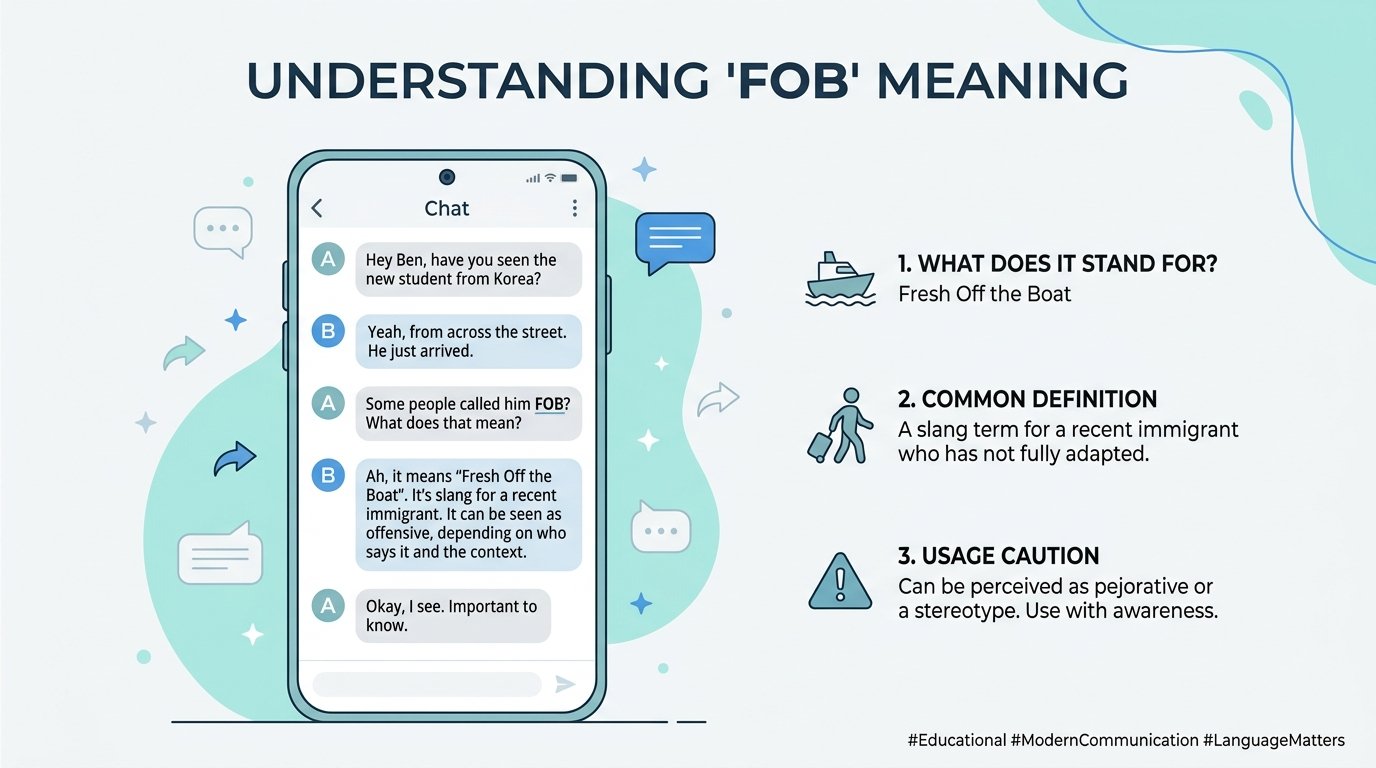
A: FOB on TikTok can have different meanings depending on the video, but it may refer to “Fresh Off the Boat.”
Conclusion
FOB has one dominant meaning in business, Free on Board, a shipping term that decides who owns the goods and who’s financially responsible for them at each stage of transit plus a few unrelated everyday meanings like key fobs and military bases. If you’re dealing with a shipping contract, always check whether it’s FOB Origin or FOB Destination, confirm who’s paying freight, and make sure a specific location is named. When in doubt, ask your supplier or logistics partner to spell out the exact FOB terms in writing before you sign anything; it’s a small step that can save you from a costly surprise down the line.

Hello, I’m Mark Nichol. I’ve always been passionate about English words and how they are used in everyday communication. At Defineexa.com, I share simple guides on word meanings, acronyms, texting abbreviations, and modern slang. I believe learning English should be easy, practical, and enjoyable, so every article is written with clarity and accuracy in mind.