
Picture a building collapsing straight down into its own footprint instead of blasting outward in a cloud of debris.
That’s an implosion, and it’s the opposite of what most people picture when they hear the word explosion.
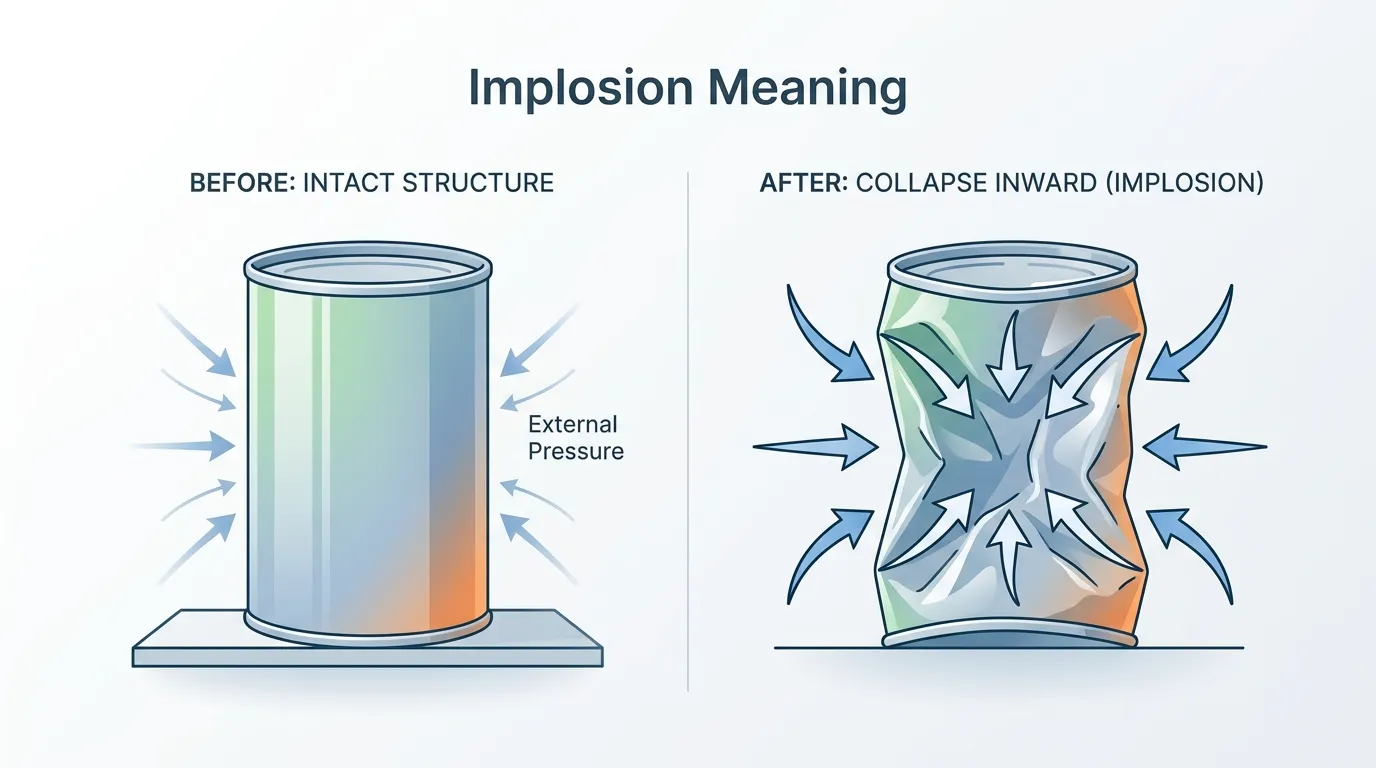
Implosion meaning, in short: an implosion happens when something collapses violently inward because the pressure outside is greater than the pressure inside.
Instead of matter being pushed out, it gets crushed in on itself.
That’s the technical definition, but the word shows up in a lot of unexpected places from old TV tubes to stock market crashes to the way people describe an emotional breakdown.
By the end of this article, you’ll understand exactly what implosion means, how it differs from an explosion, where you’ll actually encounter the term, and why the distinction matters more than most explanations let on.
Implosion meaning
Implosion meaning refers to a sudden collapse inward, usually because the pressure outside an object is greater than the pressure inside it. It is the opposite of an explosion, which sends energy and material outward. The word can describe physical events, such as a damaged building or a container crushed by pressure. It can also describe a sudden failure of a group, business, or plan. In simple terms, implosion means collapsing or breaking inward.
Example 1: The empty tank suffered an implosion under strong outside pressure.
Example 2: The company faced an internal implosion after years of poor decisions.
Implosion
Implosion is the act or process of something collapsing inward with great force. It often happens when strong external pressure overwhelms the pressure inside an object or structure. The term is common in science, engineering, construction, and news reports, but it can also be used in a figurative way. For example, people may say a team or organization had an “implosion” when internal problems caused it to suddenly fall apart. In short, an implosion is a powerful inward collapse rather than an outward blast.
Example 1: Engineers watched the old structure undergo a controlled implosion.
Example 2: The sports team suffered an implosion after several players argued.
Implosion meaning in tamil
The implosion meaning in Tamil can be explained as உள்நோக்கிய வெடிப்பு அல்லது உள்நோக்கிய சரிவு. It describes a situation where an object, structure, or system suddenly collapses inward because of pressure or internal changes. Unlike an explosion, which generally moves outward, an implosion moves toward the center. The word can also be used figuratively when something, such as an organization or relationship, suddenly falls apart from internal problems. The exact Tamil wording may change based on the context.
Example 1: The building’s implosion can be described as கட்டிடம் உள்நோக்கி இடிந்து விழுதல்.
Example 2: The team’s sudden collapse was called an உள்நோக்கிய சரிவு in a figurative sense.
Implosions meaning
Implosions meaning is the plural form of “implosion,” so it refers to more than one inward collapse. An implosion can happen when outside pressure forces an object or structure toward its center. The plural word may describe several physical collapses or several situations where people, businesses, teams, or systems suddenly fall apart. In everyday writing, “implosions” can therefore have both a literal and a figurative meaning. Understanding the surrounding sentence helps you know which meaning is intended.
Example 1: Several controlled implosions were used to remove unsafe structures.
Example 2: The newspaper described the repeated failures as political implosions.
Implosion means
Implosion means a sudden or forceful collapse inward. It happens when pressure or another powerful force causes something to move toward its center instead of expanding outward. The word can describe a physical event, such as a container collapsing under pressure, or a figurative event, such as a company suddenly falling apart because of internal conflict. So, when someone asks what implosion means, the simplest answer is a collapse inward. It is often contrasted with an explosion, which moves outward.
Example 1: “The damaged vessel suffered an implosion” means it collapsed inward.
Example 2: “The organization had an implosion” means it suddenly broke down from internal problems.
Meaning of implosion
The meaning of implosion is a sudden collapse inward caused by pressure, force, or a major imbalance. In its literal sense, it can describe a physical object or structure collapsing toward its center. In a broader sense, “implosion” can describe the sudden breakdown of something because of problems within it. This figurative use is common when discussing businesses, relationships, teams, or organizations. The key idea is that the collapse happens inward, making the word different from an explosion.
Example 1: The pressure difference caused the container’s implosion.
Example 2: Internal disputes led to the political party’s implosion.
Define implosion
To define implosion simply, it means a sudden collapse inward caused by pressure or force. The term is commonly used for physical objects or structures that collapse toward their center. It can also be used figuratively to describe something that quickly falls apart because of internal problems. For example, a business may experience an “implosion” when conflict, poor leadership, or serious mistakes cause it to break down. The central idea behind the word is an inward collapse, rather than an outward expansion.
Example 1: The submarine’s damaged section experienced an implosion under extreme pressure.
Example 2: The company experienced an implosion after its leadership team turned against each other.
You have not enough Humanizer words left. Upgrade your Surfer plan.
What Does Implosion Mean, Exactly?
At its core, implosion describes a structure or system collapsing inward because it can no longer resist outside pressure. The forces pressing in from the outside overwhelm whatever was holding the shape together from within.
Think of a sealed metal can. If you pump air into it, pressure builds until the can bursts outward. That’s an explosion. Now imagine sucking all the air out of that same can. With nothing pushing back from the inside, outside atmospheric pressure crushes it inward. That’s an implosion.
The key mechanism is a pressure imbalance. Something breaks that seal or support system, and whatever was keeping outside forces in check disappears almost instantly.
Implosion vs Explosion: The Real Difference
People often use these words like they’re just directional opposites, and technically, that’s close to right but the mechanics behind each one are genuinely different, not just mirror images.
| Feature | Implosion | Explosion |
| Direction of force | Inward, toward the center | Outward, away from the center |
| Cause | External pressure exceeds internal pressure | Internal pressure exceeds external pressure |
| Typical trigger | Vacuum, loss of structural support, pressure drop | Rapid gas expansion, chemical reaction, buildup of internal pressure |
| Debris pattern | Falls inward/downward, often contained | Scatters outward, often widespread |
| Common examples | Collapsing stars, controlled building demolition, imploding vacuum tubes | Fireworks, gas leaks igniting, bombs |
The practical takeaway: if you see something collapse into itself, that’s implosion. If you see something burst apart, that’s an explosion. Same physics, opposite direction.
Where You’ll Actually Encounter Implosion
The word gets used across several very different fields, and the meaning shifts slightly depending on context. Here’s where it shows up most.
1. Physics and Astronomy
This is where implosion has its most literal, scientific meaning. When a massive star runs out of fuel, it can no longer generate the outward pressure needed to counteract its own gravity. Gravity wins, and the star’s core collapses inward in a fraction of a second, sometimes triggering a supernova explosion right afterward. It’s a strange but real example of implosion causing an explosion.
Underwater, submarines face a similar risk. Water pressure at extreme depths can crush a hull inward if it fails, which is a genuine implosion in the truest physical sense.
2. Controlled Demolition
This is probably the most familiar real-world use of the word for most people. Demolition crews use the term implosion loosely to describe a building collapsing straight down, but it’s worth knowing this is technically more of a controlled structural collapse than a true implosion.
Engineers place explosive charges at key support points and detonate them in sequence, timed to remove structural support from the bottom up. Gravity does the rest, pulling the building down into roughly its own footprint. It’s dramatic to watch, and calling it an implosion isn’t wrong in common usage, it’s just not the pure pressure-driven event physicists mean by the term.
3. Economics and Business
Market implosion or economic implosion describes a system collapsing rapidly from within a housing bubble bursting, a company’s stock cratering after fraud is uncovered, or an industry contracting sharply because demand disappears. The imagery works because the collapse tends to feel sudden and self-generated, not caused by an outside force pushing in.
4. Personal and Emotional Use
People also say someone is having an implosion to describe a quiet, internal breakdown as opposed to an explosion, which implies yelling, visible anger, or an outburst. An emotional implosion usually means someone is withdrawing, shutting down, or falling apart internally rather than lashing out. It’s not a clinical term, but it’s a useful, widely understood metaphor.
A Simple Way to Remember the Difference
If you only remember one thing from this article, make it this:
- Explosion = pressure escapes outward
- Implosion = pressure crushes inward
Everything else buildings, stars, submarines, markets, people is just a different setting for the same basic idea.
Quick Checklist: Is It Really an Implosion?
Use this checklist when you’re trying to figure out if something qualifies as a true implosion:
- Did the structure or system collapse toward its center, not away from it?
- Was the cause a loss of internal support or a drop in internal pressure?
- Did outside pressure or force overwhelm what was holding things together?
- Did the debris or effects end up mostly contained, rather than scattered?
If you answered yes to most of these, you’re looking at an implosion rather than an explosion.
Common Misunderstandings About Implosion
A few mix-ups come up often enough that they’re worth clearing up directly.
Implosion always involves explosives. Not true. Controlled demolitions use explosives, but a collapsing star or a crushed submarine hull involves no explosives at all just physics doing its work.
Implosion and collapse mean the same thing. They’re related but not identical. Collapse is the broader term for any structure giving way. Implosion specifically describes collapse driven by an inward pressure imbalance.
Implosions are always sudden. Usually, yes but slower versions exist too. An economic implosion, for example, can unfold over months as a company or market gradually loses the internal strength holding it together.
FAQs
Q: Implosion vs explosion
A: An implosion collapses inward, while an explosion expands outward with force.
Q: Implosion meaning in farsi
A: In Farsi, implosion refers to a sudden inward collapse or crushing movement.
Q: Implosion meaning arabic
A: In Arabic, implosion means a sudden collapse inward caused by pressure or force.
Q: Implosion meaning psychology
A: In psychology, implosion can describe emotions or stress building inward instead of being expressed outwardly.
Q: Implosion meaning in chinese
A: In Chinese, implosion refers to a sudden inward collapse caused by pressure or force.
Q: Implosion pronunciation
A: Implosion is pronounced “im-PLOH-zhun,” with the stress on the second syllable.
Q: Implosion meaning in politics
A: In politics, implosion can describe a sudden internal collapse of a party, movement, or government.
Q: Emotional implosion meaning
A: Emotional implosion means feeling intense emotions internally until they become overwhelming.
Conclusion
Implosion means something collapsing inward because outside pressure beats out whatever internal force was holding it together. It’s the structural opposite of an explosion, even though the two sometimes happen in sequence, like with a collapsing star.
You’ll run into the word in physics, demolition, economics, and everyday conversation about people or companies falling apart. Next time you hear it, you’ll know exactly what’s happening and whether it’s the real, pressure-driven kind of implosion or just a looser, figurative use of the word.

Hello, I’m Mark Nichol. I’ve always been passionate about English words and how they are used in everyday communication. At Defineexa.com, I share simple guides on word meanings, acronyms, texting abbreviations, and modern slang. I believe learning English should be easy, practical, and enjoyable, so every article is written with clarity and accuracy in mind.