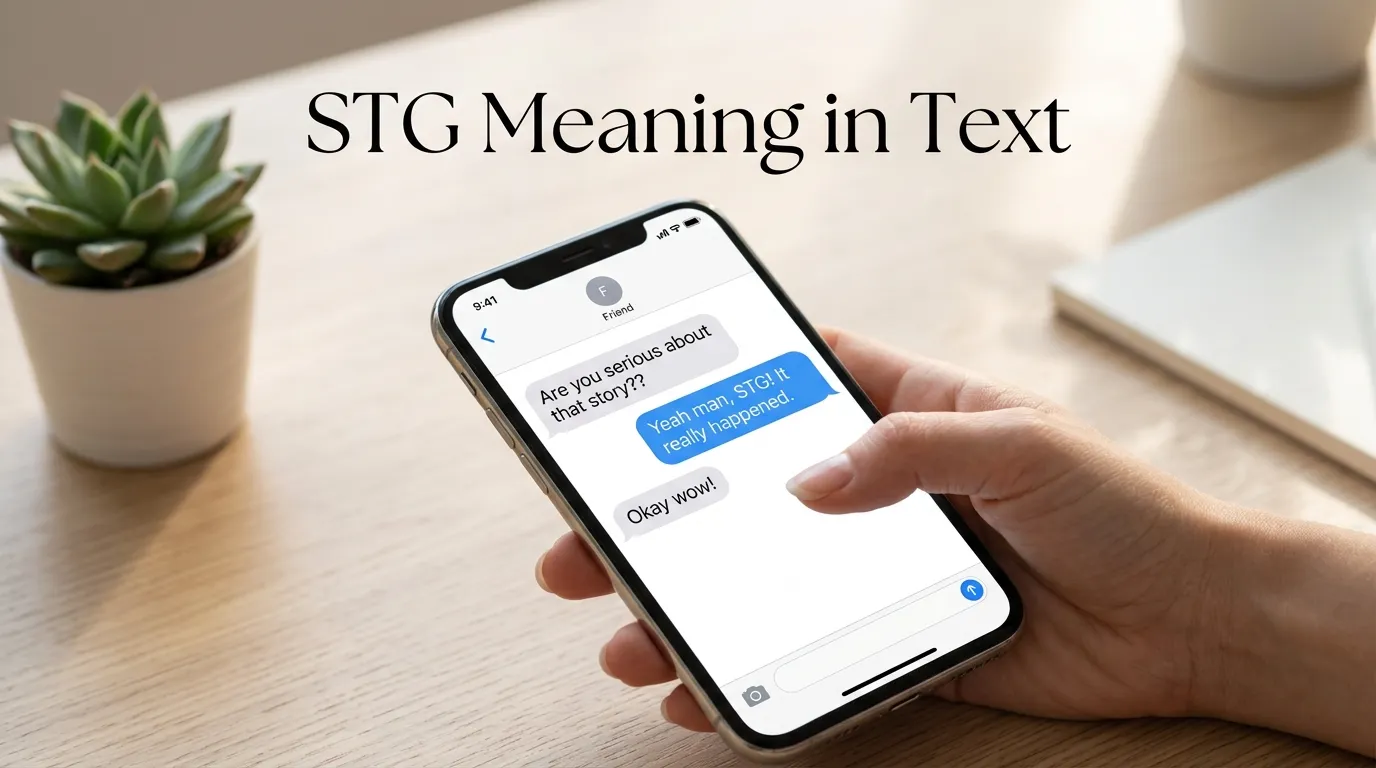
You’re scrolling through a text thread or a comment section, and someone drops STG out of nowhere.
No context, no explanation, just three letters sitting there like you’re supposed to already know.
In texting slang, STG means swear to God as a quick way to show you’re being completely honest or that something really happened the way you’re describing it.
By the end of this guide, you’ll know exactly when people use it, what it means when it shows up in different situations, and how to use it yourself without sounding off.
What Does STG Mean in Text? (Quick Answer)
STG is short for swear to God. People use it to add emphasis, back up a claim, or show they’re not exaggerating. It’s the texting version of putting your hand over your heart and saying I promise this is true.
Example 1: stg my dog just opened the fridge by himself
Example 2: i studied for six hours stg, and I still bombed the test
In both cases, STG is doing the same job: telling the reader to believe me, this really happened.
STG Meaning in Simple English
If you strip away the abbreviation, STG is just a shortened way of saying I swear to God or I’m being serious right now. It’s not a formal phrase, it’s the kind of thing you’d say out loud to a friend when you want them to know you’re not making something up.
Think of it as sitting somewhere between I promise and no joke. It carries a little more weight than fr (for real) but a little less formality than actually spelling out I swear to God.
Example 1: stg I didn’t eat your leftovers (denial, adding sincerity)
Example 2: stg that was the best burger I’ve ever had (enthusiasm, adding emphasis)
Does STG Always Mean the Same Thing?
Mostly, yes but tone changes how it lands. STG almost always means swear to God, but the feeling behind it shifts depending on context. It can express:
- Honesty backing up a true statement
- Disbelief or shock reacting to something unexpected
- Frustration venting about something annoying
- Playful exaggeration used jokingly, not literally
Example 1 (shock): stg he just walked into a glass door in front of everyone
Example 2 (frustration): stg if my Wi-Fi cuts out one more time I’m throwing this router out the window
Neither of these is a literal oath; they’re both just using STG to intensify what the person is saying.
How to Use STG in a Sentence
STG usually sits at the beginning or middle of a sentence, right where you’d naturally pause for emphasis if you were speaking out loud. It works in casual texts, group chats, and comments, but it’s rarely used in anything formal.
Placement examples:
- At the start: stg this show gets better every episode
- In the middle: I stg thought it was Friday all day today
- As a standalone reaction: STG. (used alone as a short, punchy reply to something surprising)
A quick tip: STG almost always pairs with lowercase, casual sentence structure. Writing it in a formal email or work message (STG the report is ready) would feel out of place and confusing to most readers.
STG on Different Platforms
The core meaning of STG stays the same everywhere, but how often you see it and how it’s used shifts slightly depending on where you’re texting or scrolling.
In text messages: STG is used the same way you’d use I swear in conversation reacting to news, confirming a story, or adding weight to a statement. Example: stg my sister just got engaged, I’m shaking rn
On Snapchat: Because Snapchat conversations move fast and feel private, STG often shows up in more emotional or dramatic moments venting, gossip, or reacting to a snap. Example: stg she posted that on purpose
On TikTok and Instagram comments: Here, STG usually reacts to a video or a claim someone made in the caption. Example: stg this hack actually works, I tried it
On Twitter/X: STG tends to show up in reaction threads or when someone’s making a bold claim they want people to believe. Example: stg this is the most underrated album of the year
Common Phrases and Expressions Using STG
A few combinations come up often enough that it’s worth knowing them on sight:
- istg I swear to God, essentially identical to STG but includes the I
- stg on my life an intensified version, adding extra emphasis
- stg fr combines swear to God with for real for double emphasis
- ong stg pairs on God with swear to God, both meaning roughly the same thing
Example 1: istg if this package doesn’t arrive today I’m losing it
Example 2: ong stg that was the scariest movie I’ve seen all year
These combinations aren’t grammatically correct in a traditional sense they’re stacked for emphasis, the way people naturally repeat themselves when they’re excited or frustrated.
STG vs. Similar Abbreviations
STG isn’t the only way people express sincerity in texts. Here’s how it compares to a few common alternatives.
| Abbreviation | Full Meaning | Typical Use |
| STG | Swear to God | Backing up a claim with sincerity or emphasis |
| ISTG | I Swear to God | Nearly identical to STG, slightly more direct |
| FR | For Real | Confirming something is true, often lighter in tone |
| TBH | To Be Honest | Introducing an honest opinion, not necessarily a promise |
| NGL | Not Gonna Lie | Admitting something, often slightly reluctant or surprising |
The main difference: STG and ISTG carry a bit more intensity than FR, TBH, or NGL. If someone wants to sound extra sincere or dramatic, STG is usually the stronger choice.
When STG Sounds Casual vs. Overused
STG works great in casual, personal conversations. It reads naturally between friends, in group chats, or reacting to something online. But like most slang, it can lose its punch if it’s used constantly.
Natural use: stg I almost cried during that episode one clear moment of emphasis.
Overused: stg I stg I’m not lying stg repeating it back to back weakens the impact instead of strengthening it.
A good rule: use STG when you genuinely want to underline a point, not as a filler word in every other sentence.
Common Mistakes People Make With STG
A few small mix-ups happen often enough to mention:
Using it in formal writing. STG belongs in texts and casual chats, not emails, cover letters, or professional messages.
Assuming it always means something serious. As covered earlier, STG is frequently used jokingly or for mild exaggeration; it doesn’t always signal a literal, weighty promise.
Confusing it with unrelated acronyms. In some non-texting contexts (gaming, finance, or technical fields), STG can stand for different things entirely like settings in some game menus or unrelated technical shorthand. Context always decides the meaning.
Example 1 (mistake): Texting a boss stg the file is attached too casual for a work setting.
Example 2 (correct use): Texting a friend stg I just saw a shooting star fits the tone perfectly.
FAQs
Q: STG meaning in medical?
A: In medical contexts, STG can have different meanings depending on the specific field and context.
Q: Stg meaning in text urban dictionary?
A: In texting, STG commonly means “swear to God,” used to strongly emphasize that something is true.
Q: STG meaning in Education?
A: In education, STG can refer to different terms depending on the institution or educational context.
Q: What does STG mean in military?
A: In military contexts, STG can have different meanings depending on the branch and situation.
Q: What does stg mean on snapchat?
A: On Snapchat, STG usually means “swear to God” and is used to stress honesty.
Q: STG meaning in business?
A: In business, STG can represent different terms depending on the company or industry.
Q: What does stg mean on instagram?
A: On Instagram, STG usually means “swear to God” in casual messages and comments.
Q: Stg meaning in pharmacy?
A: In pharmacy, STG can have different meanings depending on the medication or professional context.
Conclusion
STG is a simple, casual way to say swear to God in texts, comments, and social media. It’s used to show honesty, add emphasis, or react to something surprising and its tone can range from sincere to playful depending on the situation. Now that you know how it works, you’ll be able to spot it instantly and use it naturally in your own conversations. Next time it pops up in your messages, you won’t have to pause and wonder what it means.

Hi, I’m Benjamin Dreyer. I enjoy exploring the English language and making difficult words simple to understand. At Defineexa.com, I write about word meanings, text abbreviations, acronyms, and internet slang. My goal is to give readers clear, accurate, and easy-to-read explanations that help them learn something new and use English with greater confidence every day.