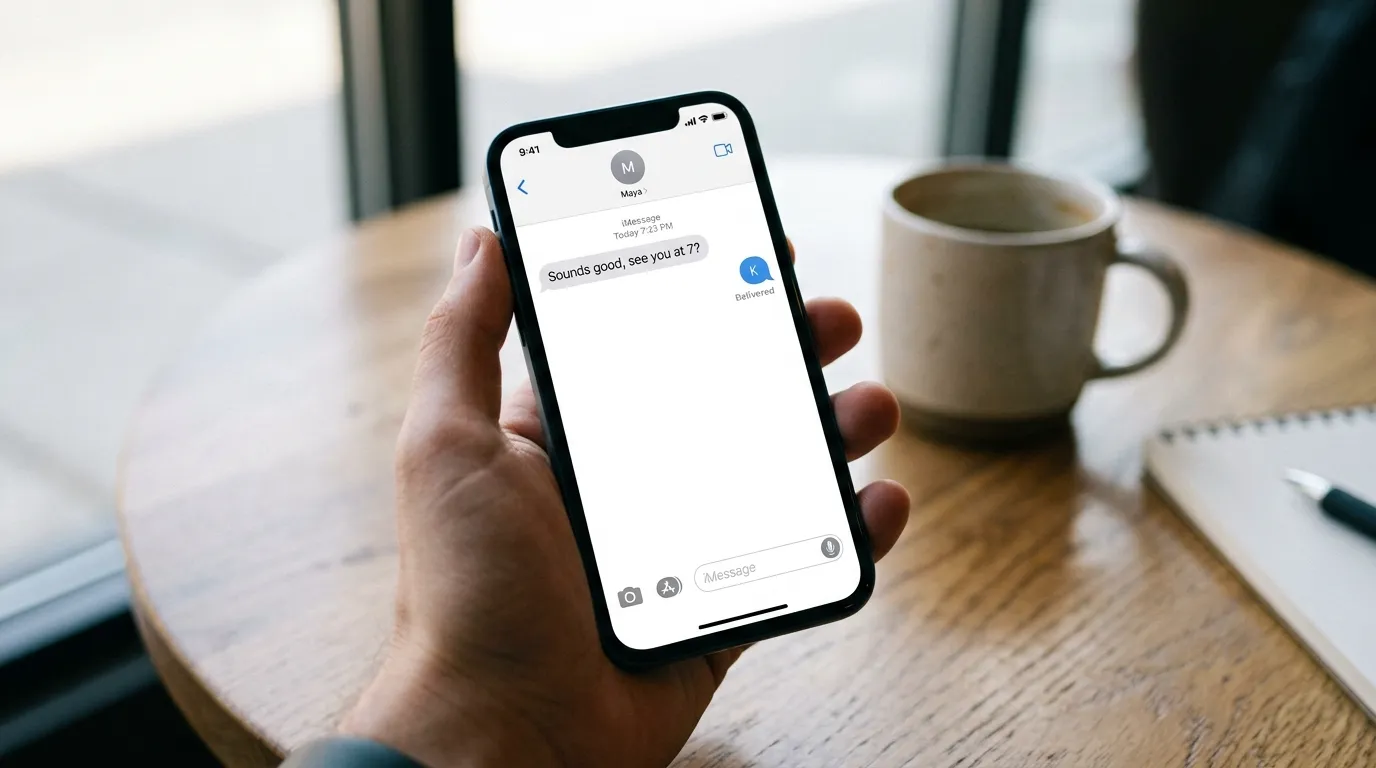
What does k mean? In texting, Snapchat, Instagram DMs, and most chat apps, k almost always stands for okay. People type the single letter as a fast way to say they got the message, agree, or understand.
That short reply can still leave you wondering. A lone k often feels colder or more distant than ok, okay, or kk. Context, timing, and the relationship between the two people decide whether it lands as neutral or a little sharp.
Why a Single K Feels Different From Okay
Most people reach for k because it is quick. Typing one letter takes almost no time, especially on a phone. The problem is that the same speed can read as low effort.
Imagine you send a longer message about plans or feelings. The other person answers with just k. Your brain fills in the silence. Maybe they are busy. Maybe they are annoyed. Maybe they simply do not want to keep talking. Studies of digital conversation have ranked the single-letter reply among the least liked responses, even more negative for some readers than being left on read.
The tone is not built into the letter itself. It comes from how little energy the reply shows. Adding a second k to make kk softens it. Spelling out okay or pairing k with an emoji usually feels warmer. A bare k or k. with a period can land hardest.
How People Actually Use K in Everyday Chats
In a light, practical exchange the letter works fine.
Friend: Meet at the corner at 7?
You: k
Here it simply means got it, see you then. No drama.
In a heavier conversation the same letter can sting.
Partner: I’ve been thinking about us a lot and I need to talk tonight.
You: k
That reply often signals distance or a wish to end the thread. Many people read it as passive-aggressive even when the sender meant nothing of the sort.
On Snapchat, k frequently appears during streaks. Someone sends a quick snap and the other person answers k just to keep the streak alive. In gaming chats or Discord servers the letter is pure efficiency: the player is focused on the game and only needs to confirm.
On Instagram or TikTok, k shows up more in comments or DMs when someone wants a fast acknowledgment without starting a full back-and-forth.
Other Real Meanings of the Letter K
The texting version is the one most people search for, but the letter carries other common uses that can confuse readers.
In numbers and social media stats, K stands for thousand. 1K equals 1,000. 10K followers means ten thousand. This comes from the metric prefix kilo. You see it on Instagram, TikTok, YouTube view counts, salary talk, and race distances (a 5K run is five kilometers).
In baseball, a K marks a strikeout. A backward K sometimes shows a called third strike where the batter did not swing. Scoreboards and box scores still use the letter this way.
In football and fantasy sports, K often means the kicker position.
Rarely, some older chat systems used <K> or K to mean a virtual kiss. That usage has mostly faded. On certain dating profiles K has appeared as shorthand for kids, but that meaning is uncommon and usually clear from context.
These other uses almost never appear as a standalone reply in a personal text thread. When someone drops a lone k after your message, they almost certainly mean okay.
Platform Differences That Change the Feel
The same letter can feel different depending on the app.
WhatsApp and regular SMS tend to make a bare k feel more personal and therefore colder if the conversation was warm. Snapchat’s fast, temporary style makes short replies normal. Instagram DMs sit somewhere in the middle. Gaming and Discord chats treat k as pure functional shorthand.
Tone also shifts with punctuation and capitalization. Lowercase k is the everyday version. K in all caps can look sharper. k. with a period often reads as final. k! with an exclamation mark can sound more upbeat.
Common Mistakes and How to Avoid Them
The biggest mistake is sending a bare k in a conversation that needs more care. If someone shared news, feelings, or a longer thought, a single letter can feel dismissive even when you did not mean it that way.
Another common error is assuming every k is hostile. Sometimes the person is simply driving, in a meeting, or multitasking. Context and history matter.
People also mix up k with related short replies. Kk usually feels friendlier and more engaged. Ok sits in the middle. Okay feels the most deliberate and polite. Mk or mhm can signal mild agreement without the same cold edge.
If you receive a k that feels off, the safest move is to ask a light clarifying question or give the other person time. Jumping straight to Are you mad? can escalate things.
When you are the one typing, match the energy of the conversation. Casual logistics can take a k. Anything emotional or important deserves a few more letters.
Here is a quick side-by-side look at the most common short replies:
| Reply | Typical tone | Best used when |
| k | Neutral to cold or distant | Quick logistics with close friends who know your style |
| kk | Warm, casual acknowledgment | Everyday chats where you want to sound friendly |
| ok | Neutral, slightly formal | Most situations when you want clear but not cold |
| okay | Clear, polite, engaged | Serious talks, work, or when tone matters |
And a second table for the number and sports meanings that sometimes cause mix-ups:
| Use of K | Meaning | Example context |
| 5K / 10K | Thousand | Social media followers, views, money |
| Baseball K | Strikeout | Scoreboard or stats |
| Football K | Kicker | Fantasy team or roster talk |
| Standalone text k | Okay | Personal messages and chats |
Related Terms You Might See Nearby
Kk is the most common cousin. It softens the single k and often means okay, got it.
Ok and okay are the fuller versions.
Sounds good, got it, and sure give more positive energy.
In some circles you will still see kay or ‘kay as a spoken-style version of the same idea.
None of these carry the exact same weight as a lone k. That is why so many people pause when they see the single letter.
When K Is Perfectly Fine and When to Skip It
With close friends who already know you text short, k is usually no problem. In group chats about dinner plans or meeting spots it works well. During a game or while multitasking it is practical.
Skip the bare k when the other person just opened up, when you are talking to someone new, or when the topic is emotional or professional. In those moments the extra letters cost almost nothing and protect the relationship.
The letter itself is neutral. The feeling comes from the space around it.
FAQs
Q: What does k mean in texting?
A: “K” usually means “okay” or “alright” in texting.
Q: What does k mean from a girl?
A: From a girl, “K” can mean okay, though its tone depends on the conversation.
Q: What does k” mean in numbers?
A: In numbers, “K” commonly represents one thousand, while “K”” can depend on the specific notation.
Q: What does k mean from a guy?
A: From a guy, “K” usually means okay or acknowledgment, but the tone can vary.
Q: What does k mean in medical terms?
A: In medical terms, “K” commonly refers to potassium or may have other meanings based on context.
Q: What does K mean in slang after a name?
A: “K” after a name can have different slang meanings depending on the person and context.
Q: What does k mean in math?
A: In math, “k” is often used as a variable or constant whose value depends on the equation.
Q: What does k mean in rap?
A: In rap, “K” can have different meanings depending on the lyrics, slang, and context.
Conclusion
The next time you see that single letter, you now know the most common meaning and the reasons it sometimes lands differently than expected. A k is almost always okay. Whether it feels friendly or flat depends on everything that surrounds it.

Hi, I’m Benjamin Dreyer. I enjoy exploring the English language and making difficult words simple to understand. At Defineexa.com, I write about word meanings, text abbreviations, acronyms, and internet slang. My goal is to give readers clear, accurate, and easy-to-read explanations that help them learn something new and use English with greater confidence every day.