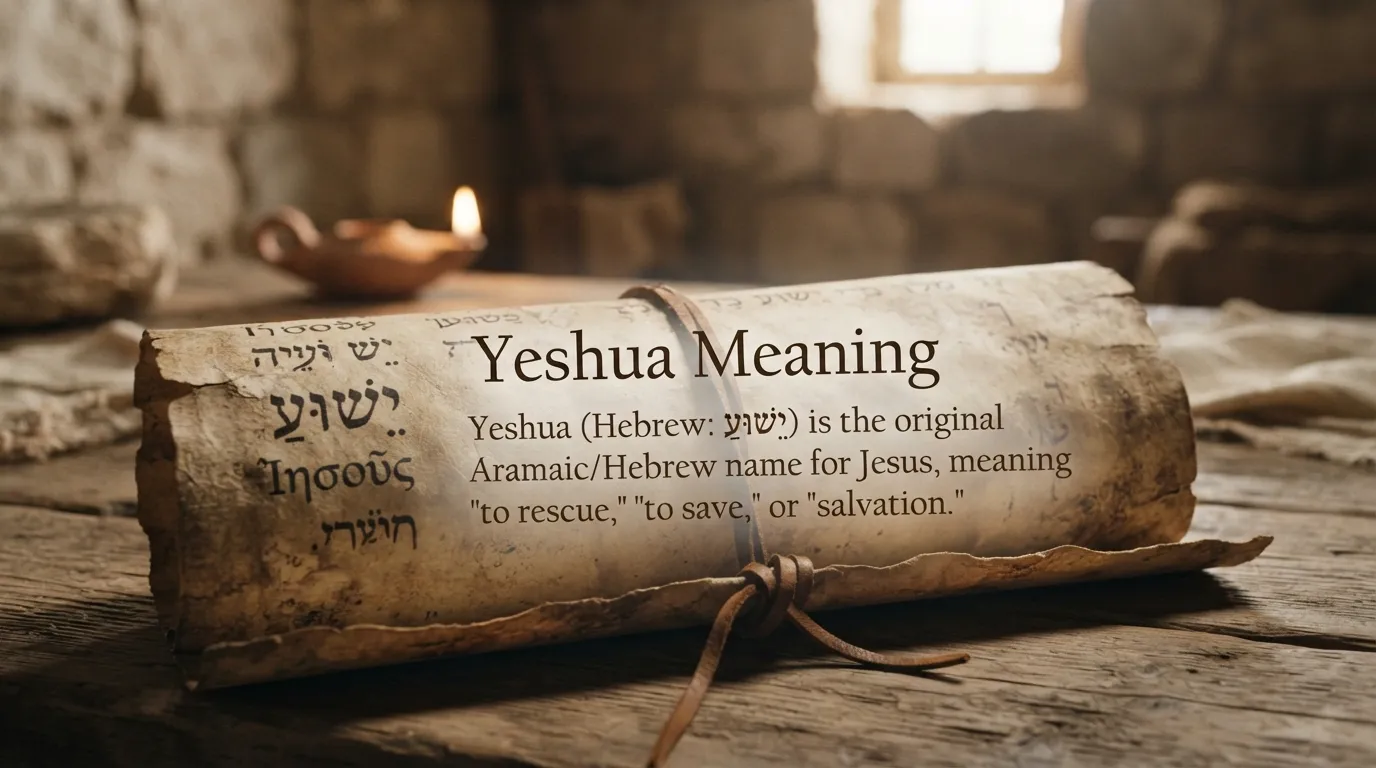
Yeshua is a Hebrew name that means Yahweh saves, or simply salvation. It is the name Jesus of Nazareth would have heard in his own home, in his own language, during his own lifetime. Yeshua is the short form of the older name Yehoshua, which English readers know as Joshua. In this guide, you will learn what Yeshua means piece by piece, how to say it the right way, and how one name traveled through Hebrew, Greek, and Latin to become the name Jesus in English.
Key Takeaways
- Yeshua means Yahweh saves or salvation in Hebrew.
- It is the short form of Yehoshua, the name English Bibles call Joshua.
- Yeshua is the original Hebrew form of the name Jesus.
- You say it yeh-SHOO-ah, with the stress in the middle.
- The name was common in ancient Judea and is now loved as a baby name too.
What Does Yeshua Mean in Hebrew?
Yeshua comes from the Hebrew root word yasha, which means to save, to rescue, or to deliver. When Hebrew speakers hear Yeshua, they hear a tiny sentence packed into a name: God saves. It works less like a plain label and more like a short promise.
The name is a shorter, later form of Yehoshua. That longer name joins two parts. The first part, Yeho, points to the name of God. The second part carries the idea of saving or a cry for help. Put together, Yehoshua means Yahweh is salvation. Over time, everyday speech trimmed Yehoshua down to Yeshua, the same way long names get shorter in every language.
This trimming happened in the years after the exile in Babylon, when Aramaic shaped daily speech in Judea. By the time of the Second Temple period, Yeshua was a normal, everyday name. Several men in the later books of the Hebrew Bible carry it, including a high priest who helped lead the people home from exile.
So when someone asks what Yeshua means, the fullest answer is this: it is a Hebrew name built on the idea of rescue, and it declares that God is the one who saves.
Our guide on joshua meaning walks through the longer form of this name, if you want to see where Yeshua began.
How Do You Pronounce Yeshua?
Many readers meet this name on the page first, so let us say it out loud together. Yeshua is pronounced yeh-SHOO-ah. It has three syllables: yeh, shoo, ah. The middle syllable carries the stress, so the name rises and lands in the center.
A few tips make it easy. The first sound is a soft yeh, like the start of yesterday. The middle sounds like the word shoe with an extra push. The ending is a gentle open ah, the same sound you make at the dentist. Put it together slowly: yeh, SHOO, ah. After two tries, it will feel natural.
In modern Hebrew, you may also hear it said a touch faster, almost yeh-SHOO-uh. Both are fine. English speakers who stress the first syllable, YESH-you-ah, are close enough that Hebrew speakers will understand them at once.
Is Yeshua the Same as Jesus?
Yes. Yeshua and Jesus are the same name, carried across languages. This is the point that surprises people the most, so here is the simple path the name traveled.
Jesus grew up in a Jewish family in the land of Israel. At home and in the streets, his name in Hebrew and Aramaic speech was Yeshua. When the story of his life was written in Greek, the writers used the Greek form of the name, Iesous, because Greek has no exact match for the Hebrew sounds. Later, Latin took the Greek form and shaped it into Iesus. English then received the name through Latin and older English spelling habits, and it settled as Jesus.
Not one step on that road changed the person or the meaning. Names often change clothes when they cross languages. A name like John becomes Juan in Spanish and Jean in French, yet it stays the same name. Yeshua, Iesous, and Jesus work the same way: one name, three languages, one meaning about God who saves.
That is also why some believers today enjoy using Yeshua in prayer or song. It connects them to the name as his mother and friends would have said it. Others happily use Jesus, the English form. Both point to the same person.
Yeshua vs Yehoshua vs Joshua: What Is the Difference?
These names confuse readers because English Bibles split them apart. Here is the clear picture in one table:
| Name | Language or Form | Who Carries It |
| Yehoshua | Full Hebrew form | Joshua, the leader after Moses |
| Yeshua | Short Hebrew and Aramaic form | Jesus, and several men in Ezra and Nehemiah |
| Jeshua | English spelling of Yeshua in older Bibles | A high priest in the books of Ezra and Nehemiah |
| Iesous | Greek form | Joshua and Jesus in the Greek Scriptures |
| Jesus | English form, through Latin | Jesus of Nazareth |
Notice something interesting. In the Greek New Testament, Joshua and Jesus share the same Greek name, Iesous. English translators later chose to write Joshua for the Old Testament leader and Jesus for the Savior, which hides how close the two names really are.
So Yeshua and Yehoshua are not rivals. One is simply the shorter everyday version of the other, the way William becomes Will. Joshua is the English coat that Yehoshua wears, and Jesus is the English coat that Yeshua wears through Greek and Latin.
What Does Yeshua Mean as a Baby Name?
Beyond history, many parents today meet Yeshua while hunting for a baby name with real depth. For them, the name offers a middle path. It carries the full weight of faith, like Jesus, but feels fresher and less worn smooth by daily use, closer in sound to Joshua yet clearly its own name.
The facts parents usually want are simple. Yeshua is a boy name in birth records. Its meaning, Yahweh saves, gives it a hopeful message to grow up with. It has been rising in the United States in the last decade, entering the top 1,000 boys names for the first time in 2024. It is known and easy to respect, yet still rare enough to feel chosen with care.
Short forms come naturally. Families land on Yesh, Shua, or Shu at home, and the full name carries an adult with ease. It also pairs well with classic middle names, because its soft middle sound blends with almost anything.
If you are weighing it against close cousins, our guide on biblical names meaning can help you compare other strong Hebrew names with honest meanings.
Why Do Some People Say Yahusha Instead?
Readers who dig deeper often meet a second form, Yahusha, and wonder which one is right. Here is the calm, factual answer.
Yeshua is the form found across ancient sources. It appears in the later books of the Hebrew Bible, in the Dead Sea Scrolls, and in the way Greek writers heard and wrote the name. Mainstream scholars of Hebrew use Yeshua for the short form of Yehoshua.
Yahusha is a newer form used by some modern groups who build the name straight from the full form Yehoshua with their own reading of the letters. It does not appear in ancient texts, but the people who use it hold it with sincere faith.
You do not need to settle a debate to understand the meaning. Both forms point at the same hope: God saves. If you read or hear Yahusha, you now know the family it belongs to, and if you use Yeshua, you stand with the form written down in history.
How Is Yeshua Used Today?
Today, Yeshua lives in a few warm places. In Israel and in Hebrew speech, it remains a name with deep roots. In churches and Messianic congregations around the world, singers and teachers use Yeshua in songs and lessons to feel closer to the first century world of the Bible. Parents, as we saw, are quietly choosing it for sons more each year.
You will also see it in books and videos that teach the Jewish background of the Christian faith. There, Yeshua acts like a bridge word. It reminds readers that the story began in Hebrew, with a Hebrew name, spoken in Hebrew streets.
Frequently Asked Questions
What does Yeshua mean?
Yeshua means Yahweh saves or salvation. It comes from the Hebrew root yasha, to save or deliver, and it is the short form of Yehoshua, the name behind Joshua.
How do you pronounce Yeshua?
Say yeh-SHOO-ah. Three syllables, with the stress in the middle. The shoo sounds like the word shoe, and the name ends with a soft open ah.
Is Yeshua the real name of Jesus?
Yeshua is the Hebrew form of his name, the form his family and neighbors would have used. Jesus is the English form of the same name, reached through Greek and Latin.
What is the difference between Yeshua and Joshua?
Joshua is the English form of Yehoshua, the full Hebrew name. Yeshua is the shorter Hebrew form of that same name. Jesus and Joshua are far closer in origin than English spelling suggests.
Is Yeshua a good baby name?
Many parents think so. It is a boy name with a strong, hopeful meaning, deep roots, and rising but still uncommon use. It entered the United States top 1,000 boys names in 2024.
What language is Yeshua?
Yeshua is Hebrew, shaped also by Aramaic, the everyday language of Judea in the Second Temple period. The Greek form is Iesous, and the English form is Jesus.
Conclusion
Yeshua is a Hebrew name that means Yahweh saves. It is the short form of Yehoshua, the name English calls Joshua, and it is the original form of the name the world now knows in English as Jesus. Said yeh-SHOO-ah, it carries a rescue story inside three small syllables.
Now the name will never feel foreign again. Whether you meet it in a Bible study, a song, or a baby name list, you know what it means, how to say it, and why so many people love it.

Hello, I’m Mark Nichol. I’ve always been passionate about English words and how they are used in everyday communication. At Defineexa.com, I share simple guides on word meanings, acronyms, texting abbreviations, and modern slang. I believe learning English should be easy, practical, and enjoyable, so every article is written with clarity and accuracy in mind.