Have you seen BCE after a date and wondered what it means? BCE stands for Before Common Era. It is used for dates that come before the Common Era.
You may see it in history books, school lessons, museum signs, and articles about the ancient world. For example, 500 BCE means a year before the Common Era.
BCE can look hard at first, but the idea is simple. It is just a way to mark old dates.
It is also used instead of BC, and both terms point to the same years. Once you know this, old dates are much easier to read and understand.
What Does BCE Mean?
BCE means “Before Common Era.”
It is used to talk about years that came before the Common Era.
For example:
- 100 BCE means 100 Before Common Era.
- 500 BCE means 500 Before Common Era.
- 1000 BCE means 1000 Before Common Era.
You will often see BCE when people talk about old history.
It may appear in books about ancient Egypt, Greece, Rome, China, India, and many other places.
The term is a date label. It tells you where a year sits on a timeline.
BCE Meaning in Simple Words
In very simple words, BCE means a date from before the Common Era.
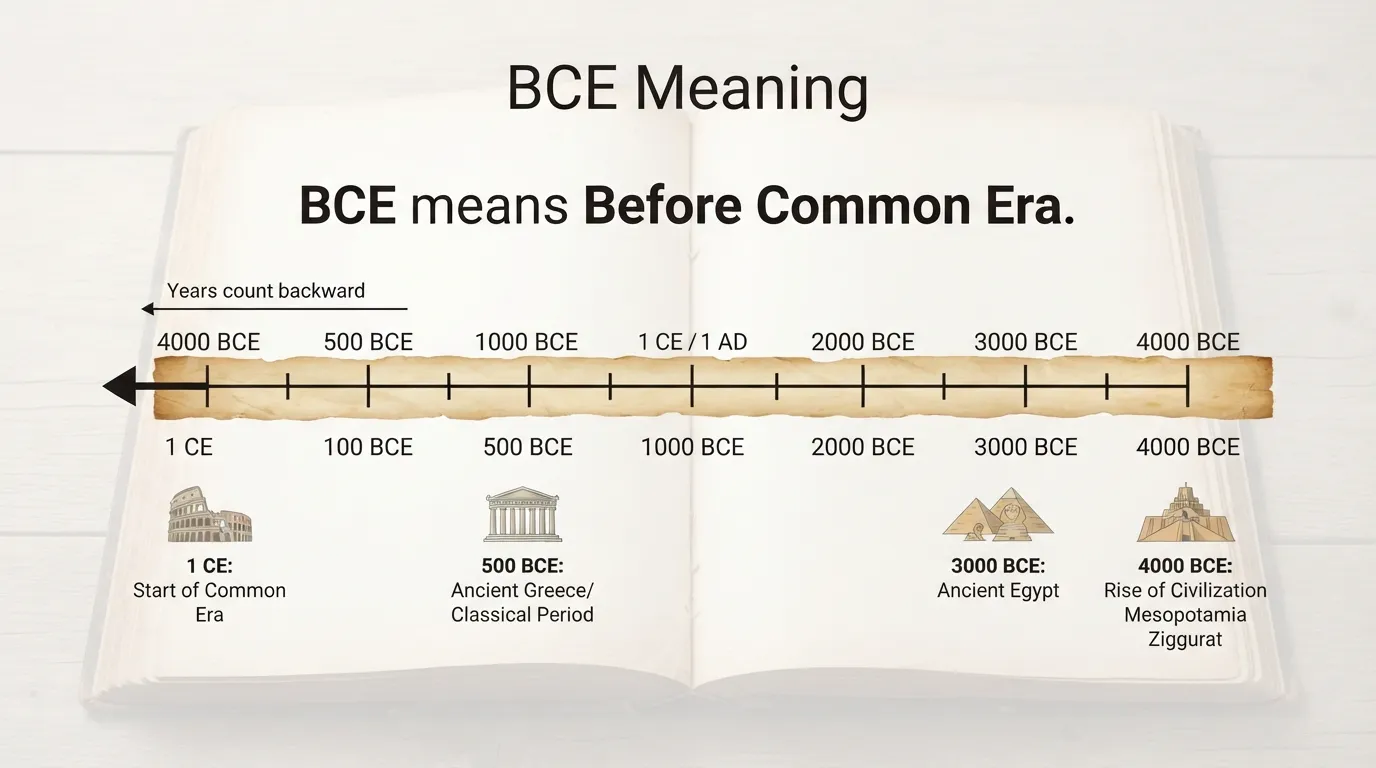
Think of it like a line:
500 BCE → 300 BCE → 100 BCE → 1 BCE → 1 CE → 100 CE
The BCE side goes back into the past.
One key point can be easy to miss:
500 BCE is older than 300 BCE.
Why?
Because BCE dates move closer to 1 BCE as time moves forward.
So, 800 BCE happened before 500 BCE.
This may feel strange at first, but it becomes easy after you see a few examples.
How does bce work
BCE stands for Before Common Era. It is used to count years before the start of the Common Era, which uses the same year numbers as CE. BCE years move backward as they get closer to the present. For example, 500 BCE happened before 400 BCE, and 400 BCE happened before 300 BCE. There is no year 0 in the traditional BCE/CE system. So, 1 BCE is followed by 1 CE. This system helps historians write dates without using religious labels while keeping the same historical year numbers.
Context and how people use it: People use BCE when talking about ancient history, archaeology, and old civilizations.
Example 1: The Greek philosopher Socrates lived in the 5th century BCE.
Example 2: Ancient Egypt was already a major civilization long before 1000 BCE.
Bce meaning
BCE means Before Common Era. It refers to years before 1 CE. BCE is the modern, neutral term often used in history, education, museums, and academic writing. It follows the same calendar numbering as BC, so 300 BCE and 300 BC refer to the same year. The main difference is the wording, not the date. BCE dates count backward toward the present. This means 800 BCE is earlier than 500 BCE. Knowing this simple rule makes ancient dates much easier to understand when reading history books or timelines.
Context and how people use it: People use BCE to describe events, people, and civilizations from ancient history.
Example 1: Rome became a major power during the centuries before the Common Era.
Example 2: Some early Greek writings date to the 7th century BCE.
900 ce meaning
900 CE means the year 900 in the Common Era. CE stands for Common Era and is the same year numbering system traditionally labeled AD. Unlike BCE, CE dates move forward as time moves toward the present. So, 900 CE came before 1000 CE but after 800 CE. The term CE is often used in history and academic writing because it provides a calendar label without using the religious wording found in AD. It is useful when reading timelines, historical records, books, and information about events from the medieval period.
Context and how people use it: People use 900 CE when discussing events, cultures, rulers, and societies from that historical period.
Example 1: Many parts of Europe were changing politically around 900 CE.
Example 2: Several important Islamic centers were active around 900 CE.
Bce date meaning
A BCE date tells you that an event happened Before Common Era. The number shows how many years before 1 CE the date is placed. One important thing to remember is that BCE years count backward. For example, 700 BCE happened earlier than 600 BCE. There is also no year 0 between BCE and CE in this dating system. A date such as 1 BCE is followed directly by 1 CE. BCE dates are common in history, archaeology, ancient studies, and museum information because they make old dates easy to label.
Context and how people use it: People use BCE dates to place ancient events in the correct order.
Example 1: An event from 900 BCE happened before one from 500 BCE.
Example 2: 200 BCE is later than 700 BCE.
Bce dates
BCE dates are dates used for years before the Common Era. They are especially common when discussing ancient people, cultures, wars, buildings, and historical events. The key rule is simple: larger BCE numbers mean earlier dates. For example, 1200 BCE came before 800 BCE, while 300 BCE came later. BCE is paired with CE, which covers years from 1 CE onward. The BCE/CE system does not include a year 0. This means history timelines move directly from 1 BCE to 1 CE without a zero year between them.
Context and how people use it: Historians and researchers use BCE dates to organize events from ancient times.
Example 1: 1000 BCE is earlier than 600 BCE.
Example 2: 250 BCE is later than 500 BCE.
1000 bce meaning
1000 BCE means the year 1000 Before Common Era. It refers to a point in history about one thousand years before 1 CE. Because BCE years count backward, 1000 BCE happened earlier than 500 BCE. The date is often used when discussing ancient civilizations, early kingdoms, religious history, archaeology, and cultural development. It is important not to read BCE numbers like modern dates. A bigger BCE number means an older date. The BCE system also has no year 0, so 1 BCE is followed by 1 CE.
Context and how people use it: People use 1000 BCE to describe events and societies from the ancient world.
Example 1: Some ancient settlements existed around 1000 BCE.
Example 2: Historical changes in the Mediterranean region occurred around 1000 BCE.
500 bc meaning
500 BC means the year 500 Before Christ. It is the same calendar year as 500 BCE, which means Before Common Era. The main difference is the label used. BC is an older and traditionally Christian-based term, while BCE is commonly used in modern academic and historical writing. In the BC/BCE system, dates count backward toward the beginning of the Common Era. So, 500 BC happened before 400 BC. There is no year 0 between 1 BC and 1 AD in this traditional calendar system.
Context and how people use it: People often use BC when discussing ancient history, classical civilizations, and older historical texts.
Example 1: Athens was an important city around 500 BC.
Example 2: Many Greek thinkers lived during the centuries before 500 BC.
500 bc means
500 BC means the year 500 Before Christ. It is another way to write 500 BCE, and both labels refer to the same historical year. The date belongs to the period before 1 CE. When reading BC dates, remember that the numbers decrease as time moves forward. For example, 700 BC came before 500 BC, while 300 BC came after 500 BC. This can feel backward at first, but it becomes simple once you remember that bigger BC numbers represent earlier years.
Context and how people use it: People use 500 BC when talking about ancient history, especially Greece, Rome, and other early civilizations.
Example 1: The year 500 BC came before 400 BC.
Example 2: 200 BC came after 500 BC.
How to read bce
To read a BCE date, say the number followed by “BCE,” such as 500 BCE. It means the year 500 Before Common Era. When comparing BCE dates, remember one easy rule: the larger number is earlier. So, 900 BCE came before 600 BCE, and 600 BCE came before 300 BCE. BCE dates move toward 1 BCE as history gets closer to the Common Era. There is no year 0 in the BCE/CE system. After 1 BCE, the next year is 1 CE.
Context and how people use it: People read BCE dates when studying ancient history, timelines, archaeology, and historical records.
Example 1: Read “300 BCE” as “300 Before Common Era.”
Example 2: 800 BCE is earlier than 500 BCE.
500 bce means
500 BCE means the year 500 Before Common Era. It is the same year traditionally called 500 BC. This date belongs to the ancient past, before 1 CE. When you compare it with other BCE dates, remember that the numbers work in reverse. For example, 800 BCE happened before 500 BCE, while 200 BCE happened after it. This simple rule helps you understand historical timelines. BCE is widely used in modern history and academic writing because it provides the same date system as BC without using the religious wording of “Before Christ.”
Context and how people use it: People use 500 BCE to place ancient events and civilizations on a historical timeline.
Example 1: A city founded in 600 BCE is older than one founded in 500 BCE.
Example 2: An event in 300 BCE happened after an event in 500 BCE.
What Is the Common Era?
The Common Era, or CE, is the period of years that comes after 1 BCE.
You may see the term CE after a date.
For example:
- 50 CE
- 500 CE
- 1200 CE
- 2026 CE
BCE and CE work as a pair.
BCE = Before Common Era
CE = Common Era
They help people place events on a historical timeline.
BCE vs. BC
BCE and BC mean the same years.
The main difference is the wording.
BCE means Before Common Era.
BC means Before Christ.
So, these two dates point to the same year:
500 BCE = 500 BC
The same is true for other dates.
| BCE | BC |
| 100 BCE | 100 BC |
| 500 BCE | 500 BC |
| 1000 BCE | 1000 BC |
| 1500 BCE | 1500 BC |
You may see either form in history books.
Some writers use BC. Others use BCE.
The date itself does not change.
BCE vs. CE
BCE and CE are also used together.
BCE marks years before the Common Era.
CE marks years in the Common Era.
For example:
200 BCE → 100 BCE → 1 BCE → 1 CE → 100 CE → 200 CE
This gives you a simple way to read a timeline.
If you see 200 BCE, you know the event took place before the Common Era.
If you see 200 CE, you know it took place in the Common Era.
BCE vs. AD
You may also see AD when reading about dates.
AD comes from a Latin phrase that means “in the year of the Lord.”
BCE and AD are not matching terms in the same way that BCE and BC are.
The common pairs are:
- BCE and BC — same years
- CE and AD — same years
For example:
500 BCE = 500 BC
And:
500 CE = AD 500
The main difference is the way the dates are named.
Why Do People Use BCE?
Many writers use BCE because it gives a simple, widely used way to name dates without the religious wording in BC.
You may find BCE in:
- History books
- Museums
- Schools
- University work
- Archaeology
- Research
- Timelines
Different schools, books, and groups may use different date styles.
Some use BC and AD.
Others use BCE and CE.
Both systems can describe the same years.
How Do BCE Dates Work?
BCE dates can seem backward.
With modern dates, a bigger number usually means a later year.
For example:
2020 → 2021 → 2022 → 2023
But BCE works in the other direction.
Look at this:
1000 BCE → 800 BCE → 500 BCE → 200 BCE → 50 BCE
Here, 1000 BCE is older than 50 BCE.
The number gets smaller as the timeline moves closer to the Common Era.
So if you see:
700 BCE and 300 BCE
the event from 700 BCE happened first.
Is There a Year 0?
There is no year 0 in the traditional BCE/CE dating system.
The order is:
2 BCE → 1 BCE → 1 CE → 2 CE
So 1 BCE is followed by 1 CE.
There is no year between them called 0.
This is useful to know when you read old dates or work out the time between two dates.
For most basic history reading, you only need to remember one thing:
1 BCE comes right before 1 CE.
What Does 500 BCE Mean?
500 BCE means the year 500 Before Common Era.
It is a date from the ancient past.
It is also the same year called 500 BC.
If a history book says that an event happened in 500 BCE, it means the event happened at that point on the BCE side of the timeline.
The number does not mean “500 years ago.”
That is an important difference.
BCE is a date label, not a simple way to say how many years ago something happened.
What Does 1000 BCE Mean?
1000 BCE means the year 1000 Before Common Era.
It is older than 500 BCE.
For example:
1000 BCE → 800 BCE → 500 BCE
The first date is the oldest of the three.
This is because BCE dates count down toward 1 BCE.
So:
- 1000 BCE is older than 500 BCE.
- 500 BCE is older than 100 BCE.
- 100 BCE is older than 10 BCE.
This simple rule can help you read most BCE dates with ease.
Where Is BCE Used?
BCE is most common in writing about the past.
You may see it when reading about:
Ancient history
Writers use BCE to give dates for old people, places, and events.
Archaeology
Archaeologists may use BCE when giving dates for old sites, objects, and cultures.
Museums
Museum signs may use BCE when they explain the age of an object or event.
Schools
History lessons may use BCE to help students place events on a timeline.
Books and research
Authors and researchers may use BCE when writing about ancient events.
The exact style can vary by source.
How Do You Read BCE?
When you see 300 BCE, you can read it as:
“300 Before Common Era.”
You may also hear someone say:
“300 B-C-E.”
Both are clear.
Here are a few more examples:
50 BCE
A date close to the start of the Common Era.
500 BCE
A much older date.
2000 BCE
A very old date from ancient history.
The bigger the number on the BCE side, the farther back the date is.
Common Mistakes About BCE
BCE is simple, but people often make a few mistakes.
500 BCE is not later than 300 BCE.
It is earlier.
BCE and BC are not different years.
500 BCE and 500 BC mean the same year.
BCE does not mean “500 years ago.”
It is a date label.
There is no year 0.
The timeline moves from 1 BCE to 1 CE.
BCE is not a new calendar.
It is a way to label years in a familiar historical dating system.
BCE in Ancient History
BCE is often used when talking about the ancient world.
You may see dates with BCE when learning about:
- Ancient Egypt
- Ancient Greece
- Ancient Rome
- Ancient Persia
- Ancient China
- Early India
- Old cities and kingdoms
- Early writing
- Ancient art
- Old trade routes
Not every ancient date is known with full certainty.
For some events, historians can give only an estimated date.
That is why you may see words such as about, around, or roughly before a BCE date.
For example:
The city was built around 500 BCE.
The word “around” shows that the exact year may not be known.
Why Can BCE Dates Feel Confusing?
The main reason is that BCE numbers go down as time moves forward.
For example:
900 BCE → 700 BCE → 400 BCE → 100 BCE
At first, it may look like 900 comes after 100 because 900 is a bigger number.
But on a BCE timeline, it is the other way around.
A simple trick is to think:
A bigger BCE number = farther back in time.
So, 900 BCE is older than 100 BCE.
Once you learn this rule, BCE dates become much easier.
BCE and CE Quick Guide
| Term | Simple meaning |
| BCE | Before Common Era |
| CE | Common Era |
| BC | Before Christ |
| AD | Anno Domini |
Remember these two facts:
BCE and BC use the same dates.
CE and AD use the same dates.
The words are different, but the years they label are the same.
FAQs
BCE meaning in Bible
BCE stands for Before Common Era and is a secular alternative to BC (Before Christ) used to refer to years before year 1 in the Gregorian calendar.
AD meaning
AD stands for Anno Domini, Latin for “in the year of our Lord,” and marks years after the traditional birth of Jesus Christ.
BC meaning
BC stands for Before Christ and refers to the years before the traditional birth of Jesus Christ.
AD and BCE meaning
AD means Anno Domini (years after Christ’s birth), while BCE means Before Common Era (the secular equivalent of BC).
CE and BCE meaning
CE means Common Era (the secular equivalent of AD) and BCE means Before Common Era (the secular equivalent of BC).
Anno Domini meaning
Anno Domini is Latin for “in the year of our Lord” and is abbreviated as AD to mark years after the birth of Jesus Christ.
AD meaning in history
In history, AD (Anno Domini) is used to number years after the traditional birth of Jesus Christ in the Gregorian calendar.
BCE vs BC
BCE (Before Common Era) and BC (Before Christ) refer to the same time period before year 1, but BCE is the secular, non-religious alternative to BC.
Conclusion
BCE means “Before Common Era.” It is used for dates before the Common Era and is common in history, archaeology, museums, and school books.
The easiest way to remember it is this: BCE and BC refer to the same years, while CE and AD refer to the same years. Also, BCE dates move down toward 1.
So 800 BCE is older than 300 BCE. Once you understand this simple rule, reading BCE dates becomes much easier.

Hello, I’m Mark Nichol. I’ve always been passionate about English words and how they are used in everyday communication. At Defineexa.com, I share simple guides on word meanings, acronyms, texting abbreviations, and modern slang. I believe learning English should be easy, practical, and enjoyable, so every article is written with clarity and accuracy in mind.